Results by title
784 books match the query 'American Government' and 14 start with h
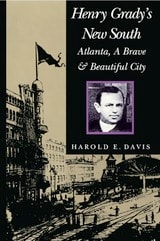
Henry Grady's New South
Atlanta, a Brave and Beautiful CityHarold E. Davis
University of Alabama Press, 1990
Reassessing the man, the movement, and the making of modern Atlanta.
The popular image of Henry W. Grady is that of a champion of the postbellum South, a region that would forgive the North for defeating it and would mobilize its own many resources for hones business and agricultural competition. Biographies and collections of Grady’s essays and speeches that appeared shortly after his death enhanced this image, and for a half-century, Grady was considered the personification of the New South Movement, a movement which promised industrialization for the South, an improved Southern agriculture, and justice and opportunity for black Southerners. As managing editor of the Atlanta Constitution, he espoused the New South throughout the nation and was in demand as a speaker for audiences in New York and Boston.
Through extensive research, focusing on the decade of the 1880s in Georgia, Davis demonstrates that although Grady said all the right things to show that he wished to industrialize the South and that he was committed to the improvement of agriculture and fairness in racial matters, in fact he spent most of his efforts on behalf of Atlanta. His major interest was in making a difference for that city, leaving the rest of the South to enjoy whatever Atlanta could not garner for itself.
Hijacking the Agenda
Economic Power and Political InfluenceChristopher Witko
Russell Sage Foundation, 2021
The authors analyze over 20 years of floor speeches by several hundred members of Congress to examine the influence of campaign contributions on how the national economic agenda is set in Congress. They find that legislators who received more money from business and professional associations were more likely to discuss the deficit and other upper-class priorities, while those who received more money from unions were more likely to discuss issues important to lower- and middle-class constituents, such as economic inequality and wages. This attention imbalance matters because issues discussed in Congress receive more direct legislative action, such as bill introductions and committee hearings. While unions use campaign contributions to push back against wealthy interests, spending by the wealthy dwarfs that of unions.
The authors use case studies analyzing financial regulation and the minimum wage to demonstrate how the financial influence of the wealthy enables them to advance their economic agenda. In each case, the authors examine the balance of structural power, or the power that comes from a person or company’s position in the economy, and kinetic power, the power that comes from the ability to mobilize organizational and financial resources in the policy process. The authors show how big business uses its structural power and resources to effect policy change in Congress, as when the financial industry sought deregulation in the late 1990s, resulting in the passage of a bill eviscerating New Deal financial regulations. Likewise, when business interests want to preserve the policy status quo, it uses its power to keep issues off of the agenda, as when inflation eats into the minimum wage and its declining purchasing power leaves low-wage workers in poverty. Although groups representing lower- and middle-class interests, particularly unions, can use their resources to shape policy responses if conditions are right, they lack structural power and suffer significant resource disadvantages. As a result, wealthy interests have the upper hand in shaping the policy process, simply due to their pivotal position in the economy and the resulting perception that policies beneficial to business are beneficial for everyone.
Hijacking the Agenda is an illuminating account of the way economic power operates through the congressional agenda and policy process to privilege the interests of the wealthy and marks a major step forward in our understanding of the politics of inequality.
Home Field Advantage
Roots, Reelection, and Representation in the Modern CongressCharles Hunt
University of Michigan Press, 2022
Although partisan polarization gets much of the attention in political science scholarship about Congress, members of Congress represent diverse communities around the country. Home Field Advantage demonstrates the importance of this understudied element of American congressional elections and representation in the modern era: the local, place-based roots that members of Congress have in their home districts. Charles Hunt argues that legislators’ local roots in their district have a significant and independent impact on their campaigns, election outcomes, and more broadly on the relationship between members of the U.S. House of Representatives and their constituents. Drawing on original data, his research reveals that there is considerable variation in election outcomes, performance relative to presidential candidates, campaign spending, and constituent communication styles that are not fully explained by partisanship, incumbency, or other well-established theories of American political representation. Rather, many of these differences are the result of the depth of a legislator’s local roots in their district that predate their time in Congress. Hunt lays out a detailed “Theory of Local Roots” and their influence in congressional representation, demonstrating this influence empirically using multiple original measures of local roots over a full cross-section of legislators and a significant period of time.
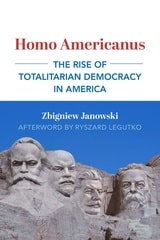
Homo Americanus
The Rise of Totalitarian Democracy in AmericaZbigniew Janowski
St. Augustine's Press, 2021
“Only someone shortsighted, or someone who values equality more than freedom, would deny that today’s citizens enjoy little or no freedom, particularly freedom of speech, and even less the ability to express openly or publicly the opinions that are not in conformity with what the majority considers acceptable at a given moment. It may sound paradoxical to contemporary ears, but a fight against totalitarianism must also mean a fight against the expansion of democracy.”
Janowski all at once brazen and out of bounds states what he calls the obvious and unthinkable truth: In the United States, we are already living in a totalitarian reality. The American citizen, the Homo Americanus, is an ideological being who is no longer good or bad, reasonable or irrational, proper or improper except when measured against the objectives of the dominating egalitarian mentality that American democracy has successfully incubated. American democracy has done what other despotic regimes have likewise achieved––namely, taken hold of the individual and forced him to renounce (or forget) his greatness, pursuit of virtue and his orientation toward history and Tradition.
Homo Americanus, Janowski argues, has no mind or soul and he cannot tolerate diversity and indeed he now censors himself. Democracy is not benign, and we should fear its principles come by and applied ad hoc. It is deeply troublesome that in the way democracy moves today it gives critics no real insight into any trajectory of reason behind its motion, which is erratic and unmappable. The Homo Americanus is an ideological entity whose thought and even morality are forbidden from universal abstraction.
Janowski mounts the offensive against what the American holds most sacred, and he does so in order to save him. After exposing the danger and the damage done, Janowski makes another startling proposal. It is a “diseased collective mind” that is the source of this ideology, the liberal anti-perspective that presses man into the image of the Homo Americanus, and its grip can only be broken through the recovery of instinct. Homo Americanus cannot be free again until he is himself again. That is, until the shadow that belongs only to him is restored, and he is thereby no longer alienated from others. Despite the condemnation Janowski seems to be levying on the citizen of the United States, he betrays a great hope and confidence that the means to shake ourselves awake from the bad dream are nevertheless in hand.
Janowski’s work is the next title in St. Augustine’s Press Dissident American Thought Today Series. It occupies a controversial overlapping terrain between the philosophical descriptions of liberalism as a tradition, psychology and the fundamentally influential critiques of democracy offered by Thucydides, Jefferson, Franklin, Tocqueville, Mill, Burke and more. More anecdotal than analytical, Janowski offers the contemporary proof that the reader is right to be scandalized by democracy and his or her own likeness of the Homo Americanus. Once upon a time it was the despicable Homo Sovieticus fruit of tyranny, but now we fear democratic society too might fall and all its citizens never be found again.
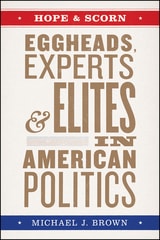
Hope and Scorn
Eggheads, Experts, and Elites in American PoliticsMichael J. Brown
University of Chicago Press, 2020
Intellectuals “have been both rallying points and railed against in American politics, vessels of hope and targets of scorn,” writes Michael J. Brown as he invigorates a recurrent debate in American life: Are intellectual public figures essential voices of knowledge and wisdom, or out-of-touch elites? Hope and Scorn investigates the role of high-profile experts and thinkers in American life and their ever-fluctuating relationship with the political and public spheres.
From Eisenhower’s era to Obama’s, the intellectual’s role in modern democracy has been up for debate. What makes an intellectual, and who can claim that privileged title? What are intellectuals’ obligations to society, and how, if at all, are their contributions compatible with democracy? For some, intellectuals were models of civic engagement. For others, the rise of the intellectual signaled the fall of the citizen. Carrying us through six key moments in this debate, Brown expertly untangles the shifting anxieties and aspirations for democracy in America in the second half of the twentieth century and beyond. Hope and Scorn begins with “egghead” politicians like Adlai Stevenson; profiles scholars like Richard Hofstadter and scholars-turned-politicians like H. Stuart Hughes; and ends with the rise of public intellectuals such as bell hooks and Cornel West. In clear and unburdened prose, Brown explicates issues of power, authority, political backlash, and more. Hope and Scorn is an essential guide to American concerns about intellectuals, their myriad shortcomings, and their formidable abilities.
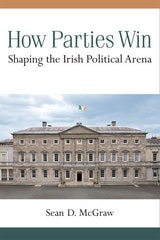
How Parties Win
Shaping the Irish Political ArenaSean D. McGraw
University of Michigan Press, 2015
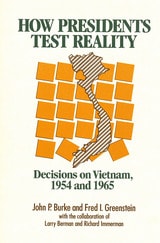
How Presidents Test Reality
Decisions on Vietnam, 1954 and 1965John P. Burke, Fred L. Greenstein, Larry Berman, and Richard Immerman
Russell Sage Foundation, 1991
Just as famines and plagues can provide opportunities for medical research, the unhappy course of United States relations with Vietnam is a prime source of evidence for students of American political institutions. How Presidents Test Reality draws on the record of American decision making about Vietnam to explore the capacity of top government executives and their advisers to engage in effective reality testing.
Authors Burke and Greenstein compare the Vietnam decisions of two presidents whose leadership styles and advisory systems diverged as sharply as any in the modern presidency. Faced with a common challenge—an incipient Communist take-over of Vietnam—presidents Eisenhower and Johnson engaged in intense debates with their aides and associates, some of whom favored intervention and some of whom opposed it. In the Dien Bien Phu Crisis of 1954, Eisenhower decided not to enter the conflict; in 1965, when it became evident that the regime in South Vietnam could not hold out much longer, Johnson intervened.
How Presidents Test Reality uses declassified records and interviews with participants to assess the adequacy of each president’s use of advice and information. This important book advances our historical understanding of the American involvement in Vietnam and illuminates the preconditions of effective presidential leadership in the modern world.
"An exceptionally thoughtful exercise in what ‘contemporary history’ ought to be. Illuminates the past in a way that suggests how we might deal with the present and the future." —John Lewis Gaddis
"Burke and Greenstein have written what amounts to an owner's manual for operating the National Security Council....This is a book Reagan's people could have used and George Bush ought to read." —Bob Schieffer, The Washington Monthly
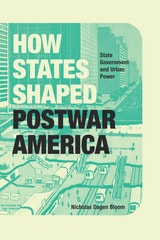
How States Shaped Postwar America
State Government and Urban PowerNicholas Dagen Bloom
University of Chicago Press, 2019
How States Shaped Postwar America
State Government and Urban PowerNicholas Dagen Bloom
University of Chicago Press, 2019
The history of public policy in postwar America tends to fixate on developments at the national level, overlooking the crucial work done by individual states in the 1960s and ’70s. In this book, Nicholas Dagen Bloom demonstrates the significant and enduring impact of activist states in five areas: urban planning and redevelopment, mass transit and highways, higher education, subsidized housing, and the environment. Bloom centers his story on the example set by New York governor Nelson Rockefeller, whose aggressive initiatives on the pressing issues in that period inspired others and led to the establishment of long-lived state polices in an age of decreasing federal power. Metropolitan areas, for both better and worse, changed and operated differently because of sustained state action—How States Shaped Postwar America uncovers the scope of this largely untold story.
How the States Shaped the Nation
American Electoral Institutions and Voter Turnout, 1920-2000Melanie Jean Springer
University of Chicago Press, 2014
With How the States Shaped the Nation, Melanie Jean Springer places contemporary reforms in historical context and systematically explores how state electoral institutions have been instrumental in shaping voting behavior throughout the twentieth century. Although reformers often assume that more convenient voting procedures will produce equivalent effects wherever they are implemented, Springer reveals that this is not the case. In fact, convenience-voting methods have had almost no effect in the southern states where turnout rates are lowest. In contrast, the adverse effects associated with restrictive institutions like poll taxes and literacy tests have been persistent and dramatic. Ultimately, Springer argues, no single institutional fix will uniformly resolve problems of low or unequal participation. If we want to reliably increase national voter turnout rates, we must explore how states’ voting histories differ and better understand the role of political and geographical context in shaping institutional effects.
How the Tea Party Captured the GOP
Insurgent Factions in American PoliticsRachel M. Blum
University of Chicago Press, 2020
In How the Tea Party Captured the GOP, Rachel Marie Blum approaches the Tea Party from the angle of party politics, explaining the Tea Party’s insurgent strategies as those of a party faction. Blum offers a novel theory of factions as miniature parties within parties, discussing how fringe groups can use factions to increase their political influence in the US two-party system. In this richly researched book, the author uncovers how the electoral losses of 2008 sparked disgruntled Republicans to form the Tea Party faction, and the strategies the Tea Party used to wage a systematic takeover of the Republican Party. This book not only illuminates how the Tea Party achieved its influence, but also provides a framework for identifying other factional insurgencies.
How to Save a Constitutional Democracy
Tom Ginsburg and Aziz Z. Huq
University of Chicago Press, 2018
How to Save a Constitutional Democracy mounts an urgent argument that we can no longer afford to be complacent. Drawing on a rich array of other countries’ experiences with democratic backsliding, Tom Ginsburg and Aziz Z. Huq show how constitutional rules can both hinder and hasten the decline of democratic institutions. The checks and balances of the federal government, a robust civil society and media, and individual rights—such as those enshrined in the First Amendment—often fail as bulwarks against democratic decline. The sobering reality for the United States, Ginsburg and Huq contend, is that the Constitution’s design makes democratic erosion more, not less, likely. Its structural rigidity has had unforeseen consequence—leaving the presidency weakly regulated and empowering the Supreme Court conjure up doctrines that ultimately facilitate rather than inhibit rights violations. Even the bright spots in the Constitution—the First Amendment, for example—may have perverse consequences in the hands of a deft communicator who can degrade the public sphere by wielding hateful language banned in many other democracies. We—and the rest of the world—can do better. The authors conclude by laying out practical steps for how laws and constitutional design can play a more positive role in managing the risk of democratic decline.
How to Save a Constitutional Democracy
Tom Ginsburg and Aziz Z. Huq
University of Chicago Press, 2018
Democracies are in danger. Around the world, a rising wave of populist leaders threatens to erode the core structures of democratic self-rule. In the United States, the tenure of Donald Trump has seemed decisive turning point for many. What kind of president intimidates jurors, calls the news media the “enemy of the American people,” and seeks foreign assistance investigating domestic political rivals? Whatever one thinks of President Trump, many think the Constitution will safeguard us from lasting damage. But is that assumption justified?
How to Save a Constitutional Democracy mounts an urgent argument that we can no longer afford to be complacent. Drawing on a rich array of other countries’ experiences with democratic backsliding, Tom Ginsburg and Aziz Z. Huq show how constitutional rules can both hinder and hasten the decline of democratic institutions. The checks and balances of the federal government, a robust civil society and media, and individual rights—such as those enshrined in the First Amendment—often fail as bulwarks against democratic decline. The sobering reality for the United States, Ginsburg and Huq contend, is that the Constitution’s design makes democratic erosion more, not less, likely. Its structural rigidity has had unforeseen consequence—leaving the presidency weakly regulated and empowering the Supreme Court conjure up doctrines that ultimately facilitate rather than inhibit rights violations. Even the bright spots in the Constitution—the First Amendment, for example—may have perverse consequences in the hands of a deft communicator who can degrade the public sphere by wielding hateful language banned in many other democracies. We—and the rest of the world—can do better. The authors conclude by laying out practical steps for how laws and constitutional design can play a more positive role in managing the risk of democratic decline.
How to Save a Constitutional Democracy
A New Edition for a Damaged PoliticsTom Ginsburg and Aziz Z. Huq
University of Chicago Press, 2026
Updated to take stock of recent developments, Tom Ginsburg and Aziz Z. Huq’s prescient and insightful book shows how constitutional rules both hinder and hasten democratic decline.
Around the world, autocratic leaders threaten the core structures of democratic self-rule. But democratic constitutions are not fail-proof safeguards. By looking at how such leaders exploit legal mechanisms to advance their aims, we can see how democratic constitutions can sometimes abet—and even accelerate—democratic decline. In this new edition of How to Save a Constitutional Democracy, constitutional law experts Tom Ginsburg and Aziz Z. Huq offer a powerful analysis of today’s challenges while arguing that the time has come for meaningful, actionable change.
This new edition takes up the torch of its predecessor, canvasing developments in the United States and other countries that have transpired since 2018. Drawing lessons from countries around the world and reflecting on the prospects for American democracy, the authors show how constitutional design can, in fact, either undermine or support democratic institutions. The sobering reality for the United States is that the Constitution’s design makes democratic erosion eminently feasible. But Ginsburg and Huq do not stop there. They suggest practical ways that law and constitutional design can better manage these mounting threats, analyzing constitutional and legal questions that are consequential yet poorly understood, all while cautioning against an overreliance on technocratic fixes.
Even more urgent and salient in its new edition, How to Save a Constitutional Democracy reflects on why autocrats tend to pose even greater danger the second time they come to power and asks how we can begin to repair a democracy that has failed.