Results by title
61 books match the query 'American West' and 4 start with h
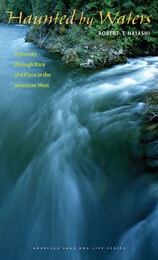
Haunted by Waters
A Journey through Race and Place in the American WestRobert T. Hayashi
University of Iowa Press, 2007
Even though race influenced how Americans envisioned, represented, and shaped the American West, discussions of its history devalue the experiences of racial and ethnic minorities. In this lyrical history of marginalized peoples in Idaho, Robert T. Hayashi views the West from a different perspective by detailing the ways in which they shaped the western landscape and its meaning.
As an easterner, researcher, angler, and third-generation Japanese American traveling across the contemporary Idaho landscape—where his grandfather died during internment during World War II—Hayashi reconstructs a landscape that lured emigrants of all races at the same time its ruling forces were developing cultured processes that excluded nonwhites. Throughout each convincing and compelling chapter, he searches for the stories of dispossessed minorities as patiently as he searches for trout.
Using a wide range of materials that include memoirs, oral interviews, poetry, legal cases, letters, government documents, and even road signs, Hayashi illustrates how Thomas Jefferson’s vision of an agrarian, all-white, and democratic West affected the Gem State’s Nez Perce, Chinese, Shoshone, Mormon, and particularly Japanese residents. Starting at the site of the Corps of Discovery’s journey into Idaho, he details the ideological, aesthetic, and material manifestations of these intertwined notions of race and place. As he ?y-?shes Idaho’s fabled rivers and visits its historical sites and museums, Hayashi reads the contemporary landscape in light of this evolution.
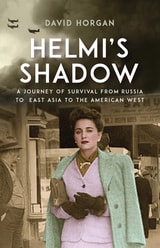
Helmi's Shadow
A Journey of Survival From Russia to East Asia to the American WestDavid Horgan
University of Nevada Press, 2021
Rachel Koskin was a middle-class Russian Jew born in Odessa, Ukraine, in 1896. Ten years later, her family fled from the murderous pogroms against Jews in the Russian Empire eastward to Harbin, a Russian-controlled city within China’s borders on the harsh plain of Manchuria. Full of lively detail and the struggles of being stateless in a time of war, the narrative follows Rachel through her life in Harbin, which became a center of Russian culture in the Far East; the birth of her daughter, Helmi, in Kobe, Japan; their life together in the slums of Shanghai and back in Japan during World War II, where they endured many more hardships; and their subsequent immigration to the United States.
This remarkable account uncovers a history of refugees living in war-torn China and Japan, a history that to this day remains largely unknown. It is also a story of survival during a long period of upheaval and war—from the Russian Revolution to the Holocaust—and an intimate portrait of an American immigrant family. David reveals both the joys and tragedies he experienced growing up in a multicultural household in post\-Second World War America with a Jewish mother, a live-in Russian grandmother, and a devout Irish Catholic American father.
As David develops a clearer awareness of the mysterious past lives of his mother and grandmother—and the impact of these events on his own understanding of the long-term effects of fear, trauma, and loss—he shows us that, even in times of peace and security, we are all shadows of our past, marked by our experiences, whether we choose to reveal them to others or not.
Helmi's Shadow
A Journey of Survival From Russia to East Asia to the American WestDavid Horgan
University of Nevada Press, 2021
Rachel Koskin was a middle-class Russian Jew born in Odessa, Ukraine, in 1896. Ten years later, her family fled from the murderous pogroms against Jews in the Russian Empire eastward to Harbin, a Russian-controlled city within China’s borders on the harsh plain of Manchuria. Full of lively detail and the struggles of being stateless in a time of war, the narrative follows Rachel through her life in Harbin, which became a center of Russian culture in the Far East; the birth of her daughter, Helmi, in Kobe, Japan; their life together in the slums of Shanghai and back in Japan during World War II, where they endured many more hardships; and their subsequent immigration to the United States.
This remarkable account uncovers a history of refugees living in war-torn China and Japan, a history that to this day remains largely unknown. It is also a story of survival during a long period of upheaval and war—from the Russian Revolution to the Holocaust—and an intimate portrait of an American immigrant family. David reveals both the joys and tragedies he experienced growing up in a multicultural household in post\-Second World War America with a Jewish mother, a live-in Russian grandmother, and a devout Irish Catholic American father.
As David develops a clearer awareness of the mysterious past lives of his mother and grandmother—and the impact of these events on his own understanding of the long-term effects of fear, trauma, and loss—he shows us that, even in times of peace and security, we are all shadows of our past, marked by our experiences, whether we choose to reveal them to others or not.
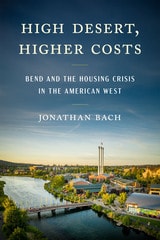
High Desert, Higher Costs
Bend and the Housing Crisis in the American WestJonathan Bach
Oregon State University Press, 2025
Nestled against the Cascade Mountains, former lumber town Bend, Oregon, entices residents who long to live in a wonderland of sagebrush and forests. But like so many other communities across the West, Bend has too few homes for everyone clambering for access. In High Desert, Higher Costs, Jonathan Bach takes a closer look at the housing crisis in this mid-sized city that is both the population center for rural Central Oregon and a major recreation area. Bach uses Bend as a lens into the growing housing crisis in the region, where residents and tourists alike prize access to outdoor recreation, and housing issues have been brewing for decades.
Like other cities in Montana, Idaho, and Colorado, Bend serves as a gateway to popular natural areas while also experiencing a limited amount of new housing, increasing populations, amenity migrants in the age of remote work, depressed or stagnating wages, and a widening gulf between homeowners and renters. High Desert, Higher Costs introduces us to regular people—from the former political candidate evicted during COVID-19 to the nonprofit worker hoping to build apartments for the houseless—who struggle to call Bend home. Bach explores the causes of these issues and the political, legal, economic, and cultural factors influencing them, and also offers potential solutions for current and future residents to build their lives now, and in the years to come, in Bend and throughout the American West.