Results by title
402 books match the query 'American poetry' and 13 start with h

H.D. and Poets After
Donna Krolik Hollenberg
University of Iowa Press, 2000
Twenty essays—half by eminent American poets writing about their literary engagement with H.D. and half by critics writing about H.D. in relation to these same poets—provide a fruitful exchange of perceptions and interpretations. The dialogue between these two perspectives—the first autobiographical testimony and the second critical analysis by scholars attuned to both modern and contemporary poetries and poetics—calls into question both traditional notions of literary criticism and earlier theories of literary influence.
The volume includes a range of contemporary responses to H.D.'s work—from Alicia Ostriker's radical eroticism to Brenda Hillman's epistemological restlessness to Carolyn Forché's response to moral disasters of the century. H.D. and Poets After demonstrates key aspects of the poet's continuing importance as a "poet's poet" in the best sense.

Hearts and Minds
Bodies, Poetry, and Resistance in the Vietnam EraMichael Bibby
Rutgers University Press, 1996
The early 1960s to the mid-1970s was one of the most turbulent periods in American history. The U.S. military was engaged in its longest, costliest overseas conflict, while the home front was torn apart by riots, protests, and social activism. In the midst of these upheavals, an underground and countercultural press emerged, giving activists an extraordinary forum for a range of imaginative expressions. Poetry held a prominent place in this alternative media. The poem was widely viewed by activists as an inherently anti-establishment form of free expression, and poets were often in the vanguards of political activism.
Hearts and Minds is the first book-length study of the poems of the Black Liberation, Women's Liberation, and GI Resistance movements during the Vietnam era. Drawing on recent cultural and literary theories, Bibby investigates the significance of images, tropes, and symbols of human bodies in activist poetry. Many key political slogans of the period––"black is beautiful," "off our backs"––foreground the body. Bibby demonstrates that figurations of bodies marked important sites of social and political struggle.
Although poetry played such an important role in Vietnam-era activism, literary criticism has largely ignored most of this literature. Bibby recuperates the cultural-historical importance of Vietnam-era activist poetry, highlighting both its relevant contexts and revealing how it engaged political and social struggles that continue to motivate contemporary history. Arguing for the need to read cultural history through these "underground" texts, Hearts and Minds offers new grounds for understanding the recent history of American poetry and the role poetry has played as a medium of imaginative political expression.
Heresy and the Ideal
On Contemporary PoetryDavid Baker
University of Arkansas Press, 2000
Hewing to Experience
Essays and Reviews on Recent American Poetry and Poetics, Nature and CultureSherman Paul
University of Iowa Press, 1989

Hints And Disguises
Marianne Moore ContemporariesCeleste Goodridge
University of Iowa Press, 1989
The first book-length exploration of Marianne Moore's prose focuses on her private and public critical exchanges with Wallace Stevens, Ezra Pound, William Carlos Williams, and T.S. Eliot. Drawing on previously unpublished material from the Moore Archive—correspondence, notebooks, manuscript notes, and books—Celeste Goodridge establishes Moore's central role as both poet-critic and prose stylist, providing a new perspective for considering Moore in relation to her contemporaries.
With clarity and elegance, Goodridge shows that Moore's most compelling critical judgments can best be recovered by examining the relationship between her private disclosures and her public pronouncements; her aesthetic of "hints and disguises" reveals a tension between what she felt free to voice and what she chose to veil.
In writing about these four poets, Moore made her greatest contribution to modernist criticism. With unusual perspicacity, she anticipated and defined many of the critical debates which still surround these writers' projects. Furthermore, Moore's critical exchanges indicated that her deepest alliances were with Stevens and Pound and not, as most have argued, with Williams and Eliot.
History Matters
Contemporary Poetry on the Margins of American CultureIra Sadoff
University of Iowa Press, 2009
Much of our most adventurous writing has occurred at history’s margins, simultaneously making use of and resisting tradition. By tracking key contemporary poets—including John Ashbery, Olena Kaltyiak Davis, Louise Glück, Czeslaw Milosz, Frank O’Hara, and C. K. Williams—as well as musing on jazz and other creative enterprises, Sadoff investigates the lively poetic art of those who have grappled with late twentieth-century attitudes about history, subjectivity, contingency, flux, and modernity. In plainspoken writing, he probes the question of the poet’s capacity to illuminate and universalize truth. Along the way, we are called to consider how and why art moves and transforms human beings.
History, Memory, and the Literary Left
Modern American Poetry, 1935-1968John Lowney
University of Iowa Press, 2006
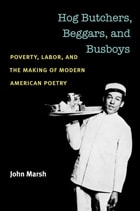
Hog Butchers, Beggars, and Busboys
Poverty, Labor, and the Making of Modern American PoetryJohn Marsh
University of Michigan Press, 2011
"Impressive—Marsh successfully rewrites the founding moment of American Modernist poetry."
---Mark Van Wienen, Northern Illinois University
"Cogently argued, instructive, and sensitive, Marsh’s revisionist reading opens new insights that will elicit lively comment and critical response."
---Douglas Wixson, University of Missouri–Rolla
Between 1909 and 1922, the genre of poetry was remade. Literary scholars have long debated why modern American poetry emerged when and how it did. While earlier poetry had rhymed, scanned, and dealt with conventional subjects such as love and nature, modern poetry looked and sounded very different and considered new areas of experience. Hog Butchers, Beggars, and Busboys: Poverty, Labor, and the Making of Modern American Poetry argues that this change was partially the result of modern poets writing into their verse what other poetry had suppressed: the gritty realities of modern life, including the problems of the poor and working class.
A closer look at the early works of the 20th century's best known poets (William Carlos Williams, T. S. Eliot, Edna St. Vincent Millay, Claude McKay, Langston Hughes, and Carl Sandburg) reveals the long-neglected role the labor problem—including sweatshops, strikes, unemployment, woman and child labor, and immigration---played in the formation of canonical modern American poetry. A revisionary history of literary modernism and exploration into how poets uniquely made the labor problem their own, this book will appeal to modernists in the fields of American and British literature as well as scholars in American studies and the growing field of working-class literature.
Hold-Outs
The Los Angeles Poetry Renaissance, 1948-1992Bill Mohr
University of Iowa Press, 2011
Homosexual Tradition in American Poetry
Robert K. Martin
University of Iowa Press, 1998
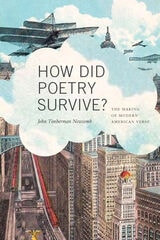
How Did Poetry Survive?
The Making of Modern American VerseJohn Timberman Newcomb
University of Illinois Press, 2013
This book traces the emergence of modern American poetry at the turn of the nineteenth century. With a particular focus on four "little magazines"--Poetry, The Masses, Others, and The Seven Arts--John Timberman Newcomb shows how each advanced ambitious agendas combining urban subjects, stylistic experimentation, and progressive social ideals. While subsequent literary history has favored the poets whose work made them distinct--individuals singled out usually on the basis of a novel technique--Newcomb provides a denser, richer view of the history that hundreds of poets made.
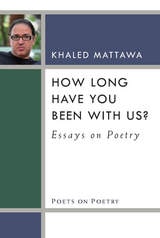
How Long Have You Been With Us?
Essays on PoetryKhaled Mattawa
University of Michigan Press, 2016
A volume in the Poets on Poetry series, which collects critical works by contemporary poets, gathering together the articles, interviews, and book reviews by which they have articulated the poetics of a new generation.
“Like the myriad companions and comrades that he summons from their exile, Khaled Mattawa is himself a ‘poet-stranger.’ In the essays, ‘written in a poet’s prose,’ collected in How Long Have You Been With Us, Mattawa evokes a powerful amalgam of the personal intimacy of the solitary and the political challenge of solidarity.”
—Barbara Harlow, University of Texas at Austin
“If you’ve read about exile, you’ve read about Brodsky and Milosz—just as, if you’ve read about translation, you’ve read about Walter Benjamin and George Steiner. While Khaled Mattawa has mastered these masters, his essays about world literature serve as a tour of the rest of the world. He introduces you to the writers you haven’t heard of but should from contemporary Libya and colonial South Asia to Latin America and China. When Mattawa invokes Saadi Youssef or Rabinidrath Tagore, Mohja Kahf or Toru Dutt, the effect is to deprovincialize American literature.”
—Ken Chen, The Asian American Writers’ Workshop
Khaled Mattawa, an American poet of Libyan origin, explores various dynamic developments shaping American poetry as it is being practiced today. Arising from an incredibly diverse range personal backgrounds, lyric traditions, and even languages, American poetry is transforming into a truly international form. Mattawa, who also translates Arabic poetry into American English and American poetry into Arabic, explores the poetics and politics of cross-cultural exchange and literary translation that fostered such transformation. The essays in this collection also shed light on Mattawa’s development as a poet and provide numerous portraits of the poets who helped shaped his poetry.
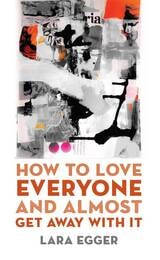
How to Love Everyone and Almost Get Away with It
Lara Egger
University of Massachusetts Press, 2021
Winner of Ploughshares’ 2022 John C. Zacharis First Book Award
Wrestling with desire, shame, and the complications of attempting to resist one's own nature, How to Love Everyone and Almost Get Away with It offers a tragicomic tour of a heart in midlife crisis. Populated by unruly angels, earthbound astronauts, xylophones, wordplay, and glitter glue, these wildly associative poems transform the world line by line, image by image. Part confessional, part kitsch, and often self-deprecating, this debut collection offers an honest and tender exploration of love's necessary absurdity. Lara Egger asks: Who put the end in crescendo, the over in lover? Are metaphors always reliable witnesses? Why does the past sleep with us when we hope the person beside us is the future?