Results by title
197 books match the query 'Arts' and 6 start with h
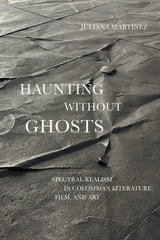
Haunting Without Ghosts
Spectral Realism in Colombian Literature, Film, and ArtBy Juliana Martínez
University of Texas Press, 2020
Winner, William M. LeoGrande Prize, Center for Latin American and Latino Studies at American University, 2022
For half a century, cultural production in Colombia has labored under the weight of magical realism—above all, the works of Gabriel García Márquez—where ghosts told stories about the country’s violent past and warned against a similarly gruesome future.
Decades later, the story of violence in Colombia is no less horrific, but the critical resources of magical realism are depleted. In their wake comes "spectral realism." Juliana Martínez argues that recent Colombian novelists, filmmakers, and artists—from Evelio Rosero and William Vega to Beatriz González and Erika Diettes—share a formal and thematic concern with the spectral but shift the focus from what the ghost is toward what the specter does. These works do not speak of ghosts. Instead, they use the specter to destabilize reality by challenging the authority of human vision and historical chronology.
By introducing the spectral into their work, these artists decommodify well-worn modes of representing violence and create a critical space from which to seek justice for the dead and disappeared. A Colombia-based study, Haunting without Ghosts brings powerful insight to the politics and ethics of spectral aesthetics, relevant for a variety of sociohistorical contexts.
Hegel and the Arts
Stephen Houlgate
Northwestern University Press, 2007
Addressing a range of important topics, the essays examine the conceptual bases of Hegel's organization of his aesthetics, his treatment of various specific arts (architecture, sculpture, painting, music, and tragedy), and several of the most famous issues in the literature--including the "end of art" thesis, the relation between art and religion, and the vexed relationship between Hegel and the romantics. Together they shed light on the profound reflections on art contained in Hegel's philosophy and also suggest ways in which his aesthetics might resonate well beyond the field of philosophical aesthetics, perhaps beyond philosophy itself.
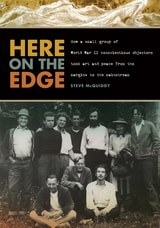
Here on the Edge
How a Small Group of World War II Conscientious Objectors Took Art and Peace from the Margins to the MainstreamSteve McQuiddy
Oregon State University Press, 2013
They worked six days a week—planting trees, crushing rock, building roads, and fighting forest fires—in exchange for only room and board. At night, they published books under the imprint of the Untide Press. They produced plays, art, and music—all during their limited non-work hours, with little money and few resources. This influential group included poet William Everson, later known as Brother Antoninus, “the Beat Friar”; violinist Broadus Erle, founder of the New Music Quartet; fine arts printer Adrian Wilson; Kermit Sheets, co-founder of San Francisco’s Interplayers theater group; architect Kemper Nomland, Jr.; and internationally renowned sculptor Clayton James.
After the war, camp members went on to participate in the San Francisco Poetry Renaissance of the 1950s, which heavily influenced the Beat Generation of Jack Kerouac, Allen Ginsberg, and Gary Snyder—who in turn inspired Ken Kesey and his Merry Pranksters, leading the way to the 1960s upheavals epitomized by San Francisco’s Summer of Love.
As camp members engaged in creative acts, they were plowing ground for the next generation, when a new set of young people, facing a war of their own in Vietnam, would populate the massive peace movements of the 1960s.
Twenty years in the making and packed with original research, Here on the Edge is the definitive history of the Fine Arts Group at Waldport, documenting how their actions resonated far beyond the borders of the camp. It will appeal to readers interested in peace studies, World War II history, influences on the 1960s generation, and in the rich social and cultural history of the West Coast.
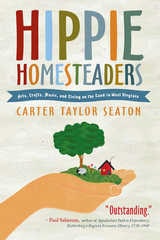
Hippie Homesteaders
Arts, Crafts, Music and Living on the Land in West VirginiaCarter Taylor Seaton
West Virginia University Press, 2014
It’s the 1960s. The Vietnam War is raging and protests are erupting across the United States. In many quarters, young people are dropping out of society, leaving their urban homes behind in an attempt to find a safe place to live on their own terms, to grow their own food, and to avoid a war they passionately decry. During this time, West Virginia becomes a haven for thousands of these homesteaders—or back-to-the-landers, as they are termed by some. Others call them hippies.
When the going got rough, many left. But a significant number remain to this day. Some were artisans when they arrived, while others adopted a craft that provided them with the cash necessary to survive. Hippie Homesteaders tells the story of this movement from the viewpoint of forty artisans and musicians who came to the state, lived on the land, and created successful careers with their craft. There’s the couple that made baskets coveted by the Smithsonian Institution’s Renwick Gallery. There’s the draft-dodger that fled to Canada and then became a premier furniture maker. There’s the Boston-born VISTA worker who started a quilting cooperative. And, there’s the immigrant Chinese potter who lived on a commune.
Along with these stories, Hippie Homesteaders examines the serendipitous timing of this influx and the community and economic support these crafters received from residents and state agencies in West Virginia. Without these young transplants, it’s possible there would be no Tamarack: The Best of West Virginia, the first statewide collection of fine arts and handcrafts in the nation, and no Mountain Stage, the weekly live musical program broadcast worldwide on National Public Radio since 1983. Forget what you know about West Virginia.
Hippie Homesteaders isn’t about coal or hillbillies or moonshine or poverty. It is the story of why West Virginia was—and still is—a kind of heaven to so many.

Hosts, Hospitals and Hospitalities
Narratives of (in)hospitality in literature, culture and the artsEdited by Susana Araújo, Catarina Nunes de Almeida, and Santiago Pérez Isasi
University College London, 2026
This book analyzes narratives of hospitality (and inhospitality) through recent crises like climate change and mass displacement.
Current historical and political issues, such as the refugee crisis and climate emergency, are deeply intertwined with notions, images, and narratives of (in)hospitality. Departing from seminal works, such as those by Kant and Derrida, on this topic, the chapters in this volume examine how new postcolonial, gender, environmental, and medical perspectives reshape current approaches to hospitality in literature, culture, and the arts.
Through a comparison of case studies in multiple national settings, Hosts, Hospitals and Hospitalities shows how the concept of hospitality shapes the way in which we relate with “the Other” in diverse—and ever-evolving—cultural, political, social, and environmental contexts. By examining the issue of hospitality from a post-pandemic standpoint, which revised the roles of our private and public spaces in the aftermath of COVID-19, by dwelling on novel issues of climate emergency, and by focusing on current developments in terms of migration and displacement, this book adds new light and significant theoretical and methodological perspectives to previous debates about hospitality.
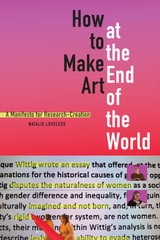
How to Make Art at the End of the World
A Manifesto for Research-CreationNatalie Loveless
Duke University Press, 2019