Results by title
354 books match the query 'Authors, American' and 18 start with h
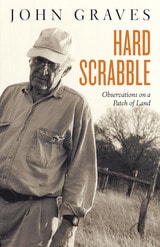
Hard Scrabble
Observations on a Patch of LandBy John Graves<br>Introduction by Rick Bass
University of Texas Press, 2016
“A kind of homemade book—imperfect like a handmade thing, a prize. It’s a galloping, spontaneous book, on occasion within whooping distance of that greatest and sweetest of country books, Ivan Turgenev’s A Sportsman’s Notebook.” —Edward Hoagland, New York Times Book Review
“His subjects are trees and brush, hired help, fences, soil, armadillos and other wildlife, flood and drought, local history, sheep and goats . . . and they come to us reshaped and reenlivened by his agreeably individual (and sometimes cranky) notions.” —New Yorker
“If Goodbye to a River was in some sense Graves’s Odyssey, this book is his [version of Hesiod’s] Works and Days. It is partly a book about work, partly a book about nature, but mostly a book about belonging. In the end John Graves has learned to belong to his patch of land so thoroughly that at moments he can sense in himself a unity with medieval peasants and Sumerian farmers, working with their fields by the Tigris.” —Larry McMurtry, Washington Post Book World
“Hard Scrabble is hard pastoral of the kind we have learned to recognize in Wordsworth, Frost, Hemingway, and Faulkner. It celebrates life in accommodation with a piece of the ‘given’ creation, a recalcitrant four hundred or so acres of Texas cedar brake, old field, and creek bottom, which will require of any genuine resident all the character he can muster.” —Southwest Review
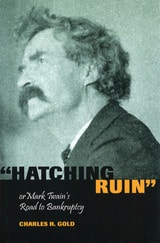
Hatching Ruin
Or Mark Twain's Road to BankruptcyCharles H. Gold
University of Missouri Press, 2003
In “Hatching Ruin,” Charles H. Gold provides a complete description of Samuel L. Clemens’s business relationships with Charles L. Webster and James W. Paige during the 1880s. Gold analyzes how these relationships affected Clemens as a person and an artist, most notably in A Connecticut Yankee in King Arthur’s Court.
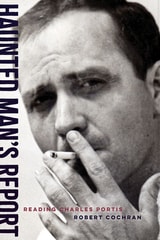
Haunted Man's Report
Reading Charles PortisRobert Cochran
University of Arkansas Press, 2024
Haunted Man’s Report, a deeply insightful literary exploration of Portis’s singular and underexamined oeuvre, celebrates this novelist’s great achievement and is certain to prove a valuable guide for readers new to Portis as well as aficionados.
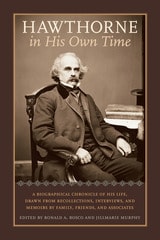
Hawthorne in His Own Time
A Biographical Chronicle of His Life,Drawn from Recollections,Interviews, and Memoirs by Family,FrieRonald A Bosco
University of Iowa Press, 2007
At his death, Nathaniel Hawthorne (1804–1864) was universally acknowledged in America and England as "the Great Romancer." Novels such as The Scarlet Letter and The House of the Seven Gables and stories published in such collections as Twice-Told Tales continue to capture the minds and imaginations of readers and critics to this day. Harder to capture, however, were the character and personality of the man himself. So few of the essays that appeared in the two years after his death offered new insights into his life, art, and reputation that Hawthorne seemed fated to premature obscurity or, at least, permanent misrepresentation. This first collection of personal reminiscences by those who knew Hawthorne intimately or knew about him through reliable secondary sources rescues him from these confusions and provides the real human history behind the successful writer.
Remembrances from Elizabeth Peabody, Sophia Hawthorne, Oliver Wendell Holmes, Ralph Waldo Emerson, Bronson Alcott, Rebecca Harding Davis, and twenty others printed in Hawthorne in His Own Time follow him from his childhood in Salem, through his years of initial literary obscurity, his days in the Boston and Salem Custom Houses, his service as U.S. Consul to Liverpool and Manchester and his life in the Anglo-American communities at Rome and Florence, to his late years as the "Great Romancer."
In their enlightening introduction, editors Ronald Bosco and Jillmarie Murphy assess the postmortem building of Hawthorne's reputation as well as his relationship to the prominent Transcendentalists, spiritualists, Swedenborgians, and other personalities of his time. By clarifying the sentimental associations between Hawthorne's writings and his actual personality and moving away from the critical review to the personal narrative, these artful and perceptive reminiscences tell the private and public story of a remarkable life.
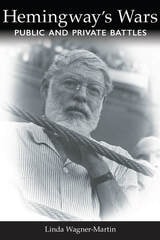
Hemingway's Wars
Public and Private BattlesLinda Wagner-Martin
University of Missouri Press, 2017
Linda Wagner-Martin has written or edited more than sixty books including Ernest Hemingway, A Literary Life. She is Frank Borden Hanes Professor Emerita at the University of North Carolina-Chapel Hill and a winner of the Jay B. Hubbell Medal for Lifetime Achievement.
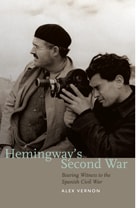
Hemingway’s Second War
Bearing Witness to the Spanish Civil WarAlex Vernon
University of Iowa Press, 2011
In 1937 and 1938, Ernest Hemingway made four trips to Spain to cover its civil war for the North American News Alliance wire service and to help create the pro-Republican documentary film The Spanish Earth. Hemingway’s Second War is the first book-length scholarly work devoted to this subject.
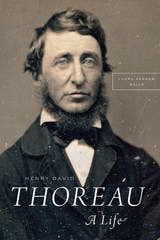
Henry David Thoreau
A LifeLaura Dassow Walls
University of Chicago Press, 2017
But there was much more to Thoreau than his brief experiment in living at Walden Pond. A member of the vibrant intellectual circle centered on his neighbor Ralph Waldo Emerson, he was also an ardent naturalist, a manual laborer and inventor, a radical political activist, and more. Many books have taken up various aspects of Thoreau’s character and achievements, but, as Laura Dassow Walls writes, “Thoreau has never been captured between covers; he was too quixotic, mischievous, many-sided.” Two hundred years after his birth, and two generations after the last full-scale biography, Walls restores Henry David Thoreau to us in all his profound, inspiring complexity.
Walls traces the full arc of Thoreau’s life, from his early days in the intellectual hothouse of Concord, when the American experiment still felt fresh and precarious, and “America was a family affair, earned by one generation and about to pass to the next.” By the time he died in 1862, at only forty-four years of age, Thoreau had witnessed the transformation of his world from a community of farmers and artisans into a bustling, interconnected commercial nation. What did that portend for the contemplative individual and abundant, wild nature that Thoreau celebrated?
Drawing on Thoreau’s copious writings, published and unpublished, Walls presents a Thoreau vigorously alive in all his quirks and contradictions: the young man shattered by the sudden death of his brother; the ambitious Harvard College student; the ecstatic visionary who closed Walden with an account of the regenerative power of the Cosmos. We meet the man whose belief in human freedom and the value of labor made him an uncompromising abolitionist; the solitary walker who found society in nature, but also found his own nature in the society of which he was a deeply interwoven part. And, running through it all, Thoreau the passionate naturalist, who, long before the age of environmentalism, saw tragedy for future generations in the human heedlessness around him.
“The Thoreau I sought was not in any book, so I wrote this one,” says Walls. The result is a Thoreau unlike any seen since he walked the streets of Concord, a Thoreau for our time and all time.
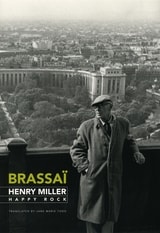
Henry Miller, Happy Rock
Brassaï
University of Chicago Press, 2002
That's Henry Miller's advice for young aspiring artists, as remembered by his very good friend Brassaï in this lively book. One of two that Brassaï wrote about the man who called himself a "happy rock," this volume covers their lives and friendship from the 1950s to 1973. Over the course of a number of warm, intimate conversations, Brassaï and Miller revisit their careers; discuss art, literature, Paris, Greece, Japan, World War II, and more; and consider the lives and works of many others in their circle, including Lawrence Durrell, Henri Matisse, Salvador Dalí, Georges Simenon, André Malraux, Hans Reichel, Paul Klee, and Amedeo Modigliani. Throughout Miller's zest for life shines through, as do his love of art and his passionate intensity for just about everything he does, from discussing a movie or play he'd just seen to reminiscing about a decades-long love.
Brassaï's Henry Miller, Happy Rock presents a vivid portrait of two close friends who thoroughly enjoy each other's company—and just happen to be world—famous artists too.
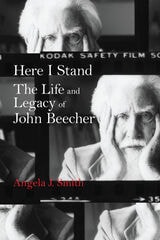
Here I Stand
The Life and Legacy of John BeecherAngela J. Smith
University of Alabama Press, 2017
Biography of a forgotten poet who used his name and influence to speak up for those on the margins of society.
Few surnames resonate in American history more than Beecher. The family’s abolitionist ministers, educators, and writers are central figures in the historical narrative of the United States. The Beechers’ influence was greatest in the nineteenth century, but the family story continued—albeit with less public attention—with a descendant who grew up in Birmingham, Alabama, during the early twentieth century.
John Beecher (1904–1980) never had the public prominence of his famous ancestors, but as a poet, professor, sociologist, New Deal administrator, journalist, and civil rights activist, he spent his life fighting for the voiceless and oppressed with a distinct moral sensibility that reflected his self-identification as the twentieth-century torchbearer for his famous family. While John Beecher had many vocations in his lifetime, he always considered himself a poet and a teacher. Some critics have compared the populist elements of Beecher’s poetry to the work of Walt Whitman and Carl Sandburg, but his writing never gained a broad audience or critical acclaim during his lifetime.
In Here I Stand: The Life and Legacy of John Beecher, Angela J. Smith examines Beecher’s writing and activism and places them in the broader context of American culture at pivotal points in the twentieth century. Employing his extensive letters, articles, unpublished poetry and prose, and audio interviews in addition to his numerous published books, Smith uncovers a record of public concerns in American history ranging from the plight of workers in 1920s steel mills to sharecroppers’ struggles during the Depression to the civil rights movement of the 1960s.
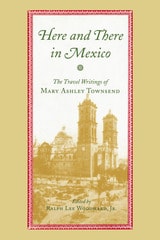
Here and There in Mexico
The Travel Writings of Mary Ashley TownsendMary Ashley Townsend, edited by Ralph Lee Woodward Jr.
University of Alabama Press, 2001
Mary Ashley Townsend was a novelist, newspaper columnist, and poet laureate of New Orleans who made several trips to Mexico with her daughter Cora during the last two decades of the 19th century. She collected her impressions of many aspects of life in that country—flora, fauna, architecture, people at work and play, fashion, society, food—and wrote about them during a time when few women engaged in solo travel, much less the pursuit of travel writing. Her collected work was still in progress when she died in a train accident in 1901, and was never published.
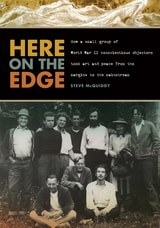
Here on the Edge
How a Small Group of World War II Conscientious Objectors Took Art and Peace from the Margins to the MainstreamSteve McQuiddy
Oregon State University Press, 2013
They worked six days a week—planting trees, crushing rock, building roads, and fighting forest fires—in exchange for only room and board. At night, they published books under the imprint of the Untide Press. They produced plays, art, and music—all during their limited non-work hours, with little money and few resources. This influential group included poet William Everson, later known as Brother Antoninus, “the Beat Friar”; violinist Broadus Erle, founder of the New Music Quartet; fine arts printer Adrian Wilson; Kermit Sheets, co-founder of San Francisco’s Interplayers theater group; architect Kemper Nomland, Jr.; and internationally renowned sculptor Clayton James.
After the war, camp members went on to participate in the San Francisco Poetry Renaissance of the 1950s, which heavily influenced the Beat Generation of Jack Kerouac, Allen Ginsberg, and Gary Snyder—who in turn inspired Ken Kesey and his Merry Pranksters, leading the way to the 1960s upheavals epitomized by San Francisco’s Summer of Love.
As camp members engaged in creative acts, they were plowing ground for the next generation, when a new set of young people, facing a war of their own in Vietnam, would populate the massive peace movements of the 1960s.
Twenty years in the making and packed with original research, Here on the Edge is the definitive history of the Fine Arts Group at Waldport, documenting how their actions resonated far beyond the borders of the camp. It will appeal to readers interested in peace studies, World War II history, influences on the 1960s generation, and in the rich social and cultural history of the West Coast.
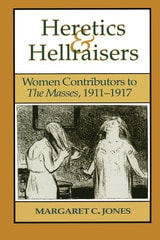
Heretics and Hellraisers
Women Contributors to The Masses, 1911-1917By Margaret C. Jones
University of Texas Press, 1993
The Masses was the most dynamic and influential left-wing magazine of the early twentieth century, a touchstone for understanding radical thought and social movements in the United States during that era. As a magazine that supported feminist issues, it played a crucial role in shaping public discourse about women's concerns. Women editors, fiction writers, poets, and activists like Mary Heaton Vorse, Louise Bryant, Adriana Spadoni, Elsie Clews Parsons, Inez Haynes Gillmore, and Helen Hull contributed as significantly to the magazine as better-known male figures.
In this major revisionist work, Margaret C. Jones calls for reexamination of the relevance of Masses feminism to that of the 1990s. She explores women contributors' perspectives on crucial issues: patriarchy, birth control, the labor movement, woman suffrage, pacifism, and ethnicity. The book includes numerous examples of the writings and visual art of Masses women and a series of biographical/bibliographical sketches designed to aid other researchers.
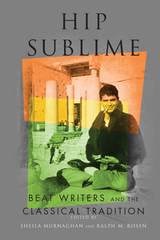
Hip Sublime
Beat Writers and the Classical TraditionEdited by Sheila Murnaghan and Ralph M. Rosen
The Ohio State University Press, 2018
In this volume, a diverse group of contributors explore for the first time the fascinating tensions and paradoxes that arose from interactions between these avant-garde writers and a literary tradition often seen as conservative and culturally hegemonic. With essays that cover the canonical Beat authors—such as Allen Ginsberg, Jack Kerouac, and William Burroughs—along with less well-known figures—including Kenneth Rexroth, Ed Sanders, and Diane di Prima—Hip Sublime: Beat Writers and the Classical Tradition brings long overdue attention to the Beat movement’s formative appropriation of the Greek and Latin classics.
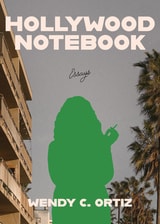
Hollywood Notebook
EssaysWendy C. Ortiz
Northwestern University Press, 2025
A daylight traipse through early-aughts Los Angeles, Hollywood Notebook encapsulates the powerful feelings and hopeful futures of twentysomething Wendy C. Ortiz. In this boundary-defying sister memoir to Bruja, Ortiz navigates internal maps as she traverses external palm-treed streets, moving through her youthful twenties and into the pensiveness of her thirties. Peering at what lies ahead while dipping her toes into the past, Ortiz shows us that there is no place like Hollywood to unearth the joys of success and the blows of mistakes—both realized and denied. An innovative and bold examination of the daytime roaming mind, Hollywood Notebook is a cartography of love, loss, and transformation in the face of a brilliant psyche in a vibrant city.
Home Movies and Other Necessary Fictions
Michelle Citron
University of Minnesota Press, 1998

Home Stand
Growing Up in SportsJames McKean
Michigan State University Press, 2005
If he had not fouled out, maybe Washington State University’s center, James McKean, might have held Lew Alcindor (now Kareem Abdul-Jabbar) to only forty points. It was 1967, a transition year for college athletics in a dramatic time for those coming ofage. In this memoir set in the 1950s and 1960s, McKean revisits his years growing up in a family dedicated to sports and the outdoors, his playing basketball at Washington State University (for coaches Marv Harshman and Jud Heathcote), and his fashioning a life during and after basketball.
Driven by the energy and spirit of athletics, the language in Home Stand lights up McKean’s wonderfully eclectic work—the aunt who won a bronze medal in the 1936 Olympics in Berlin, his last run as a misguided drag racer, his playing basketball for a washing machine factory in Bologna, Italy, or against the prisoners in Walla Walla State Penitentiary—all seen in the context of turbulent times. Needless to say, Lew Alcindor scored his points and UCLA won, which they did every game that season. What James McKean took home was five fouls and a good story.
Home Stand delivers a lyrical, thoughtful reflection of what it is to be an athlete—inside as well as outside the game—and how one man’s love of basketball evolved into a love of poetry, "good turns of speech," writing, and teaching.
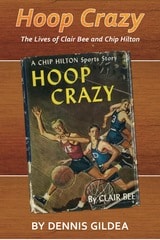
Hoop Crazy
The Lives of Clair Bee and Chip HiltonDennis Gildea
University of Arkansas Press, 2013
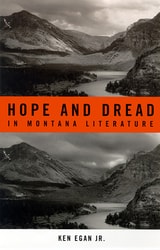
Hope And Dread In Montana Literature
Ken Egan
University of Nevada Press, 2003
This literary survey from a third-generation Montanan includes a thoughtful discussion on the now infamous events of the mid- to late-nineties. The rich literary tradition of Montana, contends author Ken Egan Jr., reflects a catastrophic vision of the West that shows the "horrors of domination" and "the foolish and destructive habits of the imperial heart." Since the 1860s, Montana’s writers have depicted struggles for survival in the state’s dramatic landscape, and for decency in a region characterized by the headlong exploitation of both natural and human resources.