Results by title
101 books match the query 'Behavior' and 4 start with h
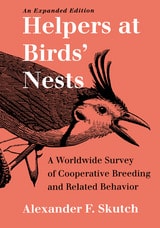
Helpers At Birds Nests
Cooperative Breeding & Related BehaviorAlexander F. Skutch
University of Iowa Press, 1999
In Helpers at Birds' Nests, renowned naturalist and ornithologist Alexander Skutch provides vivid, detailed accounts of a remarkable aspect of bird behavior—he aid that one bird gives another who is neither its mate nor its dependent young and who may even belong to a different species.
In graceful, clear prose, Skutch makes accessible to amateur bird-watchers examples of cooperation in species as far-flung as the little rifleman of New Zealand, the Laysan albatross in the mid Pacific, and the neotropical birds of Skutch's own Valley of El General in Costa Rica.
Skutch describes the cooperative behavior of more than fifty families of birds. Each family is introduced by a brief sketch of its distribution and outstanding features, followed by intimate, nontechnical accounts of the helpful behaviors that have been most carefully studied. Skutch considers the significance of helpful birds and discusses the theoretical aspects of cooperative breeding, its evolution, kin selection, altruism, and demography.
First discovered by the author more than half a century ago, cooperative breeding has become increasingly studied by professional ornithologists. In this expanded edition, noted behaviorist Stephen Emlen credits Skutch's passionate observations of birds with promoting scientific interest in avian behavior. Emlen offers readers a summary of the advances made in the field during the past ten years and places Skutch's work in the context of contemporary ornithological research.

Hormones, Brain, and Behavior
Edited by Carl Gans and David Crews
University of Chicago Press, 1992

How Dogs Work
Raymond Coppinger and Mark Feinstein
University of Chicago Press, 2015
Approaching dogs as a biological species rather than just as pets, Coppinger and Feinstein accessibly synthesize decades of research and field experiments to explain the evolutionary foundations underlying dog behaviors. They examine the central importance of the shape of dogs: how their physical body (including the genes and the brain) affects behavior, how shape interacts with the environment as animals grow, and how all of this has developed over time. Shape, they tell us, is what makes a champion sled dog or a Border collie that can successfully herd sheep. Other chapters in How Dogs Work explore such mysteries as why dogs play; whether dogs have minds, and if so what kinds of things they might know; why dogs bark; how dogs feed and forage; and the influence of the early relationship between mother and pup. Going far beyond the cozy lap dog, Coppinger and Feinstein are equally fascinated by what we can learn from the adaptations of dogs, wolves, coyotes, jackals, dingoes, and even pumas in the wild, as well as the behavior of working animals like guarding and herding dogs.
We cherish dogs as family members and deeply value our lengthy companionship with them. But, isn’t it time we knew more about who Fido and Trixie really are? How Dogs Work will provide some keys to unlocking the origins of many of our dogs' most common, most puzzling, and most endearing behaviors.

How Monkeys See the World
Inside the Mind of Another SpeciesDorothy L. Cheney and Robert M. Seyfarth
University of Chicago Press, 1990
"This reviewer had to be restrained from stopping people in the street to urge them to read it: They would learn something of the way science is done, something about how monkeys see their world, and something about themselves, the mental models they inhabit."—Roger Lewin, Washington Post Book World
"A fascinating intellectual odyssey and a superb summary of where science stands."—Geoffrey Cowley, Newsweek
"A once-in-the-history-of-science enterprise."—Duane M. Rumbaugh, Quarterly Review of Biology