478 books match the query 'Bible' and 21 start with h
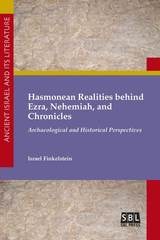
cover of Hasmonean Realities behind Ezra, Nehemiah, and Chronicles: Archaeological and Historical Perspectives

Hasmonean Realities behind Ezra, Nehemiah, and Chronicles

Archaeological and Historical Perspectives

Israel Finkelstein

SBL Press, 2018

A thorough case for a later date for of Ezra, Nehemiah, and Chronicles

In this collection of essays, Israel Finkelstein deals with key topics in Ezra, Nehemiah, and 1 and 2 Chronicles, such as the list of returnees, the construction of the city wall of Jerusalem, the adversaries of Nehemiah, the tribal genealogies, and the territorial expansion of Judah in 2 Chronicles. Finkelstein argues that the geographical and historical realities cached behind at least parts of these books fit the Hasmonean period in the late second century BCE. Seven previously published essays are supplemented by maps, updates to the archaeological material, and references to recent publications on the topics.

Features:

  • Analysis of geographical chapters of Ezra, Nehemiah, and Chronicles
  • Study of the Hasmonean period in the late second century BCE
  • Unique arguments regarding chronology and historical background
[more]
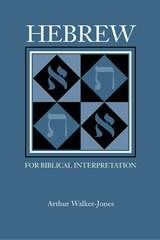
cover of Hebrew for Biblical Interpretation

Hebrew for Biblical Interpretation

Arthur W. Walker-Jones

SBL Press, 2003
Hebrew for Biblical Interpretation teaches elementary Hebrew with a specific focus on the tasks of biblical exegesis. This innovative textbook combines the features of a traditional grammar with exercises in reading and interpreting the Hebrew Bible. Grammatical descriptions are clear, concise, and systematic, and vocabulary is introduced in descending order of frequency. All words occurring more than 100 times in the Hebrew Bible are taught, and attention to grammatical indicators reduces the need for rote memorization of paradigms. The integration of grammar and exegesis helps to motivate students and makes the textbook well-suited to seminary courses, while those who teach in university settings will find the textbook useful because the focus is on scholarly biblical exegesis, not theological interpretation.
[more]
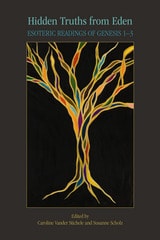
cover of Hidden Truths from Eden: Esoteric Readings of Genesis 1-3

Hidden Truths from Eden

Esoteric Readings of Genesis 1-3

Caroline Vander Stichele

SBL Press, 2014

Examine a rich history of spiritual interpretations from antiquity to the present

Since the sixteenth century CE, the field of biblical studies has focused on the literal meaning of texts. This collection seeks to rectify this oversight by integrating the study of esoteric readings into academic discourse. Case studies focusing on the first three chapters of Genesis cover different periods and methods from early Christian discourse through zoharic, kabbalistic and alchemical literature to modern and post-postmodern approaches.

Features:

  • Discussions, comparisons, and analyses of esoteric appropriations of Genesis 1–3
  • Essays on creation myths, gender, fate and free will, the concepts of knowledge, wisdom, and gnosis
  • Repsonses to papers that provide a range of view points
[more]
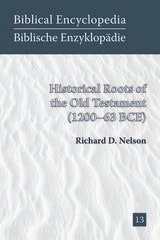
cover of Historical Roots of the Old Testament (1200-63 BCE)

Historical Roots of the Old Testament (1200-63 BCE)

Richard D. Nelson

SBL Press, 2014

A thorough overview of the history of ancient Israel for research and classroom use

Richard D. Nelson charts the beginning of the Iron Age and the emergence of Israel and its literature, including the kingdoms of Israel and Judah, the downfall of Israel, Judah in the Assyrian and Babylonian periods, Yehud and Persia, and the Hellenistic period. Each chapter provides a summary of the period under consideration, a historical reconstruction of the period, based on biblical and extrabiblical evidence; a critical study of the biblical literature deriving from or associated with the period, and theological conclusions that readers may draw from the relevant biblical texts.

Features:

  • Balanced coverage of controversial topics
  • Extensive bibliographies at the beginning of each chapter
  • Lists of rulers and key dates for reference and classroom use

[more]
cover of History of Ancient Israel

History of Ancient Israel

Christian Frevel

SBL Press, 2023

This English translation of the second edition of Christian Frevel’s essential textbook Geschichte Israels (Kohlhammer, 2018) covers the history of Israel from its beginnings until the Bar Kokhba revolt (132–135 CE). Frevel draws on archaeological evidence, inscriptions and monuments, as well as the Bible to sketch a picture of the history of ancient Israel within the context of the southern Levant that is sometimes familiar but often fresh and unexpected. Frevel has updated the second German edition with the most recent research of archaeologists and biblical scholars, including those based in Europe. Tables of rulers, a glossary, a timeline of the ancient Near East, and resources arranged by subject make this book an accessible, essential textbook for students and scholars alike.
[more]
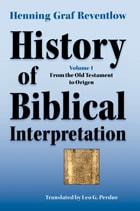
cover of History of Biblical Interpretation, Volume 1: From the Old Testament to Origen

History of Biblical Interpretation, Volume 1

From the Old Testament to Origen

Henning Graf Reventlow

SBL Press, 2009

From the very beginning, Holy Scripture has always been interpreted Scripture, and its interpretation determined the development and the history of both early Judaism and the first centuries of the Christian church. In this volume, the first of four on the History of Biblical Interpretation, readers will discover how the earliest interpreters of the Bible made the Scriptures come alive for their times—within the contexts and under the influences of Hellenism, Stoicism, and Platonism, as well as the interpretive methods developed in Alexandria. Particular attention is paid to innerbiblical interpretation (within the Hebrew Bible itself and in the New Testament’s reading of the Hebrew Bible), as well as to the interpretive practices reflected in the translation of the Septuagint and the writings of Qumran, Philo, the early rabbis, the apostolic fathers Barnabas and Clement, and early Christian leaders such as Justin Martyr, Marcion, Irenaeus, and Origen.
[more]
cover of History of Biblical Interpretation, Volume 2: From Late Antiquity to the End of the Middle Ages

History of Biblical Interpretation, Volume 2

From Late Antiquity to the End of the Middle Ages

Henning Graf Reventlow

SBL Press, 2010

Volume 2 of History of Biblical Interpretation deals with the most extensive period under examination in this four-volume set. It begins in Asia Minor in the late fourth century with Bishop Theodore of Mopsuestia, the founder of a school of interpretation that sought to accentuate the literal meaning of the Bible and thereby stood out from the tradition of antiquity. It ends with another outsider, a thousand years later in England, who by the presuppositions of his thought stood at the end of an era: John Wyclif. In between these two interpreters, this volume presents the history of biblical interpretation from late antiquity until the end of the Middle Ages by examining the lives, works, and interpretive practices of Didymus the Blind, Jerome, Ambrose, Augustine, Gregory the Great, Isidore of Seville, the Venerable Bede, Alcuin, John Scotus Eriugena, Abelard, Rupert of Deutz, Hugo of St. Victor, Joachim of Fiore, Thomas Aquinas, Bonaventure, Rashi, Abraham ibn Ezra, and Nicolas of Lyra.
[more]
cover of History of Biblical Interpretation, Volume 3: Rennaissance, Reformation, Humanism

History of Biblical Interpretation, Volume 3

Rennaissance, Reformation, Humanism

Henning Graf Reventlow

SBL Press, 2009

Volume 3 of History of Biblical Interpretation deals with an era—Renaissance, Reformation, and humanism—characterized by major changes, such as the rediscovery of the writings of antiquity and the newly invented art of printing. These developments created the context for one of the most important periods in the history of biblical interpretation, one that combined both philological insights made possible by the now-accessible ancient texts with new theological impulses and movements. As representative of this period, this volume examines the lives and teaching of Johann Reuchlin, Erasmus, Martin Luther, Philipp Melanchthon, John Calvin, Thomas Müntzer, Hugo Grotius, and a host of other influential exegetes.
[more]
cover of History of Biblical Interpretation, Volume 4: From the Englightenment to the Twentieth Century

History of Biblical Interpretation, Volume 4

From the Englightenment to the Twentieth Century

Henning Graf Reventlow

SBL Press, 2010

As in the first three volumes of History of Biblical Interpretation, From the Enlightenment to the Twentieth Century surveys the lives and works of significant theologians and lay people, politicians and philosophers, in order to portray the characteristic attitudes of the era. It discusses the philosophers and politicians Hobbes, Locke, and Spinoza and the writers Lessing and Herder. Biblical criticism per se begins with the controversy over the original Hebrew text of the Old Testament and extends into Enlightenment ethics, myth, and miracle stories. Early representatives include Richard Simon and Hermann Samuel Reimarus, followed by Johann Salomo Semler, Johann Jakob Griesbach, Johann Gottfried Eichhorn, and Philipp Jacob Spener. Biblical scholars such as Wilhelm Martin Leberecht de Wette, Ferdinand Christian Baur, Heinrich Julius Holtzmann, Julius Wellhausen, Hermann Gunkel, Wilhelm Bousset, Karl Barth, and Rudolf Bultmann round out the volume and bring readers to the twentieth century.
[more]
cover of Homilies on Genesis and Exodus

Homilies on Genesis and Exodus

Catholic University of America Press, 1982
No description available
[more]
cover of Homilies on Genesis, 1–17

Homilies on Genesis, 1–17

Saint John Chrysostom

Catholic University of America Press, 1986
No description available
[more]
cover of Homilies on Isaiah

Homilies on Isaiah

Elizabeth Ann Dively Origen

Catholic University of America Press, 2021
Hans Urs von Balthasar places Origen of Alexandria “in rank . . . beside Augustine and Thomas” in “importance for the history of Christian thought,” explaining that his “brilliance” has captivated theologians throughout history (Spirit and Fire, 1984, 1). This brilliance shines forth in his nine extant homilies on Isaiah, in which he employs his theology of the Trinity and Christ to exhort his audience to play their crucial role in salvation history. Origen reads Isaiah’s vision of the Lord and two seraphim in Isaiah 6 allegorically as representing the Trinity, and this theme runs throughout the nine homilies. His representation of the seraphim as the Son and Holy Spirit around the throne of the Father brought early accusations that Origen was a proto-Arian subordinationist, followed by a pointed condemnation by Emperor Justinian in 553. These homilies, originally delivered between 245 and 248, are extant only in a fourth-century Latin translation. Though St. Jerome, likely because of these controversies, does not identify himself as the Latin translator, the evidence overwhelmingly points to his pen, and his reliability in conveying Origen’s authentic meaning is well documented. If one sets aside the questionable charges of subordinationism, these homilies, expounding on passages from Judges 6-10, come alive with Origen’s legacy of presenting Christ as the central figure of the soul’s ascent to God. Reading allegorically the two seraphim to be Jesus and the Holy Spirit around the Father’s throne, Origen draws a picture of the Trinity as a tightly knit whole in which the Son and the Holy Spirit eternally sing the Trisagion (“Holy, holy, holy”) to each other and the Father about the divine truths of God’s nature, allowing the part of their song that conveys the “middle things” of salvation history to be heard by creation. The “second seraph” is the Son, or Jesus, who descends holding a hot coal, or Scripture, from the altar of the throne, with which he cleanses Isaiah’s lips, or the believer’s soul. Origen employs his signature exegetical method of allegory and typology through the lens of the threefold meaning of Scripture to emphasize to his hearers that Christ is the deliverer, the content, and the reward of the healing Word. He repeatedly assures them that those who submit to Scripture will enter into salvation history’s cycle of cleansing from sin, growth in virtue, and ever-deepening knowledge of God. As a result, they will become like Christ and thus will be prepared to join the Trinity for all eternity at the heavenly wedding feast.
[more]
cover of Homilies on Jeremiah and 1 Kings 28

Homilies on Jeremiah and 1 Kings 28

Catholic University of America Press, 1998
Presented in this volume are the remains of twenty-two homilies and a collection of fragments delivered by Origen around A.D. 240. The original texts of the homilies on Jeremiah have not come down to us completely; two of the homilies survive only in a Latin translation of St. Jerome. The homily on I Kings 28, while not a part of the homilies on Jeremiah, deals with the Witch of Endor and has been added to this volume in virtue of its own inherent interest.
[more]
cover of Homilies on Joshua

Homilies on Joshua

Catholic University of America Press, 2002
No description available
[more]
cover of Homilies on Judges

Homilies on Judges

Catholic University of America Press, 2010
No description available
[more]
cover of Homilies on Leviticus, 1-16

Homilies on Leviticus, 1-16

Catholic University of America Press, 1990
No description available
[more]
cover of Homilies on Luke

Homilies on Luke

Catholic University of America Press, 1996
No description available
[more]
cover of Homilies on Psalms, 36-38

Homilies on Psalms, 36-38

Michael Origen

Catholic University of America Press, 2023
This volume provides the first English translation of the nine extant homilies on Psalms 36[37]–38[39] preached by Origen (d. 253/4) to his congregation at Caesarea as arranged and translated for Latin readers by his admirer, Rufinus of Aquileia (d. 411). These homilies are among the earliest extant examples of patristic preaching on the Psalter. The interpretation offered throughout these homilies, which is almost wholly moral, reflects Origen’s understanding of the “soul” of the scriptural text. These homilies provide a glimpse of Origen’s account of scriptural meaning, outlined in De principiis 4, in pastoral practice. In his preaching, Origen offers a vision of the Christian life as centered on the soul’s continuing conversion, growth, and progress, with particular reference to and within the context of the Church. The life of the believer is one of combat and struggle with powers opposed to Christ. It is Christ, as the divine Physician, who offers healing to the one who is wounded and ailing from sin, and it is Christ, as Wisdom and Word of God, who instructs and educates the believer in the life of the Spirit. These homilies reveal the substantial coherence of Origen’s thought, as expressed in the more speculative De principiis and as revealed in the more elaborate, nuptial theology found in his Commentary on the Canticle. This volume includes a robust introduction and complements the work of Joseph Trigg, whose translation from the original Greek of the cache of homilies discovered in Codex Monacensis 314 has recently appeared in this series.
[more]
cover of Homilies on the Psalms: Codex Monacensis Graecus 314

Homilies on the Psalms

Codex Monacensis Graecus 314

Joseph W. Origen

Catholic University of America Press, 2021
In 2012 Dr. Marina Marin Pradel, an archivist at the Bayerische Stattsbibliotek in Munich, discovered that a thick 12th-century Byzantine manuscript, Codex Monacensis Graecus 314, contained twenty-nine of Origen’s Homilies on the Psalms, hitherto considered lost. Lorenzo Perrone of the University of Bologna, an internationally respected scholar of Origen, vouched for the identification and immediately began work on the scholarly edition that appeared in 2015 as the thirteenth volume of Origen’s works in the distinguished Griechische Christlichen Schrifsteller series. In an introductory essay Perrone provided proof that the homilies are genuine and demonstrated that they are, astonishingly, his last known work. Live transcripts, these collection homilies constitute our largest collection of actual Christian preaching from the pre-Constantinian period. In these homilies, the final expression of his mature thought, Origen displays, more fully than elsewhere, his understanding of the church and of deification as the goal of Christian life. They also give precious insights into his understanding of the incarnation and of human nature. They are the earliest example of early Christian interpretation of the Psalms, works at the heart of Christian spirituality. Historians of biblical interpretation will find in them the largest body of Old Testament interpretation surviving in his own words, not filtered through ancient translations into Latin that often failed to convey his intense philological acumen. Among other things, they give us new insights into the life of a third-century Greco-Roman metropolis, into Christian/Jewish relations, and into Christian worship. This translation, using the GCS as its basis, seeks to convey, as faithfully as possible, Origen’s own categories of thought. An introduction and notes relate the homilies to the theology and principles of interpretation in Origen’s larger work and to that work’s intellectual context and legacy.
[more]
cover of Hosea’s God: A Metaphorical Theology

Hosea’s God

A Metaphorical Theology

Mason D. Lancaster

SBL Press, 2023

The book of Hosea is a labyrinth of juxtaposed images for God and God’s people, with such disparate metaphors as God the devouring lion and God the reviving dew. In Hosea’s God: A Metaphorical Theology, Mason D. Lancaster demonstrates that recent advances in metaphor theory help untangle these divergent portrayals of God. He analyzes fifteen metaphor clusters in Hosea 4–14 individually, then discerns patterns and reversals between the clusters. Finally, respecting the ancient value for emphasizing individual aspects of a depiction over a homogenized picture of the whole, the book identifies five characteristics of God prominent among the metaphors of Hosea. Based on this analysis, Lancaster asserts that Hosea’s metaphorical depiction of Yahweh ultimately derives from the primacy of Yahweh’s fidelity to Israel.

[more]
cover of How John Works: Storytelling in the Fourth Gospel

How John Works

Storytelling in the Fourth Gospel

Douglas Estes

SBL Press, 2016

Essential classroom resource for New Testament courses

In this book, a group of international scholars go in detail to explain how the author of the Gospel of John uses a variety of narrative strategies to best tell his story. More than a commentary, this book offers a glimpse at the way an ancient author created and used narrative features such as genre, character, style, persuasion, and even time and space to shape a dramatic story of the life of Jesus.

Features:

  • An introduction to the Fourth Gospel through its narrative features and dynamics
  • Fifteen features of story design that comprise the Gospel of John
  • Short, targeted essays about how John works that can be used as starting points for the study of other Gospels/texts
[more]