Results by title
384 books match the query 'Black Studies (Global)' and 11 start with h
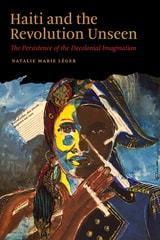
Haiti and the Revolution Unseen
The Persistence of the Decolonial ImaginationNatalie Marie Léger
Vanderbilt University Press, 2025
Léger writes against a Haiti- and Haitians-less idea of the Revolution. She asks scholars and artists of the Revolution to know Haitians as Ginens (African Haitians) and Haiti as Ayiti Ginen (Africa Haiti). This form of knowing demands a decolonial understanding of the Haitian Revolution and a reevaluation of its stories as told by influential twentieth-century Caribbean writers. The story she tells showcases the immense political impact of the African Haitian revolutionist’s philosophies of freedom in Saint Domingue and Haiti thereafter; and she argues that the absence of these philosophies in Caribbean classics of the Revolution demands consideration of why these classics continue to shape how the Revolution and Haiti are discussed in Caribbean Studies, Black Studies, Postcolonial Studies and Haitian Studies. More pressingly, Léger calls on artists and scholars of the Revolution to be mindful of how Haiti and Haitians are figured in narratives of the Revolution. The immense space Haiti holds in Caribbean imaginings of freedom and revolution makes mediating it, its Revolution, and peoples through a prejudiced gaze that serves the West hugely problematic, since a denigrated Haiti yields stunted visions of the Caribbean’s future. These conditions require attention to the pervasive presence of colonial paradigms for being in classic literatures of the Revolution and the way they undermine the generative manner Caribbean writers have used Haiti to think through their past, present, and future.

Hating Jazz
A History of Its Disparagement, Mockery, and Other Forms of AbuseAndrew S. Berish
University of Chicago Press, 2025
A rock guitarist plays four notes in front of one thousand people, while a jazz guitarist plays one thousand notes in front of four people. You might laugh or groan at this jazz joke, but what is it about jazz that makes people want to disparage it in the first place?
Andrew S. Berish’s Hating Jazz listens to the voices who have denounced, disparaged, and mocked the music. By focusing on the rejection of the music, Berish says, we see more holistically jazz’s complicated place in American cultural life. Jazz is a display of Black creativity and genius, an art form that is deeply embedded in African American life. Though the explicit racial tenor of jazz jokes has become muted over time, making fun of jazz, either in a lighthearted or aggressive way, is also an engagement with the place of Blackness in America. An individual’s taste in music may seem personal, but Berish’s analysis of jazz hatred demonstrates that musical preferences and trends are a social phenomenon. Criticism of jazz has become inextricable from the ways we understand race in America, past and present. In addition to this form of criticism, Berish also considers jazz hate as a form of taste discrimination and as a conflict over genre boundaries within different jazz cultures.
Both enlightening and original, Hating Jazz shows that our response to music can be a social act, unique to our historical moment and cultural context—we react to music in certain ways because of who we are, where we are, and when we are.

Having People, Having Heart
Charity, Sustainable Development, and Problems of Dependence in Central UgandaChina Scherz
University of Chicago Press, 2014
Through detailed studies of two different orphan support organizations in Uganda, Scherz shows how many Ugandans view material forms of Catholic charity as deeply intertwined with their own ethics of care and exchange. With a detailed examination of this overlooked relationship in hand, she reassesses the generally assumed paradox of material aid as both promising independence and preventing it. The result is a sophisticated demonstration of the powerful role that anthropological concepts of exchange, value, personhood, and religion play in the politics of international aid and development.

Health Equity in Brazil
Intersections of Gender, Race, and PolicyKia Lilly Caldwell
University of Illinois Press, 2017

Heartbreak and Other Geographies
Collected Writings of Katherine McKittrickKatherine McKittrick
University of Minnesota Press, 2026
A uniquely structured collection of essays from one of today’s most esteemed scholars of black studies
A thoughtfully curated selection of texts by preeminent black feminist scholar Katherine McKittrick, Heartbreak and Other Geographies showcases the remarkable depth of inquiry she has generated over twenty years. Edited by Brittany Meché and Camilla Hawthorne, this collection highlights McKittrick’s enduring commitment to ideas around radical placemaking and the creative articulations of and within the black diaspora.
McKittrick’s work is marked by a recurring engagement with anticolonialism, practices of liberation, and radical methodologies of black cultural production. Through discussions of figures such as Toni Morrison, Jimi Hendrix, Édouard Glissant, Paul Gilroy, Nina Simone, and Sylvia Wynter, the writing in Heartbreak and Other Geographies spans the author’s investigations into scientific method, liberal modernity, the cycles that perpetuate racial violence, and the poetics and sonics of black livingness.
Bringing together recent texts, influential pieces, and lesser-known essays, the unconventional format of Heartbreak and Other Geographies includes an introductory conversation with McKittrick as well as a series of creative interludes from the editors throughout the book. Innovative in both form and content, this wide-ranging volume invites us to rethink the boundaries between disciplines and the ways that scholarship can embody a more collaborative form of worldmaking.
Retail e-book files for this title are screen-reader friendly with images accompanied by short alt text and/or extended descriptions.
Heavyweight
Black Boxers and the Fight for RepresentationJordana Moore Saggese
Duke University Press, 2024

Here to Stay, Here to Fight
A Race Today AnthologyPaul Field
Pluto Press, 2019

Here to Stay, Here to Fight
A Race Today AnthologyPaul Field
Pluto Press, 2019
Horizon, Sea, Sound
Caribbean and African Women's Cultural Critiques of NationAndrea A. Davis
Northwestern University Press, 2022
In Horizon, Sea, Sound: Caribbean and African Women’s Cultural Critiques of Nation, Andrea Davis imagines new reciprocal relationships beyond the competitive forms of belonging suggested by the nation-state. The book employs the tropes of horizon, sea, and sound as a critique of nation-state discourses and formations, including multicultural citizenship, racial capitalism, settler colonialism, and the hierarchical nuclear family.
Drawing on Tina Campt’s discussion of Black feminist futurity, Davis offers the concept future now, which is both central to Black freedom and a joint social justice project that rejects existing structures of white supremacy. Calling for new affiliations of community among Black, Indigenous, and other racialized women, and offering new reflections on the relationship between the Caribbean and Canada, she articulates a diaspora poetics that privileges our shared humanity. In advancing these claims, Davis turns to the expressive cultures (novels, poetry, theater, and music) of Caribbean and African women artists in Canada, including work by Dionne Brand, M. NourbeSe Philip, Esi Edugyan, Ramabai Espinet, Nalo Hopkinson, Amai Kuda, and Djanet Sears. Davis considers the ways in which the diasporic characters these artists create redraw the boundaries of their horizons, invoke the fluid histories of the Caribbean Sea to overcome the brutalization of plantation histories, use sound to enter and reenter archives, and shapeshift to survive in the face of conquest. The book will interest readers of literary and cultural studies, critical race theories, and Black diasporic studies.

Hot Music, Ragmentation, and the Bluing of American Literature
Steven C. Tracy
University of Alabama Press, 2015
Exploring the deep and enduring relationship between music and literature, Hot Music, Ragmentation, and the Bluing of American Literature examines the diverse ways in which African American “hot” music influenced American culture—particularly literature—in early twentieth century America. Steven C. Tracy provides a history of the fusion of African and European elements that formed African American “hot” music, and considers how terms like ragtime, jazz, and blues developed their own particular meanings for American music and society. He draws from the fields of literature, literary criticism, cultural anthropology, American studies, and folklore to demonstrate how blues as a musical and poetic form has been a critical influence on American literature.
Hot Music, Ragmentation, and the Bluing of American Literature begins by highlighting instances in which American writers, including Herman Melville, Stephen Crane, and Gertrude Stein, use African American culture and music in their work, and then characterizes the social context of the Jazz Age, discussing how African American music reflected the wild abandon of the time. Tracy focuses on how a variety of schools of early twentieth century writers, from modernists to members of the Harlem Renaissance to dramatists and more, used their connections with “hot” music to give their own work meaning.
Tracy’s extensive and detailed understanding of how African American “hot” music operates has produced a fresh and original perspective on its influence on mainstream American literature and culture. An experienced blues musician himself, Tracy draws on his performance background to offer an added dimension to his analysis. Where another blues scholar might only analyze blues language, Tracy shows how the language is actually performed.
Hot Music, Ragmentation, and the Bluing of American Literature is the first book to offer such a refreshingly broad interdisciplinary vision of the influence of African American “hot” music on American literature. It is an essential addition to the library of serious scholars of American and African American literature and culture and blues aficionados alike.

Hustling Is Not Stealing
Stories of an African Bar GirlJohn M. Chernoff
University of Chicago Press, 2003
In Hustling Is Not Stealing and its follow-up, Exchange Is Not Robbery, a chronicle of exploitation is transformed by verbal art into an ebullient comedy. In Hustling Is Not Stealing, Hawa is a playful warrior struggling against circumstances in Ghana and Togo. In Exchange Is Not Robbery, Hawa returns to her native Burkina Faso, where she achieves greater control over her life but faces new difficulties. As a woman making sacrifices to live independently, Hawa sees her own situation become more complex as she confronts an atmosphere in Burkina Faso that is in some ways more challenging than the one she left behind, and the moral ambiguities of her life begin to intensify.
Combining elements of folklore and memoir, Hawa’s stories portray the diverse social landscape of West Africa. Individually the anecdotes can be funny, shocking, or poignant; assembled together they offer a sweeping critical and satirical vision.