Results by title
171 books match the query 'Books & Reading' and 5 start with h
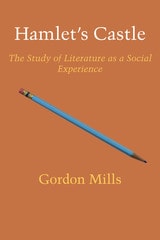
Hamlet's Castle
The Study of Literature as a Social ExperienceBy Gordon Mills
University of Texas Press, 1976
Hamlet's Castle is both a theoretical and a practical examination of the interactions that take place in a literary classroom. The book traces the source of literature's power to the relationship between its illusional quality and its abstract meaning and relates these elements to the process by which a group, typically an academic class, forms a judgment about a literary work. In focusing on the importance of the exchange of ideas by readers, Gordon Mills reveals a new way of looking at literature as well as a different concept of the social function of the literary classroom and the possible application of this model to other human activities.
The three fundamental elements that constitute Mills's schema are the relationship between a reader and the illusional quality of literature, the relationship between a reader and the meaning of a text, and the concept of social experience within the environment of a text. The roles of illusion and meaning in a text are explored in detail and are associated with areas outside literature, including science and jurisprudence. There is an examination of the way in which decisions are forced by peers upon one another during discussion of a literary work-an exchange of opinion which is commonly a source of pleasure and insight, sought for its own sake. In the course of his study, Mills shows that the act of apprehending a literary structure resembles that of apprehending a social structure. From this relationship, he derives the social function of the literary classroom.
In combining a theoretical analysis with the practical objective of determining what value can be found in the study of literature by groups of people, Mills has produced a critical study of great significance. Hamlet's Castle will change concepts about the purpose of teaching literature, affect the way in which literature is taught, and become involved in the continuing discussion of the relationship of literary studies to other disciplines.
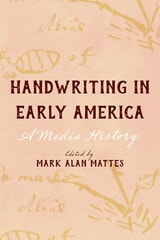
Handwriting in Early America
A Media HistoryEdited by Mark Alan Mattes, Foreword by Karen Sánchez-Eppler, Afterword by Christopher Hager
University of Massachusetts Press, 2023
As digital communication has become dominant, commentators have declared that handwriting is a thing of the past, a relic of an earlier age. This volume of original essays makes it clear that anxiety around handwriting has existed for centuries and explores writing practices from a variety of interdisciplinary fields, including manuscript studies, Native American studies, media history, African American studies, book history, bibliography, textual studies, and archive theory.
By examining how a culturally diverse set of people grappled with handwriting in their own time and weathered shifting relationships to it, Handwriting in Early America uncovers perspectives that are multiethnic and multiracial, transatlantic and hemispheric, colonial and Indigenous, multilingual and illiterate. Essays describe a future of handwriting as envisioned by practitioners, teachers, and even government officials of this time, revealing the tension between the anxiety of loss and the need to allow for variations going forward.
Contributors include James Berkey, Blake Bronson-Bartlett, John J. Garcia, Christopher Hager, Desirée Henderson, Frank Kelderman, Michelle Levy, Lisa Maruca, Christen Mucher, Alan Niles, Seth Perlow, Carla L. Peterson, Sarah Robbins, Patricia Jane Roylance, Karen Sánchez-Eppler, and Danielle Skeehan.

Haunted Man's Report
Reading Charles PortisRobert Cochran
University of Arkansas Press, 2024
Haunted Man’s Report, a deeply insightful literary exploration of Portis’s singular and underexamined oeuvre, celebrates this novelist’s great achievement and is certain to prove a valuable guide for readers new to Portis as well as aficionados.

Herman Melville
Modernity and the Material TextKatie McGettigan
University of New Hampshire Press, 2018
Combining archival research in print and publishing history with close reading, McGettigan situates Melville's works alongside advertising materials, magazine articles, trade manuals, and British and American commentary on the literary industry to demonstrate how Melville's literary practice relies on and aestheticizes the specific conditions of literary production in which he worked. For Melville, the book is a physical object produced by particular technological processes, as well as an entity that manifests social and economic values. His characters carry books, write on them, and even sleep on them; they also imagine, observe, and participate in the buying and selling of books. Melville employs the book's print, paper, and binding—and its market circulations—to construct literary figures, to shape textual form, and to create irony and ambiguity.
Exploring the printed book in Melville's writings brings neglected sections of his poetry and prose to the fore and invites new readings of familiar passages and images. These readings encourage a reassessment of Melville's career as shaped by his creative engagements with print, rather than his failures in the literary marketplace. McGettigan demonstrates that a sustained and deliberate imaginative dialogue with the material text is at the core of Melville's expressive practice and that, for Melville, the printed book served as a site for imagining the problems and possibilities of modernity.
Hardcover is un-jacketed.

Hot Books in the Cold War
The CIA-Funded Secret Western Book Distribution Program Behind the Iron CurtainAlfred A. Reisch
Central European University Press, 2013