Results by title
96 books match the query 'Buddhism' and 7 start with h
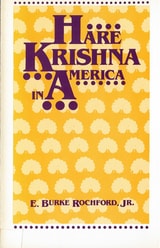
Hare Krishna In America
Rochford, E. Burke
Rutgers University Press, 1985

Hare Krishna
(Studies in Contemporary Religion)Federico Squarcini
Signature Books, 2004
When Bhaktivedanta arrived in America, it was a bold step because historically a guru who ventured outside of India was stripped of his Brahman status. However, the effort bore fruit—not the least of which was the type of intercultural understanding promoted by the current authors through their study of ISKCON’s place within the religion and culture of India.

Having Once Paused
Poems of Zen Master Ikkyu (1394-1481)Ikkyu Sojun
University of Michigan Press, 2015
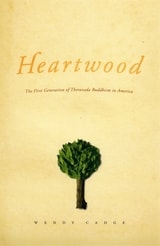
Heartwood
The First Generation of Theravada Buddhism in AmericaWendy Cadge
University of Chicago Press, 2004
Wendy Cadge first provides a historical overview of Theravada Buddhism and considers its specific origins here in the United States. She then brings her findings to bear on issues of personal identity, immigration, cultural assimilation, and the nature of religion in everyday life. Her work is the first systematic comparison of the ways in which immigrant and convert Buddhists understand, practice, and adapt the Buddhist tradition in America. The men and women whom Cadge meets and observes speak directly to us in this work, both in their personal testimonials and as they meditate, pray, and practice Buddhism.
Creative and insightful, Heartwood will be of enormous value to sociologists of religion and anyone wishing to understand the rise of Buddhism in the Western world.
History of Religious Ideas, Volume 2
From Gautama Buddha to the Triumph of ChristianityMircea Eliade
University of Chicago Press, 1982
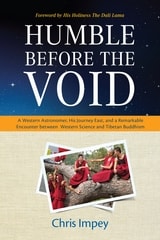
Humble before the Void
A Western Astronomer, his Journey East, and a Remarkable Encounter Between Western Science and Tibetan BuddhismChris Impey
Templeton Press, 2014
“This book will provide readers with a greater awareness of the spirit of curiosity and inquiry that lies at the heart of the Buddhist tradition, as well as the fruitfulness of maintaining active communication between the Buddhist and scientific communities.” —from the Foreword by His Holiness the Dalai Lama
In Humble before the Void, Impey, a noted astronomer, educator, and author gives us a thoroughly absorbing and engaging account of his journey to Northern India to teach in the first-ever “Science for Monks” leadership program. The program was initiated by His Holiness the Dalai Lama to introduce science into the Tibetan Buddhist monastic tradition.
In a vivid and compelling narrative, Impey introduces us to a group of exiled Tibetan monks whose charm, tenacity and unbridled enthusiasm for learning is infectious. Impey marvels not only at their enthusiasm, but at their tireless diligence that allows the monks to painstakingly build intricate sand mandalas—that can be swept away in an instant. He observes them as they meticulously count galaxies and notes how their enthusiasm and diligence stands in contrast to many American students who are frequently turned off by science’s inability to deliver easy, immediate payoffs. Because the Buddhist monks have had a limited science education, Impey must devise creative pedagogy. His new students immediately take to his inspired teaching methods, whether it’s the use of balloons to demonstrate the Hubble expansion or donning an Einstein mask to explain the theory of relativity.
Humble before the Void also recounts Impey’s experiences outside the classroom, from the monks’ eagerness to engage in pick-up basketball games and stream episodes of hip American sitcoms to the effects on his relationship with the teenage son who makes the trip with him. Moments of profound serenity and beauty in the Himalayas are contrasted with the sorrow of learning that other monks have set themselves on fire to protest the Chinese oppression in Tibet.
At the end of the three week program, both the monks and Impey have gained a valuable education. While the monks have a greater understanding and appreciation of science, Impey has acquired greater self- knowledge and a deeper understanding of the nature of learning and teaching in the East and West. This understanding leads to a renewed enthusiasm for making his topic come alive for others.
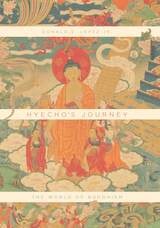
Hyecho's Journey
The World of BuddhismDonald S. Lopez Jr.
University of Chicago Press, 2017
With Hyecho’s Journey, eminent scholar of Buddhism Donald S. Lopez Jr. re-creates Hyecho’s trek. Using the surviving fragments of Hyecho’s travel memoir, along with numerous other textual and visual sources, Lopez imagines the thriving Buddhist world the monk explored. Along the way, Lopez introduces key elements of Buddhism, including its basic doctrines, monastic institutions, works of art, and the many stories that have inspired Buddhist pilgrimage. Through the eyes of one remarkable Korean monk, we discover a vibrant tradition flourishing across a vast stretch of Asia. Hyecho’s Journey is simultaneously a rediscovery of a forgotten pilgrim, an accessible primer on Buddhist history and doctrine, and a gripping, beautifully illustrated account of travel in a world long lost.