Results by title
101 books match the query 'Care' and 4 start with h
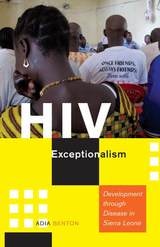
HIV Exceptionalism
Development through Disease in Sierra LeoneAdia Benton
University of Minnesota Press, 2015
WINNER, 2017 RACHEL CARSON PRIZE, SOCIETY FOR THE SOCIAL STUDIES OF SCIENCE
In 2002, Sierra Leone emerged from a decadelong civil war. Seeking international attention and development aid, its government faced a dilemma. Though devastated by conflict, Sierra Leone had a low prevalence of HIV. However, like most African countries, it stood to benefit from a large influx of foreign funds specifically targeted at HIV/AIDS prevention and care.
What Adia Benton chronicles in this ethnographically rich and often moving book is how one war-ravaged nation reoriented itself as a country suffering from HIV at the expense of other, more pressing health concerns. During her fieldwork in the capital, Freetown, a city of one million people, at least thirty NGOs administered internationally funded programs that included HIV/AIDS prevention and care. Benton probes why HIV exceptionalism—the idea that HIV is an exceptional disease requiring an exceptional response—continues to guide approaches to the epidemic worldwide and especially in Africa, even in low-prevalence settings.
In the fourth decade since the emergence of HIV/AIDS, many today are questioning whether the effort and money spent on this health crisis has in fact helped or exacerbated the problem. HIV Exceptionalism does this and more, asking, what are the unanticipated consequences that HIV/AIDS development programs engender?
Health and Health Care In Developing Countries
Sociological PerspectivesPeter Conrad
Temple University Press, 1993
In this seminal collection of articles on health care in the Third World, sociological perspectives are applied to medical issues in revealing ways. Fourteen essays (all but two of which are original to this volume) examine the social production of health, disease, and systems of care throughout the developing world. The volume covers a range of areas—central Africa, Nigeria, Singapore, Taiwan, Indonesia, Nepal, China, United Arab Emirates, Oman, and Mexico—and a broad scope of topics, from emergency care, the AIDS epidemic, and women's health care, to public health programs and national health care policies.
Contributors address the central question of whether health systems in developing areas should emphasize the role of clinical medicine and individual physicians or community and preventive medical resources. The major health problems faced by these societies—inadequate sanitation, infectious disease, high infant-child mortality, and a lack of family planning—indicate the greater need for health educators and public health workers despite many poor nations' desire for Western doctors. Other topics that are examined include the process of seeking medical aid; the relationship between traditional and modern medicines; medical education, hospital care, and communication between doctors and patients in developing countries; and the relevance and application of sociology in Third World settings.
This volume seeks to draw attention to the significance of medical sociology for understanding Third World health problems and to show how examining developing societies may necessitate reframing or modifying some Western sociological notions. In addition, these essays stretch the boundaries of medical sociology to include Third World issues.

Hierarchies of Care
Girls, Motherhood, and Inequality in PeruKrista E. Van Vleet
University of Illinois Press, 2019

Human Rights and the Care of the Self
Alexandre Lefebvre
Duke University Press, 2018