Results by title
59 books match the query 'Caribbean' and 3 start with h
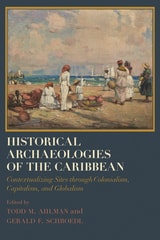
Historical Archaeologies of the Caribbean
Contextualizing Sites through Colonialism, Capitalism, and Globalismedited by Todd M. Ahlman and Gerald F. Schroedl
University of Alabama Press, 2019
Historical Archaeologies of the Caribbean: Contextualizing Sites through Colonialism, Capitalism, and Globalism addresses issues in Caribbean history and historical archaeology such as freedom, frontiers, urbanism, postemancipation life, trade, plantation life, and new heritage. This collection moves beyond plantation archaeology by expanding the knowledge of the diverse Caribbean experiences from the late seventeenth through the mid-nineteenth centuries.
The essays in this volume are grounded in strong research programs and data analysis that incorporate humanistic narratives in their discussions of Amerindian, freedmen, plantation, institutional, military, and urban sites. Sites include a sample of the many different types found across the Caribbean from a variety of colonial contexts that are seldom reported in archaeological research, yet constitute components essential to understanding the full range and depth of Caribbean history.
Contributors examine urban contexts in Nevis and St. John and explore the economic connections between Europeans and enslaved Africans in urban and plantation settings in St. Eustatius. The volume contains a pioneering study of frontier exchange with Amerindians in Dominica and a synthesis of ceramic exchange networks among enslaved Africans in the Leeward Islands. Chapters on military forts in Nevis and St. Kitts call attention to this often-neglected aspect of the Caribbean colonial landscape. Contributors also directly address culture heritage issues relating to community participation and interpretation. On St. Kitts, the legacy of forced confinement of lepers ties into debates of current public health policy. Plantation site studies from Antigua and Martinique are especially relevant because they detail comparisons of French and British patterns of African enslavement and provide insights into how each addressed the social and economic changes that occurred with emancipation.
Contributors
Todd M. Ahlman / Douglas V. Armstrong / Samantha Rebovich Bardoe / Paul Farnsworth / Jeffrey R. Ferguson / R. Grant Gilmore III / Diana González-Tennant / Edward González-Tennant / Barbara J. Heath / Carter L. Hudgins Kenneth G. Kelly / Eric Klingelhofer / Roger H. Leech / Stephan Lenik / Gerald F. Schroedl / Diane Wallman / Christian Williamson
Horizon, Sea, Sound
Caribbean and African Women's Cultural Critiques of NationAndrea A. Davis
Northwestern University Press, 2022
In Horizon, Sea, Sound: Caribbean and African Women’s Cultural Critiques of Nation, Andrea Davis imagines new reciprocal relationships beyond the competitive forms of belonging suggested by the nation-state. The book employs the tropes of horizon, sea, and sound as a critique of nation-state discourses and formations, including multicultural citizenship, racial capitalism, settler colonialism, and the hierarchical nuclear family.
Drawing on Tina Campt’s discussion of Black feminist futurity, Davis offers the concept future now, which is both central to Black freedom and a joint social justice project that rejects existing structures of white supremacy. Calling for new affiliations of community among Black, Indigenous, and other racialized women, and offering new reflections on the relationship between the Caribbean and Canada, she articulates a diaspora poetics that privileges our shared humanity. In advancing these claims, Davis turns to the expressive cultures (novels, poetry, theater, and music) of Caribbean and African women artists in Canada, including work by Dionne Brand, M. NourbeSe Philip, Esi Edugyan, Ramabai Espinet, Nalo Hopkinson, Amai Kuda, and Djanet Sears. Davis considers the ways in which the diasporic characters these artists create redraw the boundaries of their horizons, invoke the fluid histories of the Caribbean Sea to overcome the brutalization of plantation histories, use sound to enter and reenter archives, and shapeshift to survive in the face of conquest. The book will interest readers of literary and cultural studies, critical race theories, and Black diasporic studies.
Horizontal Comparison
Africa, the Caribbean, and the Making of Black World LiteratureCajetan Iheka
University of Chicago Press, 2026
By analyzing African and Caribbean texts on their own terms, Horizontal Comparison articulates new forms of transoceanic solidarity.
The fields of comparative literature and Black Atlantic studies have an Africa problem: despite sustained attempts to decenter Western paradigms, they still privilege the United States and Europe as the primary loci of reference. So argues Cajetan Iheka in Horizontal Comparison, which aims to redirect both fields toward a non-hierarchical, South-South orientation focusing on the links between Africa and the Caribbean.
By analyzing the literary work and real-life trajectories of writers such as Peter Abrahams, Chimamanda Adichie, Maryse Condé, Buchi Emecheta, Jamaica Kincaid, Claude McKay, Dinaw Mengestu, Ferdinand Oyono, Taiye Selasi, and Sam Selvon, Iheka draws our attention to the ways in which African and Caribbean texts inform and mutually constitute each other, bypassing the usual comparisons to Western literary canons. The book challenges not only Western cultural hegemony in the study of global Black writing but also the very methodologies of comparative literary studies, offering fresh insights into reading, trauma, character, and the “worlding” of literature.