Results by title
335 books match the query 'Caribbean & Latin American Studies' and 8 start with h
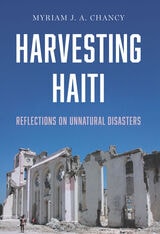
Harvesting Haiti
Reflections on Unnatural DisastersMyriam J.A. Chancy
University of Texas Press, 2023
2024 Isis Duarte Book Prize, Haiti/ Dominican Republic Section, Latin American Studies Association
2024 Longlist, OCM Bocas Prize for Caribbean Literature, Bocas Lit Fest
This collection ponders the personal and political implications for Haitians at home and abroad resulting from the devastating 2010 earthquake.
The 7.0 magnitude earthquake that struck Haiti in January 2010 was a debilitating event that followed decades of political, social, and financial issues. Leaving over 250,000 people dead, 300,000 injured, and 1.5 million people homeless, the earthquake has had lasting repercussions on a struggling nation. As the post-earthquake political situation unfolded, Myriam Chancy worked to illuminate on-the-ground concerns, from the vulnerable position of Haitian women to the failures of international aid. Originally presented at invited campus talks, published as columns for a newspaper in Trinidad and Tobago, and circulated in other ways, her essays and creative responses preserve the reactions and urgencies of the years following the disaster.
In Harvesting Haiti, Chancy examines the structures that have resulted in Haiti's post-earthquake conditions and reflects at key points after the earthquake on its effects on vulnerable communities. Her essays make clear the importance of sustaining and supporting the dignity of Haitian lives and of creating a better, contextualized understanding of the issues that mark Haitians’ historical and present realities, from gender parity to the vexed relationship between Haiti and the Dominican Republic.
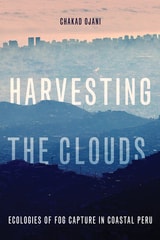
Harvesting the Clouds
Ecologies of Fog Capture in Coastal PeruChakad Ojani
University of Arizona Press, 2027
Vision limited, sounds muffled. Tiny water droplets reflect light back to its source and make it difficult to locate the origin of sounds: this is fog. In Chakad Ojani’s ethnography, this atmospheric phenomenon plays a pivotal role.
Drawing on long-term ethnographic research on engagements with fog in Lima and coastal Peru, Harvesting the Clouds examines how local NGO workers and fog oasis conservationists sought to utilize coastal fog as a water source. NGO workers installed fog catchers in informal or recently formalized neighborhoods where state infrastructure was absent, while conservationists harnessed ground-touching clouds in order to prevent informal urbanization. As they set out to capture ground-touching clouds to pursue their distinct goals, these collectives became entrapped by activities, demands, and expectations that they had not foreseen. The book frames these relationships as ecologies of capture: emergent webs of relationships held together by conflicting aims and expectations, the possibilities and limitations of fog capture, and the material qualities of fog itself.
Harvesting the Clouds argues that capture is always only partially successful, but by virtue of this partiality, it becomes productive of social relations—an understanding that the author extends to anthropological inquiry itself as an exercise in the productive impossibility of ethnographic entrapment.

Hemispheric Blackface
Impersonation and Nationalist Fictions in the AmericasDanielle Roper
Duke University Press, 2025

Hiding in Plain Sight
Black Women, the Law, and the Making of a White Argentine RepublicErika Denise Edwards
University of Alabama Press, 2020
WINNER OF THE ASSOCIATION OF BLACK WOMEN HISTORIANS 2020 LETITIA WOODS-BROWN AWARD FOR THE BEST BOOK IN AFRICAN AMERICAN WOMEN'S HISTORY
WINNER OF THE WESTERN ASSOCIATION OF WOMEN HISTORIAN'S BARBARA “PENNY” KANNER AWARD
2021 FINALIST FOR THE HARRIET TUBMAN BOOK PRIZE
2020 FINALIST BERSHIRE CONFERENCE OF WOMEN HISTORIANS BOOK PRIZE
Uncovering the Afro-Argentine women behind the myth of a white nation.
Argentina promotes itself as a country of European immigrants. This makes it an exception to other Latin American countries, which embrace a more mixed—African, Indian, European—heritage. Hiding in Plain Sight: Black Women, the Law, and the Making of a White Argentine Republic traces the origins of what some white Argentines mischaracterize as a “black disappearance” by delving into the intimate lives of black women and explaining how they contributed to the making of a “white” Argentina. Erika Denise Edwards has produced the first comprehensive study in English of the history of African descendants outside of Buenos Aires in the late colonial and early republican periods, with a focus on how these women sought whiteness to better their lives and that of their children.
Edwards argues that attempts by black women to escape the stigma of blackness by recategorizing themselves and their descendants as white began as early as the late eighteenth century, challenging scholars who assert that the black population drastically declined at the end of the nineteenth century because of the whitening or modernization process. She further contends that in Córdoba, Argentina, women of African descent (such as wives, mothers, daughters, and concubines) were instrumental in shaping their own racial reclassifications and destinies.
This volume makes use of a wealth of sources to relate these women’s choices. The sources consulted include city censuses and notarial and probate records that deal with free and enslaved African descendants; criminal, ecclesiastical, and civil court cases; marriages and baptisms records and newsletters. These varied sources provide information about the day-to-day activities of cordobés society and how women of African descent lived, formed relationships, thrived, and partook in the transformation of racial identities in Argentina.
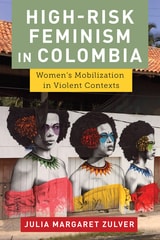
High-Risk Feminism in Colombia
Women's Mobilization in Violent ContextsJulia Margaret Zulver
Rutgers University Press, 2022
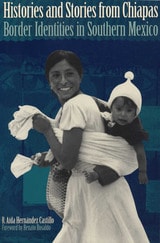
Histories and Stories from Chiapas
Border Identities in Southern MexicoBy R. Aída Hernández Castillo
University of Texas Press, 2001
The 1994 Zapatista uprising of Chiapas' Maya peoples against the Mexican government shattered the state myth that indigenous groups have been successfully assimilated into the nation. In this wide-ranging study of identity formation in Chiapas, Aída Hernández delves into the experience of a Maya group, the Mam, to analyze how Chiapas' indigenous peoples have in fact rejected, accepted, or negotiated the official discourse on "being Mexican" and participating in the construction of a Mexican national identity.
Hernández traces the complex relations between the Mam and the national government from 1934 to the Zapatista rebellion. She investigates the many policies and modernization projects through which the state has attempted to impose a Mexican identity on the Mam and shows how this Maya group has resisted or accommodated these efforts. In particular, she explores how changing religious affiliation, women's and ecological movements, economic globalization, state policies, and the Zapatista movement have all given rise to various ways of "being Mam" and considers what these indigenous identities may mean for the future of the Mexican nation. The Spanish version of this book won the 1997 Fray Bernardino de Sahagún national prize for the best social anthropology research in Mexico.
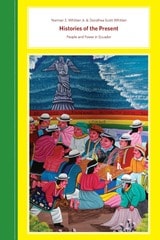
Histories of the Present
People and Power in EcuadorNorman E. Whitten Jr. and Dorothea Scott Whitten
University of Illinois Press, 2011
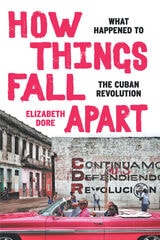
How Things Fall Apart
What Happened to the Cuban RevolutionElizabeth Dore
Duke University Press, 2023