475 books match the query 'Catholic' and 10 start with h
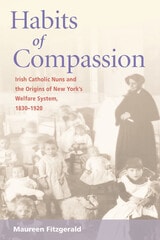
cover of Habits of Compassion: Irish Catholic Nuns and the Origins of New York's Welfare System, 1830-1920

Habits of Compassion

Irish Catholic Nuns and the Origins of New York's Welfare System, 1830-1920

Maureen Fitzgerald

University of Illinois Press, 2006

The Irish-Catholic Sisters accomplished tremendously successful work in founding charitable organizations in New York City from the Irish famine through the early twentieth century. Maureen Fitzgerald argues that their championing of the rights of the poor—especially poor women—resulted in an explosion of state-supported services and programs. 

Parting from Protestant belief in meager and means-tested aid, Irish Catholic nuns argued for an approach based on compassion for the poor. Fitzgerald positions the nuns' activism as resistance to Protestantism's cultural hegemony. As she shows, Roman Catholic nuns offered strong and unequivocal moral leadership in condemning those who punished the poor for their poverty and unmarried women for sexual transgression. Fitzgerald also delves into the nuns' own communities, from the class-based hierarchies within the convents to the political power they wielded within the city. That power, amplified by an alliance with the local Irish Catholic political machine, allowed the women to expand public charities in the city on an unprecedented scale.
[more]
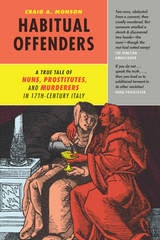
cover of Habitual Offenders: A True Tale of Nuns, Prostitutes, and Murderers in Seventeenth-Century Italy

Habitual Offenders

A True Tale of Nuns, Prostitutes, and Murderers in Seventeenth-Century Italy

Craig A. Monson

University of Chicago Press, 2016

In April 1644, two nuns fled Bologna’s convent for reformed prostitutes. A perfunctory archiepiscopal investigation went nowhere, and the nuns were quickly forgotten. By June of the next year, however, an overwhelming stench drew a woman to the wine cellar of her Bolognese townhouse, reopened after a two-year absence—where to her horror she discovered the eerily intact, garroted corpses of the two missing women.
           
Drawing on over four thousand pages of primary sources, the intrepid Craig A. Monson reconstructs this fascinating history of crime and punishment in seventeenth-century Italy. Along the way, he explores Italy’s back streets and back stairs, giving us access to voices we rarely encounter in conventional histories: prostitutes and maidservants, mercenaries and bandits, along with other “dubious” figures negotiating the boundaries of polite society. Painstakingly researched and breathlessly told, Habitual Offenders will delight historians and true-crime fans alike.
[more]
cover of Handbook of Catholic Social Teaching: A Guide for Christians in the World Today

Handbook of Catholic Social Teaching

A Guide for Christians in the World Today

Martin Schlag

Catholic University of America Press, 2017
Handbook of Catholic Social Teaching employs a question and answer format, to better accentuate the response of the Church's message to the questions Catholics have about their social role and what the Church intends to teach about it. Written in consultation with the Pontifical Council for Justice and Peace, the Handbook should take its place alongside the Catechism of the Social Doctrine of the Church on the shelf of informed Catholics as works that can inform what we believe and do in the public sphere.
[more]
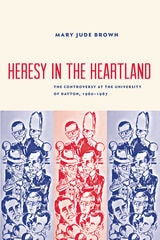
cover of Heresy in the Heartland: The Controversy at The University of Dayton, 1960-67

Heresy in the Heartland

The Controversy at The University of Dayton, 1960-67

Mary Jude Brown

Catholic University of America Press, 2022
Heresy in the Heartland is a narrative case study of the 'Heresy' Affair at the University of Dayton, a series of events predominantly in the philosophy department that occurred when tensions between the Thomists and proponents of new philosophies reached crisis stage in fall 1966. The controversy culminated in a letter written by a lay assistant professor to the Cincinnati archbishop, Karl J. Alter. In the letter, the professor cited a number of instances where “erroneous teachings” were “endorsed” or “openly advocated” by four lay faculty members. Concerned about the pastoral impact on the University of Dayton community, the professor asked the archbishop to conduct an investigation. How the University weathered this controversy, the second of three major controversies to hit Catholic higher education within three years (St. John’s University, University of Dayton and the Curran affair at Catholic University of America), is of interest to faculty and administrators in Catholic higher education who continue to struggle with defining what it means to be a “Catholic” university, with the relationship of Catholic universities to the Church at large and the hierarchy in particular, and with Church teachings that conflict with the culture we live in such as immigration, the environment and sexual ethics. The story is told in chronological order by the participants in the controversy - faculty, administrators, students and clergy - using the words of those involved. Heresy in the Heartland concludes with a synopsis of what happened at the University of Dayton and draws some lessons for the future of Catholic higher education.
[more]
cover of History's Erratics: Irish Catholic Dissidents and the Transformation of American Capitalism, 1870-1930

History's Erratics

Irish Catholic Dissidents and the Transformation of American Capitalism, 1870-1930

David M. Emmons

University of Illinois Press, 2024

As Ice Age glaciers left behind erratics, so the external forces of history tumbled the Irish into America. Existing both out of time and out of space, a diverse range of these Roman-Catholic immigrants saw their new country in a much different way than did the Protestants who settled and claimed it. These erratics chose backward looking tradition and independence over assimilation and embraced a quintessentially Irish form of subversiveness that arose from their culture, faith, and working-class outlook. David M. Emmons draws on decades of research and thought to plumb the mismatch of values between Protestant Americans hostile to Roman Catholicism and the Catholic Irish strangers among them. Joining ethnicity and faith to social class, Emmons explores the unique form of dissidence that arose when Catholic Irish workers and their sympathizers rejected the beliefs and symbols of American capitalism.

A vibrant and original tour de force, History’s Erratics explores the ancestral roots of Irish nonconformity and defiance in America.
[more]
cover of Hockey Priest: Father David Bauer and the Spirit of the Canadian Game

Hockey Priest

Father David Bauer and the Spirit of the Canadian Game

Matt Hoven

Catholic University of America Press, 2024
Born in Waterloo, Ontario, in 1924, to a prominent family, David Bauer attended St. Michael’s College-School run by the Basilian Fathers of Toronto. After serving in World War II, Bauer joined the religious community and coached its St. Michael’s Majors to a national championship in 1961. Influenced by philosophers like Jacques Maritain, Bauer tried to find solutions to problems created within elite hockey and thus founded Canada’s first ever National Team program. This team countered the cutthroat ideals of hockey’s powerbrokers and set out to return Canada to international glory. The team represented the nation at several global tournaments and three Winter Olympic Games. Bauer was posthumously inducted into the Hockey Hall of Fame in 1989. Hockey Priest looks past simply understanding Bauer as a do-gooder or hockey innovator. It shows how he attempted to create a different stream of hockey that could better support youth and so build up the nation. Archival research for the book uncovered Bauer-written hockey reports, speeches, and notes that detail his thinking about the game and his politicking to bring about change in it. Interviews with dozens of associates and family members told the story of his bold efforts to take on the National Hockey League. Despite his work being undermined by some supporters of the corporate game, Bauer offered a vision for Canada’s sport that remains an important counterpoint in the sport’s history and its ongoing challenges.
[more]
cover of Holiness through Work: Commemorating the Encyclical Laborem Exercens

Holiness through Work

Commemorating the Encyclical Laborem Exercens

Martin Schlag

St. Augustine's Press, 2022

To mark the 40th anniversary of John Paul II's encyclical on human work, published in 1981, a group of globally-recognized scholars presents the critical aspects of this document and its purpose. These original essays revisit John Paul II's approach to work in post-modern society and reconnect the dignity of the working person to a pursuit of holiness. These authors convey that only when it is truly Christian can humanism accomplish the lofty ideals it indicates.
This book is a timely contribution to the field of scholarship that focuses on Catholic Social Thought and is ideally suited for graduate studies and the reader interested in more serious questions in Christian theology. 

Giulio Maspero, "The Bible and the Fathers of the Church on Work"
Patricia Ranft, "Work Theology in the High Middle Ages"
Angela Franks, "John Paul II's Metaphysics of Labor"
Deborah Savage, "Confronting a Technocratic Future: Women's Work and the Church's Social Vision"
Martin Schlag, "Contemplation at Work: A Theological Conversation Between John Paul II and Josemaría Escrivá"
Richard Turnbull, "Laborem Exercens: A Protestant Appreciation"
Michael Naughton, "Good Work: Insights from the Subjective Dimension of Work"
Christopher Michaelson, "Subjects and Objects in Meaningful Work"
Javier Ignacio Pinto Garay and Alvaro Pezoa Bissieres, "The Worker and the Transistor: The Dignity of Work and Business Ethics in Global Corporate Practices"
Gonzalo Flores-Castro Lingán, "The Real Work: Making the Encyclical Laborem Exercens Operational"
Geoffrey C. Friesen, "Laborem Exercens and the Subjective Dimension of Work in Economics and Finance" 
[more]
cover of Homilies on Psalms, 36-38

Homilies on Psalms, 36-38

Michael Origen

Catholic University of America Press, 2023
This volume provides the first English translation of the nine extant homilies on Psalms 36[37]–38[39] preached by Origen (d. 253/4) to his congregation at Caesarea as arranged and translated for Latin readers by his admirer, Rufinus of Aquileia (d. 411). These homilies are among the earliest extant examples of patristic preaching on the Psalter. The interpretation offered throughout these homilies, which is almost wholly moral, reflects Origen’s understanding of the “soul” of the scriptural text. These homilies provide a glimpse of Origen’s account of scriptural meaning, outlined in De principiis 4, in pastoral practice. In his preaching, Origen offers a vision of the Christian life as centered on the soul’s continuing conversion, growth, and progress, with particular reference to and within the context of the Church. The life of the believer is one of combat and struggle with powers opposed to Christ. It is Christ, as the divine Physician, who offers healing to the one who is wounded and ailing from sin, and it is Christ, as Wisdom and Word of God, who instructs and educates the believer in the life of the Spirit. These homilies reveal the substantial coherence of Origen’s thought, as expressed in the more speculative De principiis and as revealed in the more elaborate, nuptial theology found in his Commentary on the Canticle. This volume includes a robust introduction and complements the work of Joseph Trigg, whose translation from the original Greek of the cache of homilies discovered in Codex Monacensis 314 has recently appeared in this series.
[more]
cover of Homilies on the Psalms: Codex Monacensis Graecus 314

Homilies on the Psalms

Codex Monacensis Graecus 314

Joseph W. Origen

Catholic University of America Press, 2021
In 2012 Dr. Marina Marin Pradel, an archivist at the Bayerische Stattsbibliotek in Munich, discovered that a thick 12th-century Byzantine manuscript, Codex Monacensis Graecus 314, contained twenty-nine of Origen’s Homilies on the Psalms, hitherto considered lost. Lorenzo Perrone of the University of Bologna, an internationally respected scholar of Origen, vouched for the identification and immediately began work on the scholarly edition that appeared in 2015 as the thirteenth volume of Origen’s works in the distinguished Griechische Christlichen Schrifsteller series. In an introductory essay Perrone provided proof that the homilies are genuine and demonstrated that they are, astonishingly, his last known work. Live transcripts, these collection homilies constitute our largest collection of actual Christian preaching from the pre-Constantinian period. In these homilies, the final expression of his mature thought, Origen displays, more fully than elsewhere, his understanding of the church and of deification as the goal of Christian life. They also give precious insights into his understanding of the incarnation and of human nature. They are the earliest example of early Christian interpretation of the Psalms, works at the heart of Christian spirituality. Historians of biblical interpretation will find in them the largest body of Old Testament interpretation surviving in his own words, not filtered through ancient translations into Latin that often failed to convey his intense philological acumen. Among other things, they give us new insights into the life of a third-century Greco-Roman metropolis, into Christian/Jewish relations, and into Christian worship. This translation, using the GCS as its basis, seeks to convey, as faithfully as possible, Origen’s own categories of thought. An introduction and notes relate the homilies to the theology and principles of interpretation in Origen’s larger work and to that work’s intellectual context and legacy.
[more]
cover of Humanae Vitae, 50 Years Later: Embracing God's Vision for Marriage, Love, and Life; A Compendium

Humanae Vitae, 50 Years Later

Embracing God's Vision for Marriage, Love, and Life; A Compendium

Preface by Most. Rev. Charles J. Chaput, OFM, Cap.

Catholic University of America Press, 2019

In the life of the Catholic Church, the papal encyclical Humanae vitae represents a deepening of understanding regarding the nature of married love and the transmission of life. Despite fifty years (1968-2018) since it’s promulgation, many Catholics have yet to discover the treasure of these rich teachings. This volume therefore seeks to elucidate the encyclical’s reaffirmation of the divine plan. It does this in a unique way by providing essays from experts of various disciplines that include history, theology, science, medicine, law, and governmental policy. The occasion of the fiftieth anniversary of Humanae vitae offers a teaching moment. In this compendium, experts representing a variety of disciplines including history, culture, theology, medicine, law, and psychology present their reflections upon God’s divine plan as described in Humanae vitae. The authors first presented this work in an abbreviated form at a symposium held at The Catholic University of America (April 4-6, 2018). Here, their presentations are substantively developed and hopefully will encourage further scholarly work. Ultimately, their purpose is to help the reader arrive at a more positive understanding of the teachings found in Humanae vitae. Although designed for the educated reader, the essays presume that when the teachings of Humanae vitae are embraced by men and women, they can contribute to the healing of the wounds of a world broken by sin but redeemed by Christ.
[more]