Results by title
50 books match the query 'Catholics' and 3 start with h

Heavenly Supper
The Story of Maria JanisFulvio Tomizza
University of Chicago Press, 1991
So begins Fulvio Tomizza's absorbing account of the true story of Maria Janis, a devout peasant woman from the mountains north of Bergamo. Too poor to enter a convent, Maria had set out to serve God by relinquishing the little she had, through renunciation of all food but the bread and wine of communion. Encouraged by the restless village priest Pietro Morali, Maria claimed to have existed in this sanctified state for five years. During this time, she, Morali, and the weaver Pietro Palazzi travel from a little village in the Alps to Rome and then to Venice, where their alleged sacrilege is discovered and they are brought to trial. Both revered as a saint and reviled as a fraud, Maria with her "privilege" inspires and threatens believers within the Church. Combining the historian's precision with the novelist's imagination, Tomizza painstakingly reconstructs her story, crafting a fascinating portrait of sublimated love, ambition, and jealousy.
Heavenly Supper alternates a chronological account of the trial with analyses of each protagonist's life history. Along the way, Tomizza gives voice to the minds and hearts of his characters, allowing them to speak for themselves in their own words. The world he recreates resonates with the fervor of the Counter Reformation when faith and its consequences were rigidly controlled by the Church. As suspenseful as a detective novel, Tomizza's story goes beyond the trial to evoke a panoramic view of seventeenth-century Italian culture.
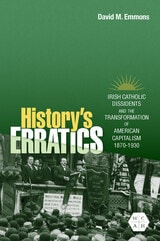
History's Erratics
Irish Catholic Dissidents and the Transformation of American Capitalism, 1870-1930David M. Emmons
University of Illinois Press, 2024
As Ice Age glaciers left behind erratics, so the external forces of history tumbled the Irish into America. Existing both out of time and out of space, a diverse range of these Roman-Catholic immigrants saw their new country in a much different way than did the Protestants who settled and claimed it. These erratics chose backward looking tradition and independence over assimilation and embraced a quintessentially Irish form of subversiveness that arose from their culture, faith, and working-class outlook. David M. Emmons draws on decades of research and thought to plumb the mismatch of values between Protestant Americans hostile to Roman Catholicism and the Catholic Irish strangers among them. Joining ethnicity and faith to social class, Emmons explores the unique form of dissidence that arose when Catholic Irish workers and their sympathizers rejected the beliefs and symbols of American capitalism.
A vibrant and original tour de force, History’s Erratics explores the ancestral roots of Irish nonconformity and defiance in America.
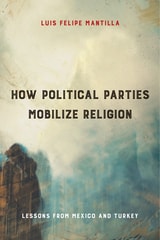
How Political Parties Mobilize Religion
Lessons from Mexico and TurkeyLuis Felipe Mantilla
Temple University Press, 2021
Political mobilization tends to take different forms in contemporary Catholic- and Sunni-majority countries. Luis Felipe Mantilla attributes this dynamic to changes taking place in religious communities and the political institutions that govern religious political engagement.
In How Political Parties Mobilize Religion, Mantillaevenhandedly traces the emergence and success of religious parties in Mexico and Turkey, two countries shaped by assertive secular regimes. In doing so, he demonstrates that religious parties are highly responsive to political institutions, such as electoral laws, as well as to the structure of broader religious communities.
Whereas in both countries, the electoral success of religious mobilizers was initially a boon for democracy, in Mexico it was marred by political mismanagement and became entangled with persistent corruption and escalating violence. In Turkey, the democratic credentials of religious mobilizers were profoundly eroded as the government became increasingly autocratic, concentrating power in very few hands and rolling back basic liberal rights.
Mantilla investigates the role religious mobilization plays in the evolution of electoral politics and democratic institutions, and to what extent their trajectories reflect broader trends in political Catholicism and Islam.