Results by title
152 books match the query 'Childhood and youth' and 6 start with h
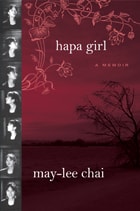
Hapa Girl
A MemoirMay-lee Chai
Temple University Press, 2008
In the mid-1960s, Winberg Chai, a young academic and the son of Chinese immigrants, married an Irish-American artist. In Hapa Girl ("hapa" is Hawaiian for "mixed") their daughter tells the story of this loving family as they moved from Southern California to New York to a South Dakota farm by the 1980s. In their new Midwestern home, the family finds itself the object of unwelcome attention, which swiftly escalates to violence. The Chais are suddenly socially isolated and barely able to cope with the tension that arises from daily incidents of racial animosity, including random acts of cruelty.
May-lee Chai's memoir ends in China, where she arrives just in time to witness a riot and demonstrations. Here she realizes that the rural Americans' "fears of change, of economic uncertainty, of racial anxiety, of the unknowable future compared to the known past were the same as China's. And I realized finally that it had not been my fault."
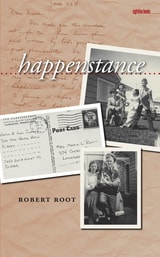
Happenstance
Robert Root
University of Iowa Press, 2013
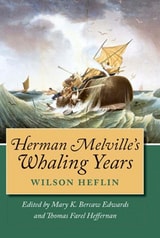
Herman Melville's Whaling Years
Wilson Heflin
Vanderbilt University Press, 2004
During his time in the Pacific, Melville served on three whaling ships, as well as on a U.S. Navy man-of-war. As a deserter from one whaleship, he spent four weeks among the cannibals of Nukahiva in the Marquesas, seeing those islands in a relatively untouched state before they were irrevocably changed by French annexation in 1842. Rebelling against duty on another ship, he was held as a prisoner in a native calaboose in Tahiti. He prowled South American ports while on liberty, hunted giant tortoises in the Galapagos Islands, and explored the islands of Eimeo (Moorea) and Maui. He also saw the Society and Sandwich (Hawaiian) Islands when the Western missionary presence was at its height.
Heflin combed the logbooks of any ship at sea at the time of Melville's voyages and examined nineteenth-century newspaper items, especially the marine intelligence columns, for mention of Melville's vessels. He also studied British consular records pertaining to the mutiny aboard the Australian whaler Lucy Ann, an insurrection in which Melville participated and which inspired his second novel, Omoo.
Distilling the life's work of a leading Melville expert into book form for the first time, this scrupulously edited volume is the most in-depth account ever published of Melville's years on whaleships and how those singular experiences influenced his writing.
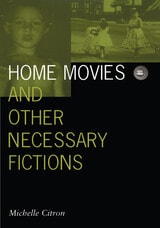
Home Movies and Other Necessary Fictions
Michelle Citron
University of Minnesota Press, 1998

Home Stand
Growing Up in SportsJames McKean
Michigan State University Press, 2005
If he had not fouled out, maybe Washington State University’s center, James McKean, might have held Lew Alcindor (now Kareem Abdul-Jabbar) to only forty points. It was 1967, a transition year for college athletics in a dramatic time for those coming ofage. In this memoir set in the 1950s and 1960s, McKean revisits his years growing up in a family dedicated to sports and the outdoors, his playing basketball at Washington State University (for coaches Marv Harshman and Jud Heathcote), and his fashioning a life during and after basketball.
Driven by the energy and spirit of athletics, the language in Home Stand lights up McKean’s wonderfully eclectic work—the aunt who won a bronze medal in the 1936 Olympics in Berlin, his last run as a misguided drag racer, his playing basketball for a washing machine factory in Bologna, Italy, or against the prisoners in Walla Walla State Penitentiary—all seen in the context of turbulent times. Needless to say, Lew Alcindor scored his points and UCLA won, which they did every game that season. What James McKean took home was five fouls and a good story.
Home Stand delivers a lyrical, thoughtful reflection of what it is to be an athlete—inside as well as outside the game—and how one man’s love of basketball evolved into a love of poetry, "good turns of speech," writing, and teaching.
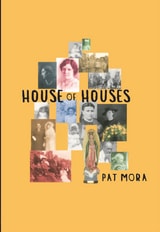
House of Houses
Pat Mora
University of Arizona Press, 1997