Results by title
662 books match the query 'China' and 14 start with h
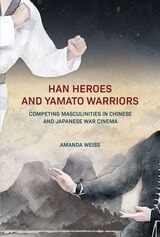
Han Heroes and Yamato Warriors
Competing Masculinities in Chinese and Japanese War CinemaAmanda Weiss
Hong Kong University Press, 2023
Taking the “tidal wave” of memory in the late twentieth and early twenty-first century as its starting point, this monograph explores the collective memory of World War II in East Asia (1937–1945) through film. Weiss argues that Chinese, Japanese, and American remembrance of World War II is intertwined in what she terms a “memory loop,” the transnational mediation and remediation of war narratives. Gender is central to this process, as the changing representation of male soldiers, political leaders, and patriarchal father figures within these narratives reveals Japanese and Chinese challenges to each other and to the perceived “foundational” American narrative of the war. This process continues to intensify due to the globally visible nature of the memory loop, which drives this cycle of transmission, translation, and reassessment.
This volume is the first to bring together a collection of Chinese and Japanese war films that have received little attention in English-language literature. It also produces new readings of popular war memory in East Asia by revealing the gendered dimensions of collective remembrance in these films.
Harbin and Manchuria
Place, Space, and Identity, Volume 99Thomas Lahusen, ed.
Duke University Press, 0
Crossing the boundaries of their specializations, contributors respond to the complexity of this history while considering the concrete concept of place and its relation to the more abstract idea of space. A rare encounter between scholars of East Asian and Slavic studies, this well-illustrated collections includes discussions of history, politics, economics, anthropology, sociology, cinema, and cultural studies. An eclectic and comprehensive exploration of memory and its reconstruction in the Harbin-Manchuria diaspora, Harbin and Manchuria provides the first full treatment of this colonial encounter.
Contributors. Olga Bakich, Sabine Breuillard, James Carter, Elena Chernolutskaya, Prasenjit Duara, Thomas Lahusen, Hyun-Ok Park, Andre Schmid, Mariko Asano Tamanoi, David Wolff
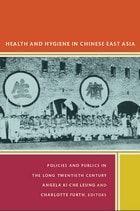
Health and Hygiene in Chinese East Asia
Policies and Publics in the Long Twentieth CenturyAngela Ki Che Leung and Charlotte Furth, eds.
Duke University Press, 2010
Contributors. Warwick Anderson, Charlotte Furth, Marta E. Hanson, Sean Hsiang-lin Lei, Angela Ki Che Leung, Shang-Jen Li, Yushang Li, Yi-Ping Lin, Shiyung Liu, Ruth Rogaski, Yen-Fen Tseng, Chia-ling Wu, Xinzhong Yu
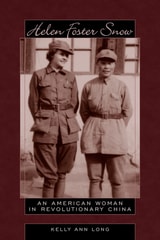
Helen Foster Snow
An American Woman in Revolutionary ChinaKelly Ann Long
University Press of Colorado, 2006
As Kelly Ann Long recounts in this engaging biography, Helen Foster Snow immersed herself in the social and political currents of a nation in turmoil. After marrying renowned journalist Edgar Snow, she developed her own writing talents and offered an important perspective on emerging events in China as that nation was wracked by Japanese invasion, the outbreak of World War II, and a continuing civil war. She supported the December Ninth Movement of 1935, broke boundaries to enter communist Yenan in 1937, and helped initiate the "gung ho" Chinese Industrial Cooperative movement.
Helen Foster Snow wrote about the people and events in China's remote communist territories during an important era. She relayed detailed portraits of female communist leaders and famous figures such as Mao Zedong and Zhu De, as well as common people struggling to survive in a period of increasing turmoil. Her informed, compassionate depictions built a bridge linking American interest to the welfare of the Chinese.
Long's account recovers the story of a controversial and important commentator on a critical period in U.S.-China relations and in Chinese history

Hidden Transfers
How Rural Women’s Reproductive Work Paid for Industrialization in Mao’s ChinaJacob Eyferth
University of Chicago Press, 0
Provides a striking, new interpretation of the importance of rural women’s cloth production in collective-era China.
Based on extensive archival research, fieldwork across multiple villages, and hundreds of interviews, Hidden Transfers offers a material history of the working lives of rural women in communist China from 1949 to 1983.
Focusing on cotton cultivation and manual textile production in rural households, historian Jacob Eyferth examines the relationship between domestic labor and socialist development by recovering the story of the millions of women who spent countless hours spinning yarn, weaving cloth, and making clothes for their families. He shows how the “hidden transfers” from the domestic economy to fund accumulation rested, as with capitalist economies, on women’s unpaid domestic work. But state socialism went even further, celebrating the future-making work of production while disparaging work that reproduced life at home. Through careful research, Eyferth tracks how the Chinese state’s project of primitive accumulation, in turn, created the conditions for the spectacular growth experienced in the post-Mao years.
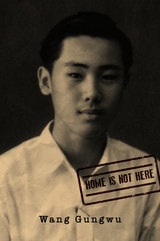
Home Is Not Here
Wang Gungwu
National University of Singapore Press, 2018
As someone who has studied history for much of my life, I have found the past fascinating. But it has always been some grand and even intimidating universe that I wanted to unpick and explain to myself.
Wang Gungwu is one of Asia’s most important public intellectuals. He is best known for his explorations of Chinese history in the long view and for his writings on the Chinese diaspora. With Home is Not Here, the historian of grand themes turns to a single life history: his own.
Wang writes about his multicultural upbringing and life under British rule. He was born in Surabaya, Java, but his parents’ orientation was always to China. Wang grew up in the plural, multi-ethnic town of Ipoh, Malaya (now Malaysia). He learned English in colonial schools and was taught the Confucian classics at home. After the end of WWII and the Japanese occupation, he left for the National Central University in Nanjing to study alongside some of the finest of his generation of Chinese undergraduates. The victory of Mao Zedong’s Communist Party interrupted his education, and he ends this volume with his return to Malaya.
Wise and moving, Home Is Not Here speaks to the ability of the individual to find a place amid the historical currents that have shaped Asia and the world.

Home Team Away
Watching European Football in Urban ChinaYuan Gong
University of Michigan Press, 2026
Home Team Away calls for a rethinking of sport fandom that is divorced from an attachment to location. As the first comprehensive account of the European football fandom in China, this book explores how the Chinese middle class subjectivity is formed through the cross-cultural, digital consumption of the Big Five leagues. Yuan Gong captures the embodied experiences of fans and fan clubs, fan discourses and activities unfolding on digital platforms on Weibo, Weixin, and Hupu, combining fieldwork in Shanghai and virtual ethnography. Gong argues that Chinese fans’ decisions to follow and engage with European football result from their material conditions, ideological contestation, and technology appropriation as a new demographic bloc arising during China’s transition to authoritarian digital capitalism. By engaging with their home teams away, the Chinese middle class fans perform as citizens with a global vision despite the resurgence of the nationalist and anti-Western sentiments.
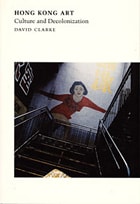
Hong Kong Art
Culture and DecolonizationDavid Clarke
Duke University Press, 2002
Clarke shows how a sense of local identity emerged in Hong Kong as the transition approached and found expression in the often politicized art produced. Given the recent international exposure of mainland Chinese contemporary art, this book considers the uniqueness of the art of China’s most cosmopolitan city. With a modern visual culture that was flourishing even when the People’s Republic was still closed to the outside world, Hong Kong has established itself as an exemplary site for both local and transnational elements to formulate into brilliant and groundbreaking art.
The author writes about individual artists and art works with a detail that will appeal to artists, curators, and art historians, as well as to postcolonial scholars, cultural studies scholars, and others.

Hong Kong Connections
Transnational Imagination in Action CinemaMeaghan Morris, Siu-Leung Li, and Stephen Chan Ching-kiu, eds.
Duke University Press, 2005
Hong Kong Connections brings leading film scholars together to explore the circulation of Hong Kong cinema in Japan, Korea, India, Australia, France, and the United States, as well as its links with Taiwan, Singapore, and the Chinese mainland. In the process, this collection examines diverse cultural contexts for action cinema’s popularity and the problems involved in the transnational study of globally popular forms, suggesting that in order to grasp the history of Hong Kong action cinema’s influence we need to bring out the differences as well as the links that constitute popularity.
Contributors. Nicole Brenez, Stephen Chan Ching-kiu, Dai Jinhua, David Desser, Laleen Jayamanne, Kim Soyoung, Siu Leung Li, Adrian Martin, S. V. Srinivas, Stephen Teo, Valentina Vitali, Paul Willemen, Rob Wilson, Wong Kin-yuen, Kinnia Yau Shuk-ting, Yung Sai-shing
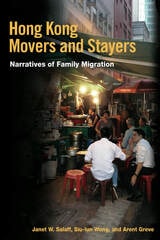
Hong Kong Movers and Stayers
Narratives of Family MigrationJanet W. Salaff, Siu-lun Wong, and Arent Greve
University of Illinois Press, 2010
Half a million Hong Kong residents fled their homeland during the thirteen years before Hong Kong's reversion to China in 1997. Nearly half of those returned within the next several years. Filled with detailed, first-hand stories of nine Hong Kong families over nearly two decades, Hong Kong Movers and Stayers is a multifaceted yet intimate look at the forces behind Hong Kong families' successful, and failed, efforts at migration and settlement.
Defining migration as a process, not a single act of leaving, Hong Kong Movers and Stayers provides an antidote to ethnocentric and simplistic theories by uncovering migration stories as they relate to social structures and social capital. The authors meld survey analysis, personal biography, and sociology and compare multiple families in order to give voice to the interplay of gender, age, and diverse family roles as motivating factors in migration.

Hong Kong in Revolt
The Protest Movement and the Future of ChinaAu Loong-Yu
Pluto Press, 2020
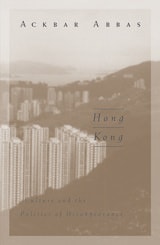
Hong Kong
Culture and the Politics of DisappearanceAckbar Abbas
University of Minnesota Press, 1997
A consideration of what the culture of Hong Kong tells us about the state of the world at the fin-de-siècle.
On June 30, 1997, Hong Kong as we know it will disappear, ceasing its singular and ambiguous existence as a colonial holdover and becoming part of the People’s Republic of China. In an intriguing and provocative exploration of its cinema, architecture, photography, and literature, Ackbar Abbas considers what Hong Kong, with its unique relations to decolonization and disappearance, can teach us about the future of both the colonial city and the global city.
The culture of Hong Kong encompasses Jackie Chan and John Woo, British colonial architecture and postmodern skyscrapers. Ironically, it was not until they were faced with the imposition of Mainland power—with the signing of the Sino-British Joint Agreement in 1984—that the denizens of the colony began the search for a Hong Kong identity. According to Abbas, Hong Kong’s peculiar lack of identity is due to its status as “not so much a place as a space of transit,” whose residents think of themselves as transients and migrants on their way from China to somewhere else. Abbas explores the way Hong Kong’s media saturation changes its people’s experience of space so that it becomes abstract, dominated by signs and images that dispel memory, history, and presence.Hong Kong disappears through simple dualities such as East/West and tradition/modernity. What is missing from a view of Hong Kong as merely a colony is the paradox that Hong Kong has benefited from and made a virtue of its dependent colonial status, turning itself into a global and financial city and outstripping its colonizer in terms of wealth.Combining sophisticated theory and a critical perspective, this rich and thought-provoking work captures the complex situation of the metropolis that is contemporary Hong Kong. Along the way, it challenges, entertains, and makes an important contribution to our thinking about the surprising processes and consequences of colonialism.Copublished with Hong Kong University Press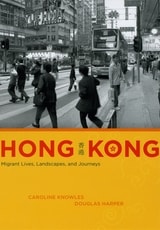
Hong Kong
Migrant Lives, Landscapes, and JourneysCaroline Knowles and Douglas Harper
University of Chicago Press, 2009
In 1997 the United Kingdom returned control of Hong Kong to China, ending the city’s status as one of the last remnants of the British Empire and initiating a new phase for it as both a modern city and a hub for global migrations. Hong Kong is a tour of the city’s postcolonial urban landscape, innovatively told through fieldwork and photography.
Caroline Knowles and Douglas Harper’s point of entry into Hong Kong is the unusual position of the British expatriates who chose to remain in the city after the transition. Now a relatively insignificant presence, British migrants in Hong Kong have become intimately connected with another small minority group there: immigrants from Southeast Asia. The lives, journeys, and stories of these two groups bring to life a place where the past continues to resonate for all its residents, even as the city hurtles forward into a future marked by transience and transition. By skillfully blending ethnographic and visual approaches, Hong Kong offers a fascinating guide to a city that is at once unique in its recent history and exemplary of our globalized present.
Humble before the Void
A Western Astronomer, his Journey East, and a Remarkable Encounter Between Western Science and Tibetan BuddhismChris Impey
Templeton Press, 2014
“This book will provide readers with a greater awareness of the spirit of curiosity and inquiry that lies at the heart of the Buddhist tradition, as well as the fruitfulness of maintaining active communication between the Buddhist and scientific communities.” —from the Foreword by His Holiness the Dalai Lama
In Humble before the Void, Impey, a noted astronomer, educator, and author gives us a thoroughly absorbing and engaging account of his journey to Northern India to teach in the first-ever “Science for Monks” leadership program. The program was initiated by His Holiness the Dalai Lama to introduce science into the Tibetan Buddhist monastic tradition.
In a vivid and compelling narrative, Impey introduces us to a group of exiled Tibetan monks whose charm, tenacity and unbridled enthusiasm for learning is infectious. Impey marvels not only at their enthusiasm, but at their tireless diligence that allows the monks to painstakingly build intricate sand mandalas—that can be swept away in an instant. He observes them as they meticulously count galaxies and notes how their enthusiasm and diligence stands in contrast to many American students who are frequently turned off by science’s inability to deliver easy, immediate payoffs. Because the Buddhist monks have had a limited science education, Impey must devise creative pedagogy. His new students immediately take to his inspired teaching methods, whether it’s the use of balloons to demonstrate the Hubble expansion or donning an Einstein mask to explain the theory of relativity.
Humble before the Void also recounts Impey’s experiences outside the classroom, from the monks’ eagerness to engage in pick-up basketball games and stream episodes of hip American sitcoms to the effects on his relationship with the teenage son who makes the trip with him. Moments of profound serenity and beauty in the Himalayas are contrasted with the sorrow of learning that other monks have set themselves on fire to protest the Chinese oppression in Tibet.
At the end of the three week program, both the monks and Impey have gained a valuable education. While the monks have a greater understanding and appreciation of science, Impey has acquired greater self- knowledge and a deeper understanding of the nature of learning and teaching in the East and West. This understanding leads to a renewed enthusiasm for making his topic come alive for others.