Results by title
138 books match the query 'Civil War' and 4 start with h
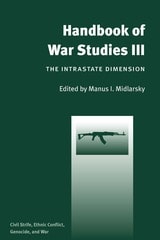
Handbook of War Studies III
The Intrastate DimensionManus I. Midlarsky, ed.
University of Michigan Press, 2009
"Midlarsky has done it again, another state-of-the art handbook on the most recent developments in the study of war. This volume is entirely new with a focus on internal war. It is a 'must-read' for scholars and students of conflict. Even the most knowledgeable will learn a great deal from the book."
---John A. Vasquez, Thomas B. Mackie Scholar in International Relations, University of
Illinois at Urbana-Champaign
"Handbook of War Studies III is a tour de force. This is a compelling and comprehensive work of scholarship. Midlarsky, as with previous volumes, has assembled an 'all star' team from the interdisciplinary field of conflict processes. In response to trends in place over the last few decades, this third volume rightly focuses on the intrastate dimension of international conflict. The volume includes lucid presentations on rational choice and political psychology as alternative visions, along with convincing treatments of civil war, ethnic conflict, genocide, and related issues. This book will be required reading for anyone with an interest in conflict processes."
---Patrick James, Director, Center for International Studies, University of Southern California
"This third volume of the Handbook is a very welcome addition with its focus on intrastate conflict. Scholarship on internal conflict has proliferated over the past decade, and therefore it is time to take stock of the work that has been done and to point out directions for future research. In this volume a team of leading scholars do just that as they provide trenchant assessments of what has been accomplished and what are the remaining big questions that require further research. This volume will be indispensable to students and scholars alike."
---Paul Huth, Editor, Journal of Conflict Resolution, and Professor of Government and Politics, University of Maryland, College Park
Handbook of War Studies III is a follow-up to Handbook of War Studies I (1993) and II (2000). This new volume collects original work from leading international relations scholars on domestic strife, ethnic conflict, genocide, and other timely topics. Special attention is given to civil war, which has become one of the dominant forms---if not the dominant form---of conflict in the world today.
Nils Petter Gleditsch, International Peace Research Institute, Oslo (PRIO), and Norwegian University of Science and Technology (NTNU), Trondheim
Håvard Hegre, University of Oslo, and International Peace Research Institute, Oslo (PRIO)
Erin K. Jenne, Central European University, Budapest
Mark Irving Lichbach, University of Maryland
Roy Licklider, Rutgers University, New Brunswick
T. David Mason, University of North Texas
Rose McDermott, Cornell University
Stephen Saideman, McGill University
Håvard Strand, International Peace Research Institute, Oslo (PRIO)
Monica Duffy Toft, Harvard University
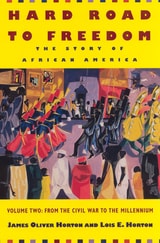
Hard Road to Freedom
The Story of African America, The Civil War to the MillenniumHorton, Lois E
Rutgers University Press, 2002
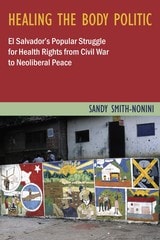
Healing the Body Politic
El Salvador's Popular Struggle for Health Rights from Civil War to Neoliberal PeaceSmith-Nonini, Sandy
Rutgers University Press, 2010

How the North Won
A MILITARY HISTORY OF THE CIVIL WARHerman Hattaway and Archer Jones
University of Illinois Press, 1983
“To those unacquainted with military history, [this book] provides an elementary, instructive, and readable military account of the American Civil War. The basic concepts of war, its conduct, management, and support, are thoroughly explained and explicitly applied throughout in order to make clear what many authors often incorrectly take for granted that readers already know. . . .
We have tried to tell the military history of the war from the viewpoint of the higher commanders on both sides. We therefore emphasize strategy and logistics rather than tactics. . . .Strategy, management, and execution weigh more than superior numbers and resources in dictating the outcomes of wars, and the Civil War is no exception. The weaker side can win; the South almost did.”