Results by title
145 books match the query 'Classical' and 5 start with h
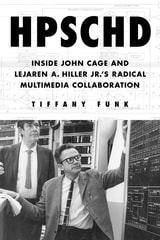
HPSCHD
Inside John Cage and Lejaren A. Hiller Jr.'s Radical Multimedia CollaborationTiffany Funk
University of Illinois Press, 2027
Tiffany Funk explores how HPSCHD’s use of early computer art helped change ideas about sound, chance, and authorship. The event was less a concert than a performative system built through programming, labor, and shared decision-making. Computer art of the era required physical labor and collaboration. The impact of everything from punch cards to magnetic tape shaped the work while revealing the human effort involved. Throughout, Funk reveals that HPSCHD still offers valuable lessons about machines as collaborators rather than tools; the politics of technology; and the tension between the excitement and fears of automation.
An in-depth look at an avant-garde landmark, HPSCHD takes readers inside a legendary merger of music with computer art and its ongoing relevance in today’s digital world.
Haydn and the Performance of Rhetoric
Edited by Tom Beghin and Sander M. Goldberg
University of Chicago Press, 2007
In this volume, a distinguished group of contributors in fields from classics to literature to musicology restores the rhetorical model to prominence and shows what can be achieved by returning to the idea of music as a rhetorical process. An accompanying DVD, specially designed for this project, presents performances and illustrations keyed to its chapters, making musicological arguments accessible to nonspecialists and advancing additional arguments of its own through the medium of performance. The volume thus reaches beyond musicology to enrich and complicate the larger debate over rhetoric's role in eighteenth-century culture.
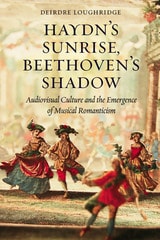
Haydn’s Sunrise, Beethoven’s Shadow
Audiovisual Culture and the Emergence of Musical RomanticismDeirdre Loughridge
University of Chicago Press, 2016
Deirdre Loughridge reveals that allusions in musical writings to optical technologies reflect their spread from fairgrounds and laboratories into public consciousness and a range of discourses, including that of music. She demonstrates how concrete points of intersection—composers’ treatments of telescopes and peepshows in opera, for instance, or a shadow-play performance of a ballad—could then fuel new modes of listening that aimed to extend the senses. An illuminating look at romantic musical practices and aesthetics, this book yields surprising relations between the past and present and offers insight into our own contemporary audiovisual culture.
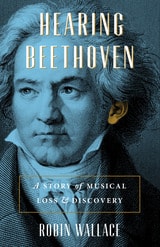
Hearing Beethoven
A Story of Musical Loss and DiscoveryRobin Wallace
University of Chicago Press, 2018
We’re all familiar with the image of a fierce and scowling Beethoven, struggling doggedly to overcome his rapidly progressing deafness. That Beethoven continued to play and compose for more than a decade after he lost his hearing is often seen as an act of superhuman heroism. But the truth is that Beethoven’s response to his deafness was entirely human. And by demystifying what he did, we can learn a great deal about Beethoven’s music. Perhaps no one is better positioned to help us do so than Robin Wallace, who not only has dedicated his life to the music of Beethoven but also has close personal experience with deafness. One day, Wallace’s late wife, Barbara, found she couldn’t hear out of her right ear—the result of radiation administered to treat a brain tumor early in life. Three years later, she lost hearing in her left ear as well. Over the eight and a half years that remained of her life, despite receiving a cochlear implant, Barbara didn’t overcome her deafness or ever function again like a hearing person.
Wallace shows here that Beethoven didn’t do those things, either. Rather than heroically overcoming his deafness, Beethoven accomplished something even more challenging: he adapted to his hearing loss and changed the way he interacted with music, revealing important aspects of its very nature in the process. Wallace tells the story of Beethoven’s creative life, interweaving it with his and Barbara’s experience to reveal aspects that only living with deafness could open up. The resulting insights make Beethoven and his music more accessible and help us see how a disability can enhance human wholeness and flourishing.
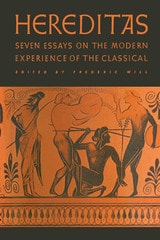
Hereditas
Seven Essays on the Modern Experience of the ClassicalEdited with an introduction by Frederic Will
University of Texas Press, 1964
Is Ancient Greece still meaningful to the twenty-first-century world? The vitality of the classical tradition, which has been a long-enduring and important element in our culture, is the concern of the seven scholars who in this book present their answers to this question.
In various ways their essays support editor Frederic Will's statement that the "complex and mature group of awarenesses" embodied in the classical tradition still help to maintain the continuity of human culture, thus sharing in the unbroken process of developing a Western civilization. These awarenesses are not self-perpetuating but must be sustained by the guardians of tradition—schools, literary creators and critics, libraries, and scholars. In this book, particular attention is devoted to the literary creators. In discussing the impact of Greek myth, Greek literature, and Greek philosophy on modern writers, the present essayists try to determine how alive Greek classical culture is today, how meaningful it is, and how it can be perpetuated. Through their presentations in these seven essays, the contributors prove that the tradition does not suffer from lack of able guardians.
These studies in the interpretation of literature and thought afford stimulating evidence that the classical tradition is still alive in our modern age.