Results by title
81 books match the query 'Composers' and 5 start with h
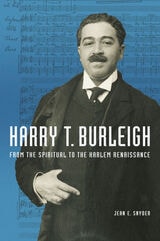
Harry T. Burleigh
From the Spiritual to the Harlem RenaissanceJean E. Snyder
University of Illinois Press, 2021
Hildegard of Bingen
Honey Meconi
University of Illinois Press, 2018
Honey Meconi draws on her own experience as a scholar and performer of Hildegard's music to explore the life and work of this foundational figure. Combining historical detail with musical analysis, Meconi delves into Hildegard's mastery of plainchant, her innovative musical drama, and her voluminous writings. Hildegard's distinctive musical style still excites modern listeners through wide-ranging, sinuous melodies set to her own evocative poetry. Together with her passionate religious texts, her music reveals a holistic understanding of the medieval world still relevant to today's readers.
Hitting the Right Notes
Film Directors and Composers in HarmonyLester D. Friedman
Rutgers University Press, 2027
Hitting the Right Notes: Film Directors and Composers in Harmony is a unique, multi-disciplinary volume co-authored by scholars from both media studies and music theory. The book features a chronological and systematic approach that concentrates on analyzing representative scenes from a broad spectrum of mainstream movies as exemplars. With a distinctive focus on versatile analytical tools from film studies, music cognition, and music theory, each chapter supplies background on the time period, director, composer, and their working relationship, then a close reading incorporates both visual analysis and musical elements beyond pitch and harmony. Robust yet accessible, Hitting the Right Notes highlights up-to-date ways of understanding film music, directly demonstrates their application across eras and genres, and displays the artistic magic directors and composers create together. It is essential reading for those interested in film and music.
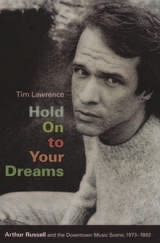
Hold On to Your Dreams
Arthur Russell and the Downtown Music Scene, 1973-1992Tim Lawrence
Duke University Press, 2009
Tim Lawrence traces Russell's odyssey from his hometown of Oskaloosa, Iowa, to countercultural San Francisco, and eventually to New York, where he lived from 1973 until his death from AIDS-related complications in 1992. Resisting definition while dreaming of commercial success, Russell wrote and performed new wave and disco as well as quirky rock, twisted folk, voice-cello dub, and hip-hop-inflected pop. “He was way ahead of other people in understanding that the walls between concert music and popular music and avant-garde music were illusory,” comments the composer Philip Glass. "He lived in a world in which those walls weren't there." Lawrence follows Russell across musical genres and through such vital downtown music spaces as the Kitchen, the Loft, the Gallery, the Paradise Garage, and the Experimental Intermedia Foundation. Along the way, he captures Russell's openness to sound, his commitment to collaboration, and his uncompromising idealism.
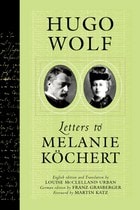
Hugo Wolf
Letters To Melanie KochertHugo Wolf
University of Wisconsin Press, 2003
Wolf’s letters to Köchert—he wrote 245 between 1887 and 1899—were composed during a period of almost unprecedented cultural upheaval in Europe, in the shadow of Vienna during the era of Freud, Mahler, and Klimt. They reveal Wolf at his most optimistic, celebrating his concert successes and the solitude he believed was so precious to his ability to compose. They follow Wolf through times of overwhelming despair, when his musical failures left him profoundly alienated, overcome, as he revealed to Köchert, "by a feeling of unspeakable emptiness and desolation." And they follow Wolf as he struggled to compose the 250 astounding art songs that are his creative legacy, and his almost simultaneous descent into madness.
Hugo Wolf: Letters to Melanie Köchert, sensitively translated by Wolf scholar and interpreter Louise McClelland Urban, is a literary and musical even of the highest order