Results by title
69 books match the query 'Conduct of life' and 5 start with h
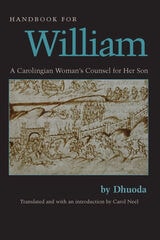
Handbook for William
A Carolingian Woman's Counsel for Her Son (Medieval Texts in Translation)Catholic University of America Press, 1999
[more]
Hardship and Happiness
Lucius Annaeus Seneca
University of Chicago Press, 2014
Lucius Annaeus Seneca (4 BCE–65 CE) was a Roman Stoic philosopher, dramatist, statesman, and advisor to the emperor Nero, all during the Silver Age of Latin literature. The Complete Works of Lucius Annaeus Seneca is a fresh and compelling series of new English-language translations of his works in seven accessible volumes. Edited by Elizabeth Asmis, Shadi Bartsch, and Martha C. Nussbaum, this engaging collection helps restore Seneca—whose works have been highly praised by modern authors from Desiderius Erasmus to Ralph Waldo Emerson—to his rightful place among the classical writers most widely studied in the humanities.
Hardship and Happiness collects a range of essays intended to instruct, from consolations—works that offer comfort to someone who has suffered a personal loss—to pieces on how to achieve happiness or tranquility in the face of a difficult world. Expertly translated, the essays will be read and used by undergraduate philosophy students and experienced scholars alike.
Hardship and Happiness collects a range of essays intended to instruct, from consolations—works that offer comfort to someone who has suffered a personal loss—to pieces on how to achieve happiness or tranquility in the face of a difficult world. Expertly translated, the essays will be read and used by undergraduate philosophy students and experienced scholars alike.
[more]
How Should We Live?
A Practical Approach to Everyday MoralityJohn Kekes
University of Chicago Press, 2014
What is your highest ideal? What code do you live by? We all know that these differ from person to person. Artists, scientists, social activists, farmers, executives, and athletes are guided by very different ideals. Nonetheless for hundreds of years philosophers have sought a single, overriding ideal that should guide everyone, always, everywhere, and after centuries of debate we’re no closer to an answer. In How Should We Live?, John Kekes offers a refreshing alternative, one in which we eschew absolute ideals and instead consider our lives as they really are, day by day, subject to countless vicissitudes and unforeseen obstacles.
Kekes argues that ideal theories are abstractions from the realities of everyday life and its problems. The well-known arenas where absolute ideals conflict—dramatic moral controversies about complex problems involved in abortion, euthanasia, plea bargaining, privacy, and other hotly debated topics—should not be the primary concerns of moral thinking. Instead, he focuses on the simpler problems of ordinary lives in ordinary circumstances. In each chapter he presents the conflicts that a real person—a schoolteacher, lawyer, father, or nurse, for example—is likely to face. He then uses their situations to shed light on the mundane issues we all must deal with in everyday life, such as how we use our limited time, energy, or money; how we balance short- and long-term satisfactions; how we deal with conflicting loyalties; how we control our emotions; how we deal with people we dislike; and so on. Along the way he engages some of our most important theorists, including Donald Davidson, Thomas Nagel, Christine Korsgaard, Harry Frankfurt, Charles Taylor, Alasdair MacIntyre, and Bernard Williams, ultimately showing that no ideal—whether autonomy, love, duty, happiness, or truthfulness—trumps any other. No single ideal can always guide how we overcome the many different problems that stand in the way of living as we should. Rather than rejecting such ideals, How Should We Live? offers a way of balancing them by a practical and pluralistic approach—rather than a theory—that helps us cope with our problems and come closer to what our lives should be.
Kekes argues that ideal theories are abstractions from the realities of everyday life and its problems. The well-known arenas where absolute ideals conflict—dramatic moral controversies about complex problems involved in abortion, euthanasia, plea bargaining, privacy, and other hotly debated topics—should not be the primary concerns of moral thinking. Instead, he focuses on the simpler problems of ordinary lives in ordinary circumstances. In each chapter he presents the conflicts that a real person—a schoolteacher, lawyer, father, or nurse, for example—is likely to face. He then uses their situations to shed light on the mundane issues we all must deal with in everyday life, such as how we use our limited time, energy, or money; how we balance short- and long-term satisfactions; how we deal with conflicting loyalties; how we control our emotions; how we deal with people we dislike; and so on. Along the way he engages some of our most important theorists, including Donald Davidson, Thomas Nagel, Christine Korsgaard, Harry Frankfurt, Charles Taylor, Alasdair MacIntyre, and Bernard Williams, ultimately showing that no ideal—whether autonomy, love, duty, happiness, or truthfulness—trumps any other. No single ideal can always guide how we overcome the many different problems that stand in the way of living as we should. Rather than rejecting such ideals, How Should We Live? offers a way of balancing them by a practical and pluralistic approach—rather than a theory—that helps us cope with our problems and come closer to what our lives should be.
[more]
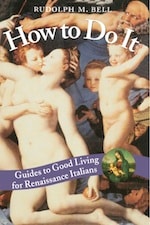
How to Do It
Guides to Good Living for Renaissance ItaliansRudolph M. Bell
University of Chicago Press, 1999
How to Do It shows us sixteenth-century Italy from an entirely new perspective: through manuals which were staples in the households of middlebrow Italians merely trying to lead better lives. Addressing challenges such as how to conceive a boy, the manuals offered suggestions such as tying a tourniquet around your husband's left testicle. Or should you want to goad female desires, throw 90 grubs in a liter of olive oil, let steep in the sun for a week and apply liberally on the male anatomy. Bell's journey through booklets long dismissed by scholars as being of little literary value gives us a refreshing and surprisingly fun social history.
"Lively and curious reading, particularly in its cascade of anecdote, offered in a breezy, cozy, journalistic style." —Lauro Martines, Times Literary Supplement
"[Bell's] fascinating book is a window on a lost world far nearer to our own than we might imagine. . . . How pleasant to read his delightful, informative and often hilarious book." —Kate Saunders, The Independent
"An extraordinary work which blends the learned with the frankly bizarre." —The Economist
"Professor Bell has a sly sense of humor and an enviably strong stomach. . . . He wants to know how people actually behaved, not how the Church or philosophers or earnest humanists thought they should behave. I loved this book." —Christopher Stace, Daily Telegraph
[more]
Human Goodness
Tuan, Yi-Fu
University of Wisconsin Press, 2008
In his many best-selling books, Yi-Fu Tuan seizes big, metaphysical issues and considers them in uniquely accessible ways. Human Goodness is evidence of this talent and is both as simple, and as epic, as it sounds.
Genuinely good people and their actions, Tuan contends, are far from boring, naive, and trite; they are complex, varied, and enormously exciting. In a refreshing antidote to skeptical times, he writes of ordinary human courtesies, as simple as busing your dishes after eating, that make society functional and livable. And he writes of extraordinary courage and inventiveness under the weight of adversity and evil. He considers the impact of communal goodness over time, and his sketches of six very different individuals—Confucius, Socrates, Wolfgang Amadeus Mozart, John Keats, Dr. Albert Schweitzer, and Simone Weil—confirm that there are human lives that can encourage and lead us to our better selves.
Best Books for General Audiences, selected by the American Association of School Librarians, and Best Books for Special Interests, selected by the Public Library Association
[more]