Results by title
244 books match the query 'Crime' and 8 start with h

He Rode with Butch and Sundance
The Story of Harvey "Kid Curry" LoganMark T. Smokov
University of North Texas Press, 2012

Hell's Belles, Revised Edition
Prostitution, Vice, and Crime in Early Denver, With a Biography of Sam Howe, Frontier LawmanClark Secrest
University Press of Colorado, 2001
The popular veneer of Denver's present-day Market Street - its fancy bars, posh restaurants, and Coors Field - is stripped away to reveal the street's former incarnation: a mecca of loose morals entrenched in prostitution, liquor, and money. Hell's Belles examines the neglected topics of vice and crime in Denver and utilizes a unique and invaluable historic source - the scrapbooks of Detective Sam Howe.
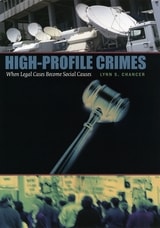
High-Profile Crimes
When Legal Cases Become Social CausesLynn S. Chancer
University of Chicago Press, 2005
An astute and incisive chronicle of some of the most polarizing cases of the 1980s and 1990s, High-Profile Crimes shows that their landmark status results from the overlapping interaction of diverse participants. The merging of legal cases and social causes, Chancer argues, has wrought ambivalent effects on both social movements and the law. On the one hand, high-profile crimes offer important opportunities for emotional expression and raise awareness of social issues. But on the other hand, social problems cannot be resolved through the either/or determinations that are the goals of the legal system, creating frustration for those who look to the outcome of these cases for social progress. Guilt or innocence through the lens of the media leads to either defeat or victory for a social cause-a confounding situation that made the O. J. Simpson case, for example, unable to resolve the issues of domestic violence and police racism that it had come to symbolize.
Based on nearly two hundred interviews, Chancer's discussions of the infamous Central Park jogger and Bensonhurst cases-as well as the rape trials of William Kennedy Smith and Mike Tyson, the assault cases of Rodney King and Reginald Denny, and, finally, the O. J. Simpson murder trial-provide a convincing, multidimensional and innovative analysis of the most charged public dramas of the last two decades.
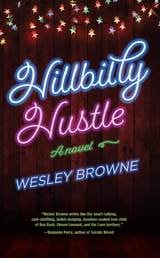
Hillbilly Hustle
Wesley Browne
West Virginia University Press, 2020
Knox’s shop makes the perfect front for a marijuana operation, but his supplier turns out to be violent and calculating, and Knox ends up under his thumb. It’s not long before more than just the pizza shop is at risk.

Hoodlum Movies
Seriality and the Outlaw Biker Film Cycle, 1966-1972Stanfield, Peter
Rutgers University Press, 2018

How to Quiet a Vampire
A SotieBorislav Pekic
Northwestern University Press, 2005
Delving far deeper than mere intellect, however, Borislav Pekic was himself a frequent political agitator and occasional prisoner, and he drew on his first hand knowledge of police methods and life under totalitarianism to paint a chilling portrait of a supposedly free-thinking intellectual acting in the service of repression. At the same time he questions whether Rutkowski's ideology puts him outside the philosophical tradition he so admires—or if the line separating European thought from totalitarianism is not as clear as we like to think.

Human Rights along the U.S.–Mexico Border
Gendered Violence and InsecurityEdited by Kathleen Staudt, Tony Payan, and Z. Anthony Kruszewski
University of Arizona Press, 2009
From the Pacific to the Gulf of Mexico, scholars from both sides of the 2,000-mile border reflect expertise in disciplines ranging from international relations to criminal justice, conveying a more complex picture of the region than that presented in other studies.
Initial chapters offer an overview of routine sexual assaults on women migrants, the harassment of Central American immigrants at the hands of authorities and residents, corruption and counterfeiting along the border, and near-death experiences of border crossers. Subsequent chapters then connect analysis with solutions in the form of institutional change, social movement activism, policy reform, and the spread of international norms that respect human rights as well as good governance.
These chapters show how all facets of the border situation—globalization, NAFTA, economic inequality, organized crime, political corruption, rampant patriarchy—promote gendered violence and other expressions of hyper-masculinity. They also show that U.S. immigration policy exacerbates the problems of border violence—in marked contrast to the border policies of European countries.
By focusing on women’s everyday experiences in order to understand human security issues, these contributions offer broad-based alternative approaches and solutions that address everyday violence and inattention to public safety, inequalities, poverty, and human rights. And by presenting a social and democratic international feminist framework to address these issues, they offer the opportunity to transform today’s security debate in constructive ways.
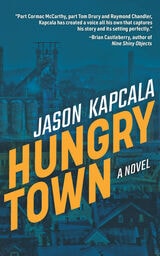
Hungry Town
A NovelJason Kapcala
West Virginia University Press, 2022
One October night in the depressed steel town of Lodi, Ohio, two police officers respond to a call about trespassers in the derelict Lodi Steel machine shop. A chase through the crumbling cathedral of steel columns launches a chain of events that will test the officers’ partnership and leave a boy to fend for himself in a decaying Rust Belt neighborhood choked by joblessness, boredom, and addiction.
On the opposite end of town, a young woman steps out of a rust-bucket Grand Marquis into an all-night diner. Instead of luggage, she carries mementos: an ankh tattoo she inked herself and a wallet-sized photograph of a boy who disappeared. She doesn’t realize her ex-boyfriend has hired two brothers to track her down and bring her back, by any means necessary.
The complex female leads of Hungry Town, with its sharp dialogue and poetic sensibility, turn classic noir and cop drama tropes on their heads. These morally complicated characters weave in and out of each other’s lives, sometimes violently, sometimes with surprising compassion.