190 books match the query 'Critical theory' and 4 start with h
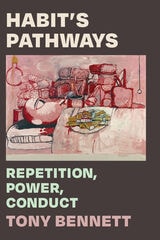
cover of Habit's Pathways: Repetition, Power, Conduct

Habit's Pathways

Repetition, Power, Conduct

Tony Bennett

Duke University Press, 2023
Habit has long preoccupied a wide range of theologians, philosophers, sociologists, psychologists, and neuroscientists. In Habit’s Pathways Tony Bennett explores the political consequences of the varied ways in which habit’s repetitions have been acted on to guide or direct conduct. Bennett considers habit’s uses and effects across the monastic regimens of medieval Europe, in plantation slavery and the factory system, through colonial forms of rule, and within a range of medicalized pathologies. He brings these episodes in habit’s political histories to bear on contemporary debates ranging from its role in relation to the politics of white supremacy to the digital harvesting of habits in practices of algorithmic governance. Throughout, Bennett tracks how habit’s repetitions have been articulated differently across divisions of class, race, and gender, demonstrating that although habit serves as an apparatus for achieving success, self-fulfillment, and freedom for the powerful, it has simultaneously served as a means of control over women, racialized peoples, and subordinate classes.
[more]
cover of Hegel and Spinoza: Substance and Negativity

Hegel and Spinoza

Substance and Negativity

Gregor Moder, with a foreword by Mladen Dolar

Northwestern University Press, 2017

Gregor Moder’s Hegel and Spinoza: Substance and Negativity is a lively entry into current debates concerning Hegel, Spinoza, and their relation. Hegel and Spinoza are two of the most influential philosophers of the modern era, and the traditions of thought they inaugurated have been in continuous dialogue and conflict ever since Hegel first criticized Spinoza. Notably, eighteenth- and nineteenth-century German Idealists aimed to overcome the determinism of Spinoza’s system by securing a place for the freedom of the subject within it, and twentieth-century French materialists such as Althusser and Deleuze rallied behind Spinoza as the ultimate champion of anti-Hegelian materialism. This conflict, or mutual rejection, lives on today in recent discussions about materialism. Contemporary thinkers either make a Hegelian case for the productiveness of concepts of the negative, nothingness, and death, or in a way that is inspired by Spinoza they abolish the concepts of the subject and negation and argue for pure affirmation and the vitalistic production of differences.

Hegel and Spinoza traces the historical roots of these alternatives and shows how contemporary discussions between Heideggerians and Althusserians, Lacanians and Deleuzians are a variation of the disagreement between Hegel and Spinoza. Throughout, Moder persuasively demonstrates that the best way to read Hegel and Spinoza is not in opposition or contrast but together: as Hegel and Spinoza.
 
[more]
cover of Hegel and the Freedom of Moderns

Hegel and the Freedom of Moderns

Domenico Losurdo

Duke University Press, 2004

Available in English for the first time, Hegel and the Freedom of Moderns revives discussion of the major political and philosophical tenets underlying contemporary liberalism through a revolutionary interpretation of G. W. F. Hegel’s thought. Domenico Losurdo,one of the world’s leading Hegelians, reveals that the philosopher was fully engaged with the political controversies of his time. In so doing, he shows how the issues addressed by Hegel in the nineteenth century resonate with many of the central political concerns of today, among them questions of community, nation, liberalism, and freedom. Based on an examination of Hegel’s entire corpus—including manuscripts, lecture notes, different versions of texts, and letters—Losurdo locates the philosopher’s works within the historical contexts and political situations in which they were composed.

Hegel and the Freedom of Moderns persuasively argues that the tug of war between “conservative” and “liberal” interpretations of Hegel has obscured and distorted the most important aspects of his political thought. Losurdo unravels this misleading dualism and provides an illuminating discussion of the relation between Hegel’s political philosophy and the thinking of Karl Marx and Friedrich Engels. He also discusses Hegel’s ideas in relation to the pertinent writings of other major figures of modern political philosophy such as Jean-Jacques Rousseau, John Locke, Edmund Burke, John Stuart Mill, Jeremy Bentham, Karl Popper, Norberto Bobbio, and Friedrich Hayek.
[more]
cover of Hegel’s Theory of Normativity: The Systematic Foundations of the Philosophical Science of Right

Hegel’s Theory of Normativity

The Systematic Foundations of the Philosophical Science of Right

Kevin Thompson

Northwestern University Press, 2019

Hegel’s Elements of the Philosophy of Right offers an innovative and important account of normativity, yet the theory set forth there rests on philosophical foundations that have remained largely obscure. In Hegel’s Theory of Normativity, Kevin Thompson proposes an interpretation of the foundations that underlie Hegel’s theory: its method of justification, its concept of freedom, and its account of right. Thompson shows how the systematic character of Hegel’s project together with the metaphysical commitments that follow from its method are essential to secure this theory against the challenges of skepticism and to understand its distinctive contribution to questions regarding normative justification, practical agency, social ontology, and the nature of critique.
[more]