Results by title
87 books match the query 'Criticism, Textual' and 4 start with h

Hemingway's Laboratory
The Paris in our timeMilton A. Cohen
University of Alabama Press, 2005
In 1924 Ernest Hemingway published a small book of eighteen vignettes, each little more than one page long, with a small press in Paris. Titled in our time, the volume was later absorbed into Hemingway’s story collection In Our Time. Those vignettes, as Milton Cohen demonstrates in Hemingway’s Laboratory, reveal a range of voices, narrative strategies, and fictional interests more wide-ranging and experimental than any other extant work of Hemingway’s. Further, they provide a vivid view of his earliest tendencies and influences, first manifestations of the style that would become his hallmark, and daring departures into narrative forms that he would forever leave behind.
Many of the chapters are pointillistic glimpses of violence--bullfights, a botched execution, the fleeting thoughts of the wounded on the battlefield. Others reach back into childhood. Still others adopt the wry, mannered voice of English aristocracy. Though critics have often read these chapters as secondary asides to the longer stories that constitute the commercial collection, Cohen argues that not only do the vignettes merit consideration as a unit unto themselves, but that they exhibit a plethora of styles and narrative gambits that show Hemingway at his most versatile.
The final section examines in detail the individual chapters of in our time, their historical origins, their drafts, themes, and styles. The result is an account of what is arguably Hemingway’s most crucial formative period.
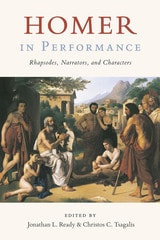
Homer in Performance
Rhapsodes, Narrators, and CharactersEdited by Jonathan L. Ready and Christos C. Tsagalis
University of Texas Press, 2018
Before they were written down, the poems attributed to Homer were performed orally, usually by rhapsodes (singers/reciters) who might have traveled from city to city or enjoyed a position in a wealthy household. Even after the Iliad and the Odyssey were committed to writing, rhapsodes performed the poems at festivals, often competing against each other. As they recited the epics, the rhapsodes spoke as both the narrator and the characters. These different acts—performing the poem and narrating and speaking in character within it—are seldom studied in tandem. Homer in Performance breaks new ground by bringing together all of the speakers involved in the performance of Homeric poetry: rhapsodes, narrators, and characters.
The first part of the book presents a detailed history of the rhapsodic performance of Homeric epic from the Archaic to the Roman Imperial periods and explores how performers might have shaped the poems. The second part investigates the Homeric narrators and characters as speakers and illuminates their interactions. The contributors include scholars versed in epigraphy, the history of art, linguistics, and performance studies, as well as those capable of working with sources from the ancient Near East and from modern Russia. This interdisciplinary approach makes the volume useful to a spectrum of readers, from undergraduates to veteran professors, in disciplines ranging from classical studies to folklore.
Homer's Text and Language
Gregory Nagy
University of Illinois Press, 2004
In Homeric studies, there has been an ongoing debate centering on different ways to establish the text of Homer and the different ways to appreciate the poetry created in the language of Homer. Gregory Nagy, a lifelong Homer scholar, takes a stand in the midst of this debate. He presents an overview of millennia of scholarly engagement with Homer's poetry, shows the different editorial principles that have been applied to the texts, and evaluates their impact.
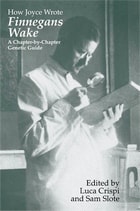
How Joyce Wrote Finnegans Wake
A Chapter-by-Chapter Genetic GuideEdited by Luca Crispi and Sarn Slote
University of Wisconsin Press, 2008
The introduction by Luca Crispi, Sam Slote, and Dirk Van Hulle offers a chronology of the composition of Finnegans Wake, an archival survey of the manuscripts, and an introduction to genetic criticism. Then, the volume provides a chapter-by-chapter interpretation of Finnegans Wake from a variety of perspectives, probing the book as a work in progress. The fruit of more than two decades’ worth of Wakean genetic studies, this book is the essential starting point for all future studies of Joyce’s most complex and fascinating work.