Results by title
176 books match the query 'Deaf' and 2 start with h
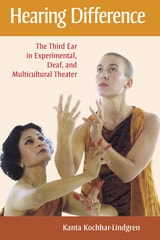
Hearing Difference
The Third Ear in Experimental, Deaf, and Multicultural TheaterKanta Kochhar-Lindgren
Gallaudet University Press, 2006
This engrossing studyinvestigates the connections between hearing and deafness in experimental, Deaf, and multicultural theater. Author Kanta Kochhar-Lindgren focuses on how to articulate a Deaf aesthetic and how to grasp the meaning of moments of “deafness” in theater works that do not simply reinscribe a hearing bias back into one’s analysis. She employs a model using a device for cross-sensory listening across domains of sound, silence, and the moving body in performance that she calls the “third ear.”
Kochhar-Lindgren then charts a genealogy of the theater of the third ear from the mid-1800s to the 1960s in examples ranging from Denis Diderot, the Symbolists, the Dadaists, Antonin Artaud, and others. She also analyzes the work of playwright Robert Wilson, the National Theatre of the Deaf, and Asian American director Ping Chong. She shows how the model of the third ear can address not only deaf performance but also multicultural performance, by analyzing the Seattle dance troupe Ragamala’s 2001 production of Transposed Heads, which melded classical South Indian use of mudras, or hand gestures, and ASL signing.
The shift in attention limned in Hearing Difference leads to a different understanding of the body, intersubjectivity, communication, and cross-cultural relations, confirming it as a critically important contribution to contemporary Deaf studies.
[more]
Hollywood Speaks
Deafness and the Film Entertainment IndustryJohn S. Schuchman
University of Illinois Press, 1988
"Hollywood Speaks is
a remarkable book. Schuchman's inquiry into how deafness has been treated in
movies provides us with yet another window onto social history in addition to
a fresh angle from which to view Hollywood. Moreover, he joins the ranks of
the few scholars who have made use of Hollywood studio archives."
-- Thomas Cripps, author of Slow Fade to Black: The Negro in American
Film, 1900-1942
[more]