Results by title
240 books match the query 'Diaries' and 6 start with h
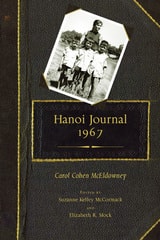
Hanoi Journal, 1967
Carol McEldowney
University of Massachusetts Press, 2007
McEldowney first gained the respect of her fellow activists as a student organizer at the University of Michigan. High regard for her intelligence, skill, and hard work with SDS's Economic Recovery Action Program during the years following her graduation in 1964 earned her an invitation to attend an international conference in Czechoslovakia and an offer to continue on to North Vietnam. Though her journal displays only traces of the feminist consciousness that would mark her later political activism, she recorded her observations of North Vietnam clearly aware that she was an outsider—a woman not subject to the military draft, not married to a soldier, and without the heartache of a brother or even a close friend serving in the war.
McEldowney searched for glimpses of everyday life that would help her to better relate to women in Hanoi and the hardships they faced during wartime. As she traveled in North Vietnam, she sought a deeper understanding of the events of her time. Her journal provides readers with a unique lens through which to study those events and gain a new perspective on the Vietnam War era.
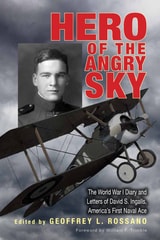
Hero of the Angry Sky
The World War I Diary and Letters of David S. Ingalls, America’s First Naval AceDavid S. Ingalls
Ohio University Press, 2012
Hero of the Angry Sky draws on the unpublished diaries, correspondence, informal memoir, and other personal documents of the U.S. Navy’s only flying “ace” of World War I to tell his unique story. David S. Ingalls was a prolific writer, and virtually all of his World War I aviation career is covered, from the teenager’s early, informal training in Palm Beach, Florida, to his exhilarating and terrifying missions over the Western Front. This edited collection of Ingalls’s writing details the career of the U.S. Navy’s most successful combat flyer from that conflict.
While Ingalls’s wartime experiences are compelling at a personal level, they also illuminate the larger, but still relatively unexplored, realm of early U.S. naval aviation. Ingalls’s engaging correspondence offers a rare personal view of the evolution of naval aviation during the war, both at home and abroad. There are no published biographies of navy combat flyers from this period, and just a handful of diaries and letters in print, the last appearing more than twenty years ago. Ingalls’s extensive letters and diaries add significantly to historians’ store of available material.
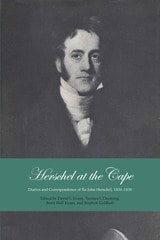
Herschel at the Cape
Diaries and Correspondence of Sir John Herschel, 1834-1838Edited by David S. Evans, Terence J. Deeming, Betty Hall Evans, and Stephen Goldfarb
University of Texas Press, 1969
Sir John Herschel, one of the founders of Southern Hemisphere astronomy, was a man of extraordinarily wide interests. He made contributions to botany, geology, and ornithology, as well as to astronomy, chemistry, and mathematics. Throughout his scientific career he kept a diary, recording his public and private life. The diaries from 1834 to 1838, years he spent making astronomical observations at the Cape of Good Hope, are reproduced in this book and prove to be much more than an ordinary scientist’s logbook. They present personal and social history, literary commentaries, the results of close observations of nature and numerous scientific experiments, the excitement of travel, political intrigues, gossip, and philosophical reflections—all interpreted through an alert and versatile mind. In the present transcription, the material has been enriched with selected correspondence of Sir John and his wife Lady Herschel (née Margaret Brodie Stewart).
Sir John devoted his working time at the Cape primarily to a systematic observation of the southern sky, complementing his earlier “sweeping” of the northern sky at Slough, England. He later became one of the founders of photography, but at the Cape he used a simple optical device, the camera lucida, in the production of numerous landscape drawings. Many of these, along with reproductions of sketches contained in the diaries and botanical drawings made by Sir John and Lady Herschel, are used to illustrate this book. Sir John was also a leading figure in the foundation of the educational system of the Cape and a supporter of exploratory expeditions into the interior.
As the son of Sir William Herschel, in his day the most famous British astronomer and the discoverer of the planet Uranus, Sir John was already celebrated when he arrived from England. Every individual of note, resident at the Cape or visiting, went to see him. He was supported in his work by his wife, who ran an enormous establishment and bore a huge family, but who nevertheless found time to travel in the country around the western Cape with him and to assist in his observations.
The diaries and letters are supplemented by especially valuable editorial notes that provide much needed and highly interesting information concerning persons and events mentioned and described by Sir John. All the original manuscript material used in this volume is archived at the Harry Ransom Center at the University of Texas at Austin. Sir John’s camera lucida drawings are from the South African Public Library in Cape Town.
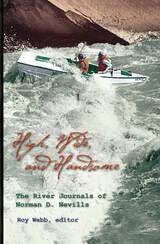
High, Wide, and Handsome
The River Journals of Norman D. Nevillsedited by Roy Webb
Utah State University Press, 2005
When he started taking paying passengers by boat through the rapids of the Colorado River's canyons, Norman Nevills invented whitewater tourism and the commercial river business. For twelve years, from 1938 until his death in a plane crash in 1949, he safely took, without a single life lost, friends, explorers, and customers down the Colorado, Green, San Juan, Salmon, and Snake Rivers in boats he designed. National media found him and his adventures irresistible and turned him into the personification of river running. Logging seven trips through the Grand Canyon when no one else had completed more than two, he was called the Fast Water Man. Boatmen he trained went on to found their own competing operations. Always controversial, Nevills had important critics and enemies as well as friends and supporters, but no one can dispute his tremendous impact on the history of western rivers and recreation.
Nevills's complete extant journals of those river expeditions are published for the first time in High, Wide, and Handsome. They contain vivid stories and images of still untamed-by-dams rivers and canyons in the Colorado River system and elsewhere, of wild rides in wooden boats, and of the few intrepid pioneers of adventure tourism who paid Nevills so they could experience it all. They have been transcribed and edited by river historian Roy Webb, author of If We Had a Boat: Green River Explorers, Adventurers, and Runners and Call of the
Colorado.

Hotel Malabar
Brendan Galvin
University of Iowa Press, 1998
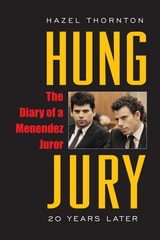
Hung Jury
The Diary of a Menendez JurorHazel Thornton
Temple University Press, 2017
More than two decades after serving as a juror on the high-profile seven-month murder trial People v. Erik Galen Menendez, Hazel Thornton updates her book Hung Jury with a new preface and a postscript essay of observations about the Menendez brothers’ second trial. Includes psychological commentary by Lawrence S. Wrightsman and Amy J. Posey, and legal commentary by Alan Scheflin.