Results by title
53 books match the query 'Dwellings' and 7 start with h
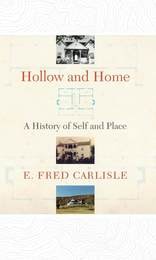
Hollow and Home
A History of Self and PlaceE. Fred Carlisle
West Virginia University Press, 2017
Carlisle incorporates perspectives from writers like Edward S. Casey, Christian Norberg-Schulz, Yi-Fu Tuan, and Witold Rybczynski, but he applies theory with a light touch. Placing this literature in dialog with personal experience, he concentrates on two places that profoundly influenced him and enabled him to overcome a lifelong sense of always leaving his pasts behind. The first is Clover Hollow in Appalachian Virginia, where the author lived for ten years among fifth-, sixth-, and seventh-generation residents. The people and places there enabled him to value his own past and primary places in a new way. The story then turns to Carlisle’s life growing up in Delaware, Ohio. He describes in rich detail the ways the town shaped him in both enabling and disabling ways. In the end, after years of moving from place to place, Carlisle’s experience in Appalachia helped him rediscover his hometown—both the Old Delaware, where he grew up, and the New Delaware, a larger, thriving small city—as his true home.
The themes of the book transcend specific localities and speak to the relationship of self and place everywhere.
Homeowners and Neighborhood Reinvestment
George C. Galster
Duke University Press, 1987
Multivariate statistical analyses of models were conducted using household data from Minneapolis and Wooster, Ohio. Three important findings emerged. First, homeowners' sense of solidarity with their neighbors is as significant in determining their efforts at home upkeep as are their income or age. Second, the optimism of homeowners toward increases in property values results in behavior opposite to that produced by optimism about neighborhood quality of life. This implies that different kinds of predictable gaming behavior occur among homeowners, depending on the neighborhoods in which they live. Third, both short-term and extremely long-term plans to move prove damaging to home upkeep.
The results of this study form the basis for a better understanding of such residential phenomena as class succession, racial transition, and gentrification. Galster's findings will also be valuable for analyzing policies that attempt to encourage neighborhood reinvestment.
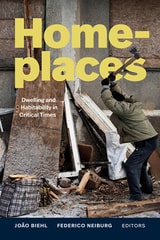
Homeplaces
Dwelling and Habitability in Critical TimesJoão Biehl and Federico Neiburg, editors
Duke University Press, 2026
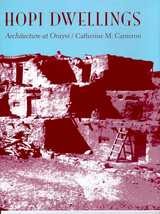
Hopi Dwellings
Architectural Change at OrayviCatherine M. Cameron
University of Arizona Press, 1999
Her study is unique in its use of historic photographs to document and understand abandonment processes and apply that knowledge to prehistoric sites. Photos taken by tourists, missionaries, and early anthropologists during the late nineteenth century portray original structures, while later photos show how Orayvi buildings changed over a period of almost eighty years. Census data relating to house size and household configuration shed additional light on social change in the pueblo.
Examining change at Orayvi afforded an opportunity to study the architectural effects of an event that must have happened many times in the past--the partial abandonment of a pueblo--by tracing the effects of sudden population decline on puebloan architecture. Cameron's work provides clues to how and why villages were abandoned and re-established repeatedly in the prehistoric Southwest as it offers a unique window on the relationship between Pueblo houses and the living people who occupied them.
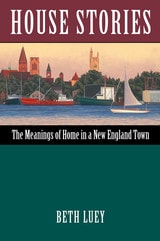
House Stories
The Meanings of Home in a New England TownBeth Luey
University of Massachusetts Press, 2017
Historic houses adorned with plaques populate New England like nowhere else in the country. These plaques note the construction year and original owner of the house, but they tell nothing about the rich lives of the people who lived there. In House Stories, Beth Luey takes readers on a virtual walking tour of several historic houses in Fairhaven, Massachusetts, a small New England coastal town, inviting us in to learn each house's secrets.
Through letters and diaries, church and business records, newspaper accounts, legal documents, and the recollections of neighbors who knew them, Luey introduces the diverse cast of historical characters who lived in these houses at various times from 1800 to the 2000s, including a Japanese castaway and his rescuer, a self-made millionaire, a seagoing adventurer, a religious pioneer, and an entrepreneurial immigrant. All of the houses are still standing and all but a lighthouse are still called home. In House Stories, Luey asks readers to join her as she considers the multiple meanings of “home” for these people and their families.
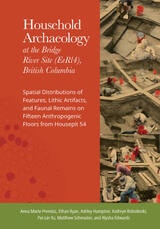
Household Archaeology at the Bridge River Site (EeRl4), British Columbia
Spatial Distributions of Features, Lithic Artifacts, and Faunal Remains on Fifteen Anthropogenic Floors from Housepit 54Anna Marie Prentiss, Ethan Ryan, Ashley Hampton, Kathryn Bobolinski, Pei-Lin Yu, Matthew Schmader, and Alysha Edwards
University of Utah Press, 2022
The authors take a methodological approach that integrates the study of household spatial organization with consideration of archaeological formation processes. Repeating the same set of analyses for each floor, they examine stability from standpoints of occupation and abandonment cycles, structure and organization of activity areas, and variation in positioning of wealth-related items. This volume is an outstanding example of research undertaken through a collaborative partnership between scholars from the University of Montana and the community of the St’át’imc Nation.

Housing Design and Society in Amsterdam
Reconfiguring Urban Order and Identity, 1900-1920Nancy Stieber
University of Chicago Press, 1998
Historians.
During the early 1900s, Amsterdam developed an international reputation as an urban mecca when invigorating reforms gave rise to new residential neighborhoods encircling the city's dispirited nineteenth-century districts. This new housing, built primarily with government subsidy, not only was affordable but also met rigorous standards of urban planning and architectural design. Nancy Stieber explores the social and political developments that fostered this innovation in public housing.
Drawing on government records, professional journals, and polemical writings, Stieber examines how government supported large-scale housing projects, how architects like Berlage redefined their role as architects in service to society, and how the housing occupants were affected by public debates about working-class life, the cultural value of housing, and the role of art in society.
Stieber emphasizes the tensions involved in making architectural design a social practice while she demonstrates the success of this collective enterprise in bringing about effective social policy and aesthetic progress.