Results by title
347 books match the query 'Early works to 1800' and 15 start with h
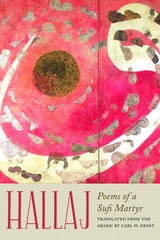
Hallaj
Poems of a Sufi MartyrTranslated from the Arabic by Carl W. Ernst
Northwestern University Press, 2018
Winner of the Global Humanities Translation Prize
Hallaj is the first authoritative translation of the Arabic poetry of Husayn ibn Mansur al-Hallaj, an early Sufi mystic. Despite his execution in Baghdad in 922 and the subsequent suppression of his work, Hallaj left an enduring literary and spiritual legacy that continues to inspire readers around the world. In Hallaj, Carl W. Ernst offers a definitive collection of 117 of Hallaj’s poems expertly translated for contemporary readers interested in Middle Eastern and Sufi poetry and spirituality.
Ernst’s fresh and direct translations reveal Hallaj’s wide range of themes and genres, from courtly love poems to metaphysical reflections on union with God. In a fascinating introduction, Ernst traces Hallaj’s dramatic story within classical Islamic civilization and early Arabic Sufi poetry. Setting himself apart by revealing Sufi secrets to the world, Hallaj was both celebrated and condemned for declaring: “I am the Truth.”
Expressing lyrics and ideas still heard in popular songs, the works of Hallaj remain vital and fresh even a thousand years after their composition. They reveal him as a master of spiritual poetry centuries before Rumi, who regarded Hallaj as a model. This unique collection makes it possible to appreciate the poems on their own, as part of the tragic legend of Hallaj, and as a formidable legacy of Middle Eastern culture.
The Global Humanities Translation Prize is awarded annually to a previously unpublished translation that strikes the delicate balance between scholarly rigor, aesthetic grace, and general readability, as judged by a rotating committee of Northwestern faculty, distinguished international scholars, writers, and public intellectuals. The Prize is organized by the Global Humanities Initiative, which is jointly supported by Northwestern University’s Buffett Institute for Global Studies and Kaplan Institute for the Humanities.
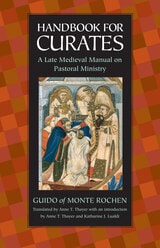
Handbook for Curates
A Late Medieval Manual on Pastoral MinistryCatholic University of America Press, 2011
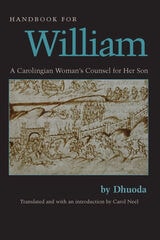
Handbook for William
A Carolingian Woman's Counsel for Her Son (Medieval Texts in Translation)Catholic University of America Press, 1999

Hans Staden's True History
An Account of Cannibal Captivity in BrazilHans Staden
Duke University Press, 2008
Staden’s narrative is a foundational text in the history and European “discovery” of Brazil, the earliest European account of the Tupi Indians, and a touchstone in the debates on cannibalism. Yet the last English-language edition of Staden’s True History was published in 1929. This new critical edition features a new translation from the sixteenth-century German along with annotations and an extensive introduction. It restores to the text the fifty-six woodcut illustrations of Staden’s adventures and final escape that appeared in the original 1557 edition.
In the introduction, Neil L. Whitehead discusses the circumstances surrounding the production of Staden’s narrative and its ethnological significance, paying particular attention to contemporary debates about cannibalism. Whitehead illuminates the value of Staden’s True History as an eyewitness account of Tupi society on the eve before its collapse, of ritual war and sacrifice among Native peoples, and of colonial rivalries in the region of Rio de Janeiro. He chronicles the history of the various editions of Staden’s narrative and their reception from 1557 until the present. Staden’s work continues to engage a wide range of readers, not least within Brazil, where it has recently been the subject of two films and a graphic novel.
Hardship and Happiness
Lucius Annaeus Seneca
University of Chicago Press, 2014
Hardship and Happiness collects a range of essays intended to instruct, from consolations—works that offer comfort to someone who has suffered a personal loss—to pieces on how to achieve happiness or tranquility in the face of a difficult world. Expertly translated, the essays will be read and used by undergraduate philosophy students and experienced scholars alike.
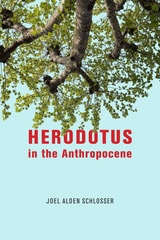
Herodotus in the Anthropocene
Joel Alden Schlosser
University of Chicago Press, 2020
Schlosser shows that the Histories, which chronicle the interactions among the Greek city-states and their neighbors that culminated in the Persian Wars, illuminate a telling paradox: at those times when humans appear capable of exerting more influence than ever before, they must also assert collective agency to avoid their own downfall. Here, success depends on nomoi, or the culture, customs, and laws that organize human communities and make them adaptable through cooperation. Nomoi arise through sustained contact between humans and their surroundings and function best when practiced willingly and with the support of strong commitments to the equality of all participants. Thus, nomoi are the very substance of political agency and, ultimately, the key to freedom and ecological survival because they guide communities to work together to respond to challenges. An ingenious contribution to political theory, political philosophy, and ecology, Herodotus in the Anthropocene reminds us that the best perspective on the present can often be gained through the lens of the past.

Historiae Britannicae Defensio / A Defence of the British History
John Prise
Bodleian Library Publishing, 2015
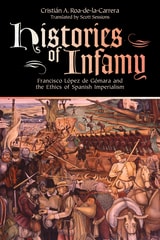
Histories of Infamy
Francisco López de Gómara and the Ethics of Spanish ImperialismCristián A. Roa-de-la-Carrera
University Press of Colorado, 2005
- Luis Fernando Restrepo, University of Arkansas
“In an eloquent and thorough exegesis, Roa-de-la-Carrera reveals how and why López de Gómara, having written the best of all possible books in exultation of Spanish imperialism, nevertheless failed to convince the readers of his time."
- Susan Schroeder, Tulane University
In Histories of Infamy, Cristián Roa-de-la-Carrera explores Francisco López de Gómara's (1511-ca.1559) attempt to ethically reconcile Spain's civilizing mission with the conquistadors' abuse and exploitation of Native peoples.
The most widely read account of the conquest in its time, Gómara's Historia general de las Indias y Conquista de México rationalized the conquistadors' crimes as unavoidable evils in the task of bringing "civilization" to the New World. Through an elaborate defense of Spanish imperialism, Gómara aimed to convince his readers of the merits of the conquest, regardless of the devastation it had wrought upon Spain's new subjects. Despite his efforts, Gómara's apologist text quickly fell into disrepute and became ammunition for Spain's critics. Evaluating the effectiveness of ideologies of colonization, Roa-de-la-Carrera's analysis will appeal to scholars in colonial studies and readers interested in the history of the Americas.
Homilies on Genesis, 1–17
Saint John Chrysostom
Catholic University of America Press, 1986
Homilies on Jeremiah and 1 Kings 28
Catholic University of America Press, 1998
Homilies on Leviticus, 1-16
Catholic University of America Press, 1990
Homilies on Luke
Catholic University of America Press, 1996
Homilies on Psalms, 36-38
Michael Origen
Catholic University of America Press, 2023
Homilies on the Psalms
Codex Monacensis Graecus 314Joseph W. Origen
Catholic University of America Press, 2021
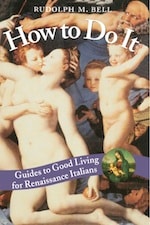
How to Do It
Guides to Good Living for Renaissance ItaliansRudolph M. Bell
University of Chicago Press, 1999
"Lively and curious reading, particularly in its cascade of anecdote, offered in a breezy, cozy, journalistic style." —Lauro Martines, Times Literary Supplement
"[Bell's] fascinating book is a window on a lost world far nearer to our own than we might imagine. . . . How pleasant to read his delightful, informative and often hilarious book." —Kate Saunders, The Independent
"An extraordinary work which blends the learned with the frankly bizarre." —The Economist
"Professor Bell has a sly sense of humor and an enviably strong stomach. . . . He wants to know how people actually behaved, not how the Church or philosophers or earnest humanists thought they should behave. I loved this book." —Christopher Stace, Daily Telegraph