Results by title
374 books match the query 'Economic History' and 15 start with h

Harmony and the Balance
An Intellectual History of Seventeenth-Century English Economic ThoughtAndrea Finkelstein
University of Michigan Press, 2000
Andrea Finkelstein is Assistant Professor of History, City University of New York.
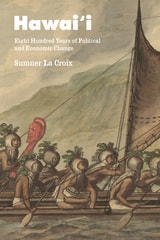
Hawai'i
Eight Hundred Years of Political and Economic ChangeSumner La Croix
University of Chicago Press, 2019
Building on new archaeological and historical research, Sumner La Croix assembles here the economic history of Hawai‘i from the first Polynesian settlements in 1200 through US colonization, the formation of statehood, and to the present day. He shows how the political and economic institutions that emerged and evolved in Hawai‘i during its three centuries of global isolation allowed an economically and culturally rich society to emerge, flourish, and ultimately survive annexation and colonization by the United States. The story of a small, open economy struggling to adapt its institutions to changes in the global economy, Hawai‘i offers broadly instructive conclusions about economic evolution and development, political institutions, and native Hawaiian rights.
Hayek and the Evolution of Capitalism
Naomi Beck
University of Chicago Press, 2018
Yet even among those who study his work in depth, few have looked closely at his use of ideas from evolutionary science to advance his vision of markets and society. With this book Naomi Beck offers the first full-length engagement with Hayek’s thought from this perspective. Hayek argued that the capitalism we see in advanced civilizations is an unintended consequence of group selection—groups that adopted free market behavior expanded more successfully than others. But this attempt at a scientific grounding for Hayek’s principles, Beck shows, fails to hold water, plagued by incoherencies, misinterpretations of the underlying science, and lack of evidence. As crises around the globe lead to reconsiderations of the place of capitalism, Beck’s excavation of this little-known strand of Hayek’s thought—and its failure—is timely and instructive.

Hayek on Mill
The Mill-Taylor Friendship and Related WritingsF. A. Hayek
University of Chicago Press, 2015
This latest addition to the University of Chicago Press’s Collected Works of F. A. Hayek series showcases the fascinating intersections between two of the most prominent thinkers from two successive centuries. Hayek situates Mill within the complex social and intellectual milieu of nineteenth-century Europe—as well as within twentieth-century debates on socialism and planning—and uncovers the influence of Taylor-Mill on Mill’s political economy. The volume features the Mill-Taylor correspondence and brings together for the first time Hayek’s related writings, which were widely credited with beginning a new era of Mill scholarship.
Hayek's The Road to Serfdom
A Brief IntroductionBruce Caldwell
University of Chicago Press, 2013
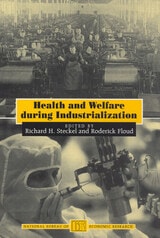
Health and Welfare during Industrialization
Edited by Richard H. Steckel and Roderick Floud
University of Chicago Press, 1997
The essays incorporate several indicators of quality of life, especially real per capita income and health, but also real wages, education, and inequality. And while the authors use traditional measures of health such as life expectancy and mortality rates, this volume stands alone in its extensive use of new "anthropometric" data—information about height, weight and body mass index that indicates changes in nations' well-being. Consequently, Health and Welfare during Industrialization signals a new direction in economic history, a broader and more thorough understanding of what constitutes standard of living.

History of Economic Thought
Isaac Ilyich Rubin
Pluto Press, 1987

House Money
A History of the American Mortgage MarketJonathan D. Rose and Kenneth Snowden
University of Chicago Press, 0
How the market that made the American Dream was made—and what that history tells us about its future and fluctuations.
When Americans poured into cities and suburbs during the twentieth century, they needed capital to build and own homes. The market that emerged did more than merely provide it: the American mortgage market became the consequential, if occasionally misunderstood, cornerstone of the US financial system.
House Money traces the history of the growth and occasional collapse of the American mortgage market over the last 150 years. Jonathan Rose and Kenneth Snowden show how three major housing-related crises (of the 1930s, 1980s, and 2000s) were not just cyclical events nor bubbles. Rather, they were episodes in a common pattern: shocks produced when the availability of capital in the market was eclipsed by the risk the market took on. Rose and Snowden chart the macro factors that produced these capital/risk asymmetries, showing that in all three crises, the macroeconomic trends—not just bubbles, not banker avarice—conspired to create a downturn despite federal and private safeguards. This illustrates Rose and Snowden’s core principle: housing markets can (and often, must) shoulder considerable risk. When the capital behind that risk evaporates, trouble becomes more likely.
Mining more than a century of economic history, Rose and Snowden show how the institutions and practices in the American mortgage market reflect the push-pulls of its past—both the private innovations and the government interventions. House Money reveals the great risk undertaken in service to American homeownership—and the perennial question of what happens when that risk goes wrong.
Housing and Mortgage Markets in Historical Perspective
Edited by Eugene N. White, Kenneth Snowden, and Price V. Fishback
University of Chicago Press, 2014
This volume begins to answer these questions, providing a much-needed context for understanding recent events by examining how historical housing and mortgage markets worked—and how they sometimes failed. Renowned economic historians Eugene N. White, Kenneth Snowden, and Price Fishback survey the foundational research on housing crises, comparing that of the 1930s to that of the early 2000s in order to authoritatively identify what contributed to each crisis. Later chapters explore notable historical experiences with mortgage securitization and the role that federal policy played in the surge in home ownership between 1940 and 1960. By providing a broad historical overview of housing and mortgage markets, the volume offers valuable new insights to inform future policy debates.
How Reason Almost Lost Its Mind
The Strange Career of Cold War RationalityPaul Erickson, Judy L. Klein, Lorraine Daston, Rebecca Lemov, Thomas Sturm, and Michael D. Gordin
University of Chicago Press, 2013
How Revolutions Happen
Konstantin Sonin
University of Chicago Press, 0
From the Russian intellectual-in-exile Konstantin Sonin, a grand theory of when and how rapid political change happens—or doesn’t.
In 2015, economist Konstantin Sonin solidified his status as an enemy of the Russian state when he published an article predicting that Vladimir Putin’s presidency would produce the country’s third revolution by the middle of this century. Forced to flee the country, Sonin settled in Chicago. In the decade that followed, the Russian government continued to pursue him—placing him on their state wanted list, tracking his movements, and sentencing him in absentia to eight years in prison. Sonin’s research and political advocacy continued unabated. So did his writing.
Now, Sonin has completed his masterpiece: a revelatory and sweeping investigation of a timeless question—what makes a revolution? How Revolutions Happen pinpoints why they arise, why they don’t, and where they’re likely to occur next. Tracing examples of successful and failed examples from history—in China, France, Haiti, Ukraine—Sonin shows that revolutions don’t grow out of mere popular unrest; they happen when states cease to evolve. This argument extends well beyond why nations fail, considering also why nations almost fail and why other nations fail repeatedly. Drawing on both empirical evidence and his firsthand experience, he also argues that although revolutions are an important part of human societies, they are not inherently good or bad—or quick to end.
Wry, sweeping, and erudite, How Revolutions Happen recasts everything we think about political change. From one of the world’s foremost political economists, this book is a momentous cumulation of knowledge that allows us to fully understand what a revolution is, why they occurred in the past—and how to measure where they might be coming.
How the Dismal Science Got Its Name
Classical Economics and the Ur-Text of Racial PoliticsDavid M. Levy
University of Michigan Press, 2002
Economists of the time argued, on the other hand, that people of color were to be protected by the rule of law--hence the moniker "the dismal science."
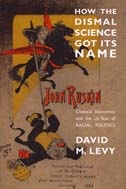
A startling image from 1893, which is reproduced in full color on this book's jacket, shows Ruskin killing someone who appears to be nonwhite. A close look reveals that the victim is reading "The Dismal Science."
Levy discusses this image at length and also includes in his text weblinks to Carlyle's "Occasional Discourse on the Negro Question" and to Mill's response, demonstrating that these are central documents in British classical economics. He explains Adam Smith's egalitarian foundations, contrasting Smith's approach to the hierarchical alternative proposed by Carlyle. Levy also examines various visual representations of this debate and provides an illuminating discussion of Smith's "katallactics," the science of exchange, comparing it with the foundations of modern neoclassical economics.
How the Dismal Science Got Its Name also introduces the notion of "rational choice scholarship" to explain how attacks on market economics from a context in which racial slavery was idealized have been interpreted as attacks on market economics from a humanistic or egalitarian context. Thus it will greatly appeal to economists, political scientists, philosophers, students of Victorian literature, and historians.
David M. Levy is Associate Professor of Economics and Research Associate, Center for Study of Public Choice, George Mason University.
How the West Came to Rule
The Geopolitical Origins of CapitalismAlex Anievas and Kerem Nisancioglu
Pluto Press, 2015
***Winner, British International Studies Association International Political Economy Working Group Book Prize 2016***
Mainstream historical accounts of the development of capitalism describe a profess which is fundamentally European—a system that was born in the mills and factories of English and under the guillotines of the French Revolution. This groundbreaking book tells a very difference story.
How the West Came to Rule offers a unique interdisciplinary and international historical account of the origins of capitalism. It argues that, contrary to dominant wisdom, capitalism’s origins should not be understood as a development confined to the geographically and culturally sealed borders of Europe, but the outcome of a wider array of global processes in which non-European societies played a decisive role.
Here is a provocative, incisive explanation of how capitalism emerged in England and Europe through a dialectical intersocietal and geopolitical process. The authors’ aim to undermine a Eurocentric bias that has been prominent in the debate about capitalisms rise to supremacy, and their case is remarkably convincing. They provide a fundamental rethinking. Anievas and Nisancioglu contend that often cited assumptions are neither theoretically nor empirically tenable and deny the agency of non-Western societies to the emergence of capitalism. Topics covered include:
*The Problem of Eurocentrism
*The Problem of Historical Specificity
*The Brenner Thesis: Explanation and Critique
*The Geopolitical in the Making of Capitalism
*The Political Marxist Conception of Capitalism
*Rethinking the Origins of Capitalism
*And much more!
Through an outline of the uneven histories of Mongolian expansion, New World discoveries, Ottoman-Habsburg rivalry, the development of the colonies, and bourgeois revolutions, Alex Anievas and Kerem Nisancioglu offer an account of capitalism’s origins that convincingly argues against the prevailing Eurocentric narratives. It will change minds and open the eyes of historians, economists, and political thinkers.

Human Capital in History
The American RecordEdited by Leah Platt Boustan, Carola Frydman, and Robert A. Margo
University of Chicago Press, 2014
Human Capital in History brings together contributions from leading researchers in economic history, labor economics, the economics of education, and related fields. Building on Claudia Goldin’s landmark research on the labor history of the United States, the authors consider the roles of education and technology in contributing to American economic growth and well-being, the experience of women in the workforce, and how trends in marriage and family affected broader economic outcomes. The volume provides important new insights on the forces that affect the accumulation of human capital.
Humanism Challenges Materialism in Economics and Economic History
Edited by Roderick Floud, Santhi Hejeebu, and David Mitch
University of Chicago Press, 2016
With Humanism Challenges Materialism in Economics and Economic History, Roderick Floud, Santhi Hejeebu, and David Mitch have brought together a distinguished group of scholars in economics, economic history, political science, philosophy, gender studies, and communications who synthesize and build on McCloskey’s work. The essays in this volume illustrate the ways in which the humanistic approach to economics that McCloskey pioneered can open up new vistas for the study of economic history and cultivate rich synergies with a wide range of disciplines. The contributors show how values and beliefs become embedded in the language of economics and shape economic outcomes. Chapters on methodology are accompanied by case studies discussing particular episodes in economic history.