Results by title
295 books match the query 'Ecosystems & Habitats' and 7 start with h
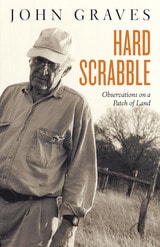
Hard Scrabble
Observations on a Patch of LandBy John Graves<br>Introduction by Rick Bass
University of Texas Press, 2016
“A kind of homemade book—imperfect like a handmade thing, a prize. It’s a galloping, spontaneous book, on occasion within whooping distance of that greatest and sweetest of country books, Ivan Turgenev’s A Sportsman’s Notebook.” —Edward Hoagland, New York Times Book Review
“His subjects are trees and brush, hired help, fences, soil, armadillos and other wildlife, flood and drought, local history, sheep and goats . . . and they come to us reshaped and reenlivened by his agreeably individual (and sometimes cranky) notions.” —New Yorker
“If Goodbye to a River was in some sense Graves’s Odyssey, this book is his [version of Hesiod’s] Works and Days. It is partly a book about work, partly a book about nature, but mostly a book about belonging. In the end John Graves has learned to belong to his patch of land so thoroughly that at moments he can sense in himself a unity with medieval peasants and Sumerian farmers, working with their fields by the Tigris.” —Larry McMurtry, Washington Post Book World
“Hard Scrabble is hard pastoral of the kind we have learned to recognize in Wordsworth, Frost, Hemingway, and Faulkner. It celebrates life in accommodation with a piece of the ‘given’ creation, a recalcitrant four hundred or so acres of Texas cedar brake, old field, and creek bottom, which will require of any genuine resident all the character he can muster.” —Southwest Review
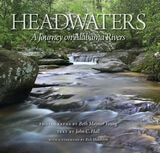
Headwaters
A Journey on Alabama RiversJohn C. Hall and Beth Maynor Young
University of Alabama Press, 2009
A breathtaking portrait of Alabama rivers.
From their primal seepages in the Appalachian highlands or along the broad Chunnenuggee Hills, Alabama’s rivers carve through the rocky uplands and down the Fall Line rapids, then ease across the coastal plain to their eventual confluence with the Gulf of Mexico.
Beth Maynor Young’s 155 full-color photographs constitute art through a lens; the colors, the light, and the angles all converge for a tender praise of her subject. Her stunning visuals are supported by tantalizing captions and introductory text from John C. Hall, a master field trip leader. Together, they tell a proud story of the native beauty and complexity of these Alabama watercourses that shepherd fully 20% of the nation’s fresh water to sea.
The intimate close-up of verdant mosses or pebbled beaches pulls one into their space just as surely as does a sweeping scene of a watershed valley or a sparkling sunset over water. We all become eager listeners and observers on this guided “paddle to the Gulf,” drinking in the peace, delight, and beauty offered by the experience. At the end, we know we won’t be the same as before beginning the journey.
In addition to being a celebration of their richness, Headwaters serves as a call to greater stewardship of these riverine resources. Conservation sidebars describe the current efforts in this direction and encourage further study and protection. This book tells us, in glorious color and instructive word, why we’ll always treasure these wonderful rivers.
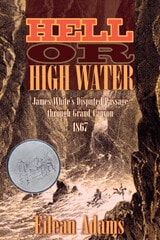
Hell Or High Water
James White's Disputed Passage through Grand Canyon, 1867Eilean Adams
Utah State University Press, 2001
Although John Wesley Powell and party are usually given credit for the first river descent through the Grand Canyon, the ghost of James White has haunted those claims. White was a Colorado prospector, who, almost two years before Powell's journey, washed up on a makeshift raft at Callville, Nevada. His claim to have entered the Colorado above the San Juan River with another man (soon drowned) as they fled from Indians was widely disseminated and believed for a time, but Powell and his successors on the river publically discounted it. Colorado River runners and historians have since debated whether White's passage through Grand Canyon even could have happened.
Hell or High Water is the first full account of White's story and how it became distorted and he disparaged over time. It is also a fascinating detective story, recounting how White's granddaughter, Eilean Adams, over decades and with the assistance of a couple of notable Colorado River historians who believed he could have done what he claimed, gradually uncovered the record of James White's adventure and put together a plausible narrative of how and why he ended up floating helplessly down a turbulent river, entrenched in massive cliffs, with nothing but a driftwood raft to carry him through.

Hidden Ocean Forests
An Undersea Journey to Uncover a Fascinating World of KelpRoss Frylinck and Faine Loubser
University of Chicago Press, 2027
Stunning underwater photography of the world’s great marine kelp forests and the wildlife they shelter.
Kelp forests, which thrive in cold, nutrient-rich waters, are found along the coasts of every continent except Antarctica. These underwater realms are stunningly beautiful and host entire ecosystems, providing food, shelter, and breeding grounds for an abundance of marine life.
With transcendent photography and compelling accounts from freedivers and storytellers Ross Frylinck and Faine Loubser, this book offers a captivating glimpse into these ocean forests. Dive beneath the midnight sun in the Arctic Circle and watch the northern lights dance over the waters of Shetland, Scotland. In Aotearoa New Zealand, swim with playful sea lions off Rakiura Stewart Island. In South Africa’s Cape Peninsula, cross paths with dusky dolphins, whales, and sharks. Meet an austral sea wolf in the icy Strait of Magellan and learn from kelp harvesters on remote islands in Japan.
Hidden Ocean Forests documents kelp forests around the world, showcasing their rich biodiversity and long-lasting impacts on human culture. These remarkable images and enchanting essays reveal the hidden beauty, significance, and fragility of these submerged wonderlands.
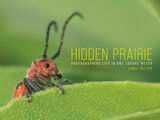
Hidden Prairie
Photographing Life in One Square MeterChris Helzer
University of Iowa Press, 2020
This book is packed with gorgeous full-page close-up photos of prairie plants and animals, interspersed with a dozen short essays that include both ecology and natural history tidbits and enthralling and gently humorous anecdotes about Helzer’s experience staring into a tiny bit of prairie for one year. Helzer writes eloquently about the conservation value of prairies and uses his photos and stories to reinforce a conservation ethic among his readers.
History of the Alps, 1500 - 1900
Environment, Development, and SocietyJon Mathieu, translated by Matthew Vester
West Virginia University Press, 2009
In the 1700s, Jean-Jacques Rousseau celebrated the Alps as the quintessence of the triumph of nature over the “horrors” of civilization. Now available in English, History of the Alps, 1500-1900: Environment, Development, and Society provides a precise history of one of the greatest mountain range systems in the world. Jon Mathieu’s work disproves a number of commonly held notions about the Alps, positioning them as neither an inversion of lowland society nor a world apart with respect to Europe. Mathieu’s broad historical portrait addresses both the economic and sociopolitical—exploring the relationship between population levels, development, and the Alpine environment, as well as the complex links between agrarian structure, society, and the development of modern civilization. More detailed analysis examines the relationship between various agrarian structures and shifting political configurations, several aspects of family history between the late Middle Ages and the turn of the twentieth century, and exploration of the Savoy, Grisons, and Carinthia regions.
Hollows, Peepers, and Highlanders
An Appalachian Mountain EcologyGeorge Constantz
West Virginia University Press, 2004
In this revised and expanded edition of Hollows, Peepers, and Highlanders, author George Constantz, a biologist and naturalist, writes about the beauty and nature of the Appalachian landscape. While the information is scientific in nature, Constantz's accessible descriptions of the adaptation of various organisms to their environment enable the reader to enjoy learning about the Appalachian ecosystem. The book is divided into three sections: "Stage and Theater," "The Players," and "Seasonal Act." Each section sets the scene and describes the events occurring in nature. "Stage and Theatre" is comprised of chapters that describe the origins of the Appalachia region. "The Players" is an interesting and in-depth look into the ecology of animals, such as the mating rituals of different species, and the evolutionary explanation for the adaptation of Appalachian wildlife. The last section, "Seasonal Act," makes note of the changes in Appalachian weather each season and its effect on the inhabitants.