Results by title
64 books match the query 'Ecuador' and 2 start with h
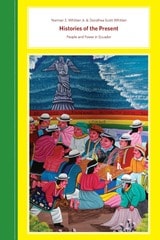
Histories of the Present
People and Power in EcuadorNorman E. Whitten Jr. and Dorothea Scott Whitten
University of Illinois Press, 2011
The wellspring of critical analysis in this book emerges from Ecuador's major Indigenous Uprising of 1990 and its ongoing aftermath in which indigenous and Afro-Ecuadorian action transformed the nation-state and established new dimensions of human relationships. The authors weave anthropological theory with longitudinal Ecuadorian ethnography to produce a unique contribution to Latin American studies.
[more]
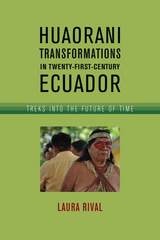
Huaorani Transformations in Twenty-First-Century Ecuador
Treks into the Future of TimeLaura Rival
University of Arizona Press, 2016
The indigenous people of the Amazon Basin known as the Huaorani are one of the world’s most intriguing peoples. The community of just under four thousand in Ecuador has been known to the public primarily for their historical identity as a violent society. But Laura Rival reveals the Huaorani in all their humanity and creativity through a longitudinal ethnography, bringing a deeper perspective beyond the stereotype.
Rival’s intimate knowledge of Huaorani culture spans twenty-five years. Here in a collection of broad-ranging essays, she offers a fascinating and provocative study. The first section, “Among Forest Beings,” shows that the Huaorani have long adapted to life in the tropical rain forest with minimal reliance on horticulture, yet have developed a complex relationship with plants. In “In the Longhouse,” the second section, Rival focuses on the intimate relations that create human persons and enact kinship relations. She also discusses women’s lives and perspectives. The third section, “In the Midst of Enemies,” considers how Huaorani society fits in larger political and economic contexts, illustrating how native values shape their encounters with oil companies, the state, and other external forces. Rival carefully analyzes insider/outsider dialectics wherein Huaorani people re-create meaningful and valued worlds in the face of alien projects, such as petroleum development, carbon trading, or intercultural education.
Capitalizing on the author’s decades-long study and interactions in the community, Huaorani Transformations in Twenty-First-Century Ecuador brings new insights to the Huaorani’s unique way of relating to humans, to other-than-humans, and to the forest landscape they have inhabited for centuries.
[more]