Results by title
2728 books match the query 'Education' and 68 start with h
Hacking the Academy
New Approaches to Scholarship and Teaching from Digital HumanitiesDaniel J. Cohen and Tom Scheinfeldt, Editors
University of Michigan Press, 2013
On May 21, 2010, Daniel J. Cohen and Tom Scheinfeldt posted the following provocative questions online:
“Can an algorithm edit a journal? Can a library exist without books? Can students build and manage their own learning management platforms? Can a conference be held without a program? Can Twitter replace a scholarly society?”
As recently as the mid-2000s, questions like these would have been unthinkable. But today serious scholars are asking whether the institutions of the academy as they have existed for decades, even centuries, aren’t becoming obsolete. Every aspect of scholarly infrastructure is being questioned, and even more importantly, being hacked. Sympathetic scholars of traditionally disparate disciplines are canceling their association memberships and building their own networks on Facebook and Twitter. Journals are being compiled automatically from self-published blog posts. Newly minted PhDs are forgoing the tenure track for alternative academic careers that blur the lines between research, teaching, and service. Graduate students are looking beyond the categories of the traditional CV and building expansive professional identities and popular followings through social media. Educational technologists are “punking” established technology vendors by rolling out their own open source infrastructure.
Here, in Hacking the Academy, Daniel J. Cohen and Tom Scheinfeldt have gathered a sampling of the answers to their initial questions from scores of engaged academics who care deeply about higher education. These are the responses from a wide array of scholars, presenting their thoughts and approaches with a vibrant intensity, as they explore and contribute to ongoing efforts to rebuild scholarly infrastructure for a new millennium.

Handbook for In-Service Training in Human Services
William Crimando
Southern Illinois University Press, 1988
A practical "how-to" workbook that outlines a plan for the design and implementation of staff in-service training programs for human service agencies and facilities.
Crimando and Riggar have made every effort to guarantee the usefulness of this text to practitioners, instructors, and students. This is a working book designed to assist trainers as they acquire the knowledge and skills needed to provide thorough, systematic in-service training that will enhance human service endeavors.
The authors have organized the nineteen chapters into four parts that treat significant steps in the training-program design process. These include analyzing problems that require training solutions; developing a proposal; writing a plan of action for training; and evaluating a program. Each of the chapters combines text, examples, exercises, and supplementary readings to foster a full appreciation of the process involved. Even those topics frequently overlooked or disregarded are included: budgeting program time and financial resources, obtaining administrative commitment, and transferring and maintaining skills in the work setting.
Handbook for Management of Human Service Agencies
T.F. Riggar and R.E. Matkin
Southern Illinois University Press, 1986
A basic guide for individuals responsible for developing and/or operating comprehensive or specialized human service programs.
Drawing on more than a decade of classroom experience and development and incorporating standards from the Commission on Accreditation of Rehabilitation Facilities (1985 Edition), Riggar and Matkin have created a management tool that is as practical for human service providers as it is for students. Here is the fundamental management knowledge required to establish or manage all types of human service programs and facilities.
The text is organized into 23 sections that describe tasks ranging from constructing mission statements and admission criteria to developing start-up budgets and allocating space for both direct and indirect services. Each section provides definitions and guidelines, practical examples, exercises, and selected references. While the focus is on the practices of the private not-for-profit sector, those working in a profit-oriented setting will find many of the sections and exercises to be valuable aids for developing, operating, and maintaining successful programs.
Handbook of Engaged Scholarship
Contemporary Landscapes, Future Directions: Volume 1: Institutional ChangeHiram E. Fitzgerald
Michigan State University Press, 2010
In the preface to the Handbook of Engaged Scholarship, Hiram Fitzgerald observes that the Kellogg Commission's challenge to higher education to engage with communities was a significant catalyst for action. At Michigan State University, the response was the development of "engaged scholarship," a distinctive, scholarly approach to campus-community partnerships.
Engaged scholars recognize that community based scholarship is founded on an underpinning of mutual respect and recognition that community knowledge is valid and that sustainability is an integral part of the partnership agenda.
In this two-volume collection, contributors capture the rich diversity of institutions and partnerships that characterize the contemporary landscape and the future of engaged scholarship. Volume One addresses such issues as the application of engaged scholarship across types of colleges and universities and the current state of the movement. Volume Two contains essays on such topics as current typologies, measuring effectiveness and accreditation, community-campus partnership development, national organizational models, and the future landscape.
Handbook of Engaged Scholarship
Contemporary Landscapes, Future Directions: Volume 2: Community-Campus PartnershipsHiram E. Fitzgerald
Michigan State University Press, 2010
In the preface to the Handbook of Engaged Scholarship, Hiram Fitzgerald observes that the Kellogg Commission's challenge to higher education to engage with communities was a significant catalyst for action. At Michigan State University, the response was the development of "engaged scholarship," a distinctive, scholarly approach to campus-community partnerships.
Engaged scholars recognize that community based scholarship is founded on an underpinning of mutual respect and recognition that community knowledge is valid and that sustainability is an integral part of the partnership agenda.
In this two-volume collection, contributors capture the rich diversity of institutions and partnerships that characterize the contemporary landscape and the future of engaged scholarship. Volume One addresses such issues as the application of engaged scholarship across types of colleges and universities and the current state of the movement. Volume Two contains essays on such topics as current typologies, measuring effectiveness and accreditation, community-campus partnership development, national organizational models, and the future landscape.

Handwriting of the Twentieth Century
Rosemary Sassoon
Intellect Books, 2007
In addition to illustrating the techniques used by handwriting instructors and documenting the ever-changing views of script stylists, this volume probes the development and manufacture of writing equipment as well as useful examples for today’s teachers of writing. Handwriting of the Twentieth Century is a delightful, comprehensive account of our constant quest for fluent and clear handwritten script.
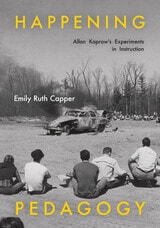
Happening Pedagogy
Allan Kaprow's Experiments in InstructionEmily Ruth Capper
University of Chicago Press, 2026
How Allan Kaprow’s happenings fused modernist pedagogy with an emerging college culture.
In Happening Pedagogy, art historian Emily Ruth Capper argues that Allan Kaprow’s famed invention of the happening brought together experimental traditions of modernist pedagogy with emerging forms of American undergraduate student culture—from hazing rituals to campus protests. Capper traces Kaprow’s trajectory from 1947 to 1968, following him through the classrooms of three of his instructors who were prominent figures in postwar American art—painter Hans Hofmann, art historian Meyer Schapiro, and composer John Cage—and across his own classrooms at institutions including Rutgers and Stony Brook University. Although Kaprow’s teachers were educated in the distinct disciplines of studio art, art history, and music, all three designed their classrooms to cultivate student creativity and critical reflection through forms of social exchange.
Capper shows that Kaprow transformed these modernist classrooms into new pedagogical environments that he developed within the novel context of the suburban state university. Drawing on archival sources, she describes how Kaprow engaged the culture and creative work of middle-class college students, whose rituals he took seriously as an avant-garde vernacular. In this way, Kaprow’s happenings represent a critical extension of modernism as a social practice of sensory attunement, experimentation, and philosophical critique. Through Kaprow’s work, modernist pedagogy became an artistic medium in itself, and his participation-based creative practices helped define the broad resurgence of the American neo-avant-garde after 1960.
Happiness and Wisdom
Augustine's Early Theology of EducationRyan N. S. Topping
Catholic University of America Press, 2012
Harker's One-Room Schoolhouses
Visions of an Iowa IconPaul Theobald
University of Iowa Press, 2008
Michael Harker’s goal is to record Iowa’s historically significant architecture before it disappears forever. From Coon Center School no. 5 in Albert City to Pleasant Valley School in Kalona, North River School in Winterset to Douglas Center School in Sioux Rapids, and Iowa’s first school to Grant Wood’s first school, he has achieved this goal on a grand scale in Harker’s One-Room Schoolhouses.
Educational historian Paul Theobald tells the story of the rise and fall of Iowa’s one-room schools, whose numbers fell from close to 15,000 in 1918 to only 1,100 in 1960, all of which had ceased to function as schools by 1980. Moving from the state-wide story to the personal, he introduces us to George Coleman, son of a local farmer and school board director, who kept a sparse diary between December 1869 and June 1870. Young George’s words reveal the intimate way in which one-room schools interacted with the local community, including the local economic scene. Theobald ends by suggesting that these one-room relics of the past may again prove useful.
Harlem vs. Columbia University
Black Student Power in the Late 1960sStefan M. Bradley
University of Illinois Press, 2012

Harry Burns Hutchins and the University of Michigan
Shirley W. Smith
University of Michigan Press, 1951

Have a Little Faith
Religion, Democracy, and the American Public SchoolBenjamin Justice and Colin Macleod
University of Chicago Press, 2016
From Bible readings and school prayer to teaching evolution and cultivating religious tolerance, Justice and Macleod consider the key issues and colorful characters that have shaped the way American schools have attempted to negotiate religious pluralism in a politically legitimate fashion. While schools and educational policies have not always advanced tolerance and understanding, Justice and Macleod point to the many efforts Americans have made to find a place for religion in public schools that both acknowledges the importance of faith to so many citizens and respects democratic ideals that insist upon a reasonable separation of church and state. Finally, they apply the lessons of history and political philosophy to an analysis of three critical areas of religious controversy in public education today: student-led religious observances in extracurricular activities, the tensions between freedom of expression and the need for inclusive environments, and the shift from democratic control of schools to loosely regulated charter and voucher programs.
Altogether Justice and Macleod show how the interpretation of educational history through the lens of contemporary democratic theory offers both a richer understanding of past disputes and new ways of addressing contemporary challenges.
Head Masters
Phrenology, Secular Education, and Nineteenth-Century Social ThoughtStephen Tomlinson
University of Alabama Press, 2005
Head Masters challenges the assumption that phrenology—the study of the conformation of the skull as it relates to mental faculties and character—played only a minor and somewhat anecdotal role in the development of education. Stephen Tomlinson asserts instead that phrenology was a scientifically respectable theory of human nature, perhaps the first solid physiological psychology. He shows that the first phrenologists were among the most prominent scientists and intellectuals of their day, and that the concept was eagerly embraced by leading members of the New England medical community.
Following its progression from European theorists Franz-Joseph Gall, Johan Gasper Spurzheim, and George Combe to Americans Horace Mann and Samuel Gridley Howe, Tomlinson traces the origins of phrenological theory and examines how its basic principles of human classification, inheritance, and development provided a foundation for the progressive practices advocated by middle-class reformers such as Combe and Mann. He also elucidates the ways in which class, race, and gender stereotypes permeated 19th century thought and how popular views of nature, mind, and society supported a secular curriculum favoring the use of disciplinary practices based on physiology.
This study ultimately offers a reconsideration of the ideas and theories that motivated education reformers such as Mann and Howe, and a reassessment of Combe, who, though hardly known by contemporary scholars, emerges as one of the most important and influential educators of the 19th century.
Head, Heart, and Hand
John Brown University and Modern Evangelical Higher EducationRick Ostrander
University of Arkansas Press, 2018
Health Extension
Community-Based Healthcare and the Future of Cooperative ExtensionCheryl L. Eschbach
Michigan State University Press, 2024
Health Humanities Reader
Jones, Therese
Rutgers University Press, 2014
In Health Humanities Reader, editors Therese Jones, Delese Wear, and Lester D. Friedman have assembled fifty-four leading scholars, educators, artists, and clinicians to survey the rich body of work that has already emerged from the field—and to imagine fresh approaches to the health humanities in these original essays. The collection’s contributors reflect the extraordinary diversity of the field, including scholars from the disciplines of disability studies, history, literature, nursing, religion, narrative medicine, philosophy, bioethics, medicine, and the social sciences.
With warmth and humor, critical acumen and ethical insight, Health Humanities Reader truly humanizes the field of medicine. Its accessible language and broad scope offers something for everyone from the experienced medical professional to a reader interested in health and illness.
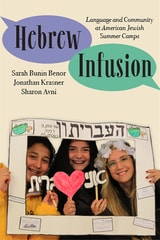
Hebrew Infusion
Language and Community at American Jewish Summer CampsSarah Bunin Benor, Jonathan B. Krasner, and Sharon Avni
Rutgers University Press, 2019
Each summer, tens of thousands of American Jews attend residential camps, where they may see Hebrew signs, sing and dance to Hebrew songs, and hear a camp-specific hybrid language register called Camp Hebraized English, as in: “Let’s hear some ruach (spirit) in this chadar ochel (dining hall)!” Using historical and sociolinguistic methods, this book explains how camp directors and staff came to infuse Hebrew in creative ways and how their rationales and practices have evolved from the early 20th century to today. Some Jewish leaders worry that Camp Hebraized English impedes Hebrew acquisition, while others recognize its power to strengthen campers’ bonds with Israel, Judaism, and the Jewish people. Hebrew Infusion explores these conflicting ideologies, showing how hybrid language can serve a formative role in fostering religious, diasporic communities. The insightful analysis and engaging descriptions of camp life will appeal to anyone interested in language, education, or American Jewish culture.
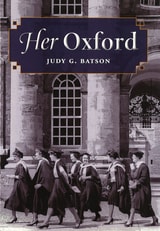
Her Oxford
Judy G. Batson
Vanderbilt University Press, 2008
Her Oxford looks at the people and the political and social forces that produced this dramatic transformation. Drawing on a vast array of biographies, histories, obituaries, and archives, Batson traces not only the institutional struggles over privileges and disciplinary rules for women, but also the rich texture of everyday life-women's amateur theatricals, debating societies, sports, and college escapades (Dorothy Sayers is the subject of quite a few). She tells the stories of women's active roles in two war efforts and in the suffrage movement.
An unusual feature of the book is the set of 120 biographical profiles of women who attended Oxford between 1879 and 1960. They constitute a Who's Who of women scientists, anthropologists, psychotherapists, educators, novelists, and social reformers in the English-speaking world.
Heritage and Hate
Old South Rhetoric at Southern UniversitiesStephen M. Monroe
University of Alabama Press, 2021
How southern universities continue to wrestle with the words and symbols that embody and perpetuate Old South traditions
The US South is a rhetorical landscape that pulsates with division, a place where words and symbols rooted in a deeply problematic past litter the ground and contaminate the soil. Stephen M. Monroe’s provocative study focuses on predominantly white southern universities where Old South rhetoric still reverberates, where rebel flags cast a shadow over attempts at racial harmony, school cheers to reinforce racial barriers, and student yearbooks to create and protect an oppressive culture of exclusion. Across the region, in college towns like Oxford, Mississippi; Athens, Georgia; and Tuscaloosa, Alabama—communities remain locked in a difficult, recursive, and inherently rhetorical struggle that wrestles with this troubling legacy.
Words, images, and symbols are not merely passive artifacts of southern history, Monroe argues, but formative agents that influence human behavior and shape historical events. Drawing on research from many disciplines, including rhetoric, southern studies, history, sociology, and African American studies, Monroe develops the concept of confederate rhetoric: the collection of Old South words and symbols that have been and remain central to the identity conflicts of the South. He charts examples of such rhetoric at work in southern universities from Reconstruction to the present day.
Tracing the long life and legacy of Old South words and symbols at southern universities, this book provides close and nuanced analysis of the rhetorical conflicts that have resulted at places like the University of Mississippi and the University of Missouri. Some conflicts erupted during the civil rights movement, when the first African American students sought admission to all-white southern universities and colleges, and others are brewing now, as African Americans (and their progressive white peers) begin to cement genuine agency and voice in these communities. Tensions have been, and remain, high.
Ultimately, Monroe offers hope and optimism, contending that if words and symbols can be used to damage and divide, then words and symbols can also be used to heal and unify. Racist rhetoric can be replaced by antiracist rhetoric. The old South can become new. While resisting naïve or facile arguments, Heritage and Hate ultimately finds the promise of progress within the tremendous power of language.
Hidden Inequities in Labor-Based Contract Grading
Ellen C. Carillo
Utah State University Press, 2021
Current Arguments in Composition Series
The Hidden Inequities in Labor-Based Contract Grading intervenes in the increasingly popular practice of labor-based grading by expanding the scope of this assessment practice to include students who are disabled and multiply marginalized. Through the lens of disability studies, the book critiques the assumption that labor is a neutral measure by which to assess students and explores how labor-based grading contracts put certain groups of students at a disadvantage. Ellen C. Carillo offers engagement-based grading contracts as an alternative that would provide a more equitable assessment model for students of color, those with disabilities, and students who are multiply marginalized.
This short book explores the history of labor-based grading contracts, reviews the scholarship on this assessment tool, highlights the ways in which it normalizes labor as an unbiased tool, and demonstrates how to extend the conversation in new and generative ways both in research and in classrooms. Carillo encourages instructors to reflect on their assessment practices by demonstrating how even assessment methods that are designed through a social-justice lens may unintentionally privilege some students over others.
Hidden Tuition
An Insider's Guide to College Pricing and Financial AidPhillip B. Levine
University of Chicago Press, 2026
The secret economics of maximizing college financial aid (and why it’s not as miserable as you think).
In the college admissions process, a terrifying unknown looms large: How much is this really going to cost? For prospective students and their families, there’s no easy answer. While college prices continue to rise, so do their promises of financial aid for qualified students. But who qualifies? And for how much? How can this monumental life decision be so utterly impossible to understand?
Hidden Tuition is an insider’s guide for navigating college financial aid to maximum effect and with (relatively) minimal pain. Economist and financial-aid expert Phillip B. Levine draws on his unique experience—including years of research in higher-education finance and work alongside admissions and financial-aid departments—to help readers first identify, then minimize, what they’ll actually pay for different types of colleges based on their circumstances. With expertise, clarity, and the warmth of someone who’s been through it, Levine details how students can find the hidden tuition costs in the opaque landscape of college pricing and financial aid. He explores topics that include:
- Why college’s “sticker prices” are rarely what students pay—and how some actual prices are even going down
- The best, worst, and most surprising deals for students with different financial resources
- How to navigate financial aid for divorced and multi-residence households
- Who really benefits from early decision
- How the nature of scholarships and merit-based aid is often framed in misleading ways
- The pros and cons of college savings accounts
- When and how to get started on college financing
- Why all student loans aren't the same (or aren't all that bad)
Debunking common myths and offering practical guidance for both families and individual students, Hidden Tuition makes a maddeningly imperfect process more manageable—and gives students a clearer path through one of life’s biggest financial decisions towards collegiate success.
High-Stakes Schooling
What We Can Learn from Japan's Experiences with Testing, Accountability, and Education ReformChristopher Bjork
University of Chicago Press, 2015
Bjork asks a variety of important questions related to testing and reform: Does testing overburden students? Does it impede innovation and encourage conformity? Can a system anchored by examination be reshaped to nurture creativity and curiosity? How should any reforms be implemented by teachers? Each chapter explores questions like these with careful attention to the actual effects policies have had on schools in Japan and other Asian settings, and each draws direct parallels to issues that US schools currently face. Offering a wake-up call for American education, Bjork ultimately cautions that the accountability-driven practice of standardized testing might very well exacerbate the precise problems it is trying to solve.
Higher Education amid the COVID-19 Pandemic
Supporting Teaching and Learning through Turbulent TimesJessica Ostrow Michel
Rutgers University Press, 2024
Higher Education and Democracy
Essays on Service-Learning and Civic EngagementEdited by John Saltmarsh and Edward Zlotkowski
Temple University Press, 2011
Higher Education and Democracy is a collection of essays written over the last ten years on how civic engagement in higher education works to achieve what authors John Saltmarsh and Edward Zlotkowsi consider to be the academic and civic purposes of higher education. These include creating new modes of teaching and learning, fostering participation in American democracy, the development and respect for community and civic institutions, and encouraging the constant renewal all of these dimensions of American life.
Organized chronologically, the twenty-two essays in this volume provide "signposts" along the road in the journey of fulfilling the civic purposes of higher education. For the authors, service-learning is positioned as centrally important to the primary academic systems and structures of higher education, departments, disciplines, curriculum, and programs that are central to the faculty domain. Progressing from the general and the contextual to specific practices embodied in ever larger academic units, the authors conclude with observations on the future of the civic engagement movement.
Higher Education and the American Dream
Success and Its DiscontentsMarvin Lazerson
Central European University Press, 2007

Higher Education and the State in Latin America
Private Challenges to Public DominanceDaniel C. Levy
University of Chicago Press, 1986
Levy shows how specific national circumstances cause variations and identifies three basic private-public patterns: one in which the private and public sectors are relatively similar and those in which one sector or the other is dominant. These patterns are analyzed in depth in case studies of Chile, Mexico, and Brazil. For each sector, Levy investigates origins and growth, and then who pays, who rules, and whose interests are served.
In addition to providing a wealth of information, Levy offers incisive analyses of the nature of public and private institutions. Finally, he explores the implications of his findings for concepts such as autonomy, corporatism, and privatization. His multifaceted study is a major contribution to the literature on Latin American studies, comparative politics, and higher education.
Higher Ground
Ethics and Leadership in the Modern UniversityNannerl O. Keohane
Duke University Press, 2006
Keohane regards colleges and universities as intergenerational partnerships in learning and discovery, whose compelling purposes include not only teaching and research but also service to society. Their mission is to equip students with a moral education, not simply preparation for a career or professional school.
But the modern era has presented universities and their leadership with unprecedented new challenges. Keohane worries about access to education in a world of rising costs and increasing economic inequality, and about threats to academic freedom and expressions of opinion on campus. She considers diversity as a key educational tool in our increasingly pluralistic campuses, ponders the impact of information technologies on the university’s core mission, and explores the challenges facing universities as they become more “global” institutions, serving far-flung constituencies while at the same time contributing to the cities and towns that are their institutional homes.
Reflecting on the role of contemporary university leaders, Keohane asserts that while they have many problems to grapple with, they will find creative ways of dealing with them, just as their predecessors have done.
Hip-Hop Civics
Connected Learning in the Rap ClassroomJabari M. Evans
University of Michigan Press, 2025
Historical Thinking
Sam Wineburg
Temple University Press, 2001
Although most of us think of history -- and learn it -- as a conglomeration of facts, dates, and key figures, for professional historians it is a way of knowing, a method for developing and understanding about the relationships of peoples and events in the past. A cognitive psychologist, Wineburg has been engaged in studying what is intrinsic to historical thinking, how it might be taught, and why most students still adhere to the "one damned thing after another" concept of history.
Whether he is comparing how students and historians interpret documentary evidence or analyzing children's drawings, Wineburg's essays offer "rough maps of how ordinary people think about the past and use it to understand the present." Arguing that we all absorb lessons about history in many settings -- in kitchen table conversations, at the movies, or on the world-wide web, for instance -- these essays acknowledge the role of collective memory in filtering what we learn in school and shaping our historical thinking.
History Repeating Itself
The Republication of Children's Historical Literature and the Christian RightGregory M. Pfitzer
University of Massachusetts Press, 2014
Recently publishers on the Christian Right have been reprinting nineteenth-century children's history books and marketing them to parents as “anchor texts” for homeschool instruction. Why, Gregory M. Pfitzer asks, would books written more than 150 years ago be presumed suitable for educating twenty-first-century children? The answer, he proposes, is that promoters of these recycled works believe that history as a discipline took a wrong turn in the early twentieth century, when progressive educators introduced social studies methodologies into public school history classrooms, foisting upon unsuspecting and vulnerable children ideologically distorted history books.
In History Repeating Itself, Pfitzer tests these assertions by scrutinizing and contextualizing the original nineteenth-century texts on which these republications are based. He focuses on how the writers borrowed from one another to produce works that were similar in many ways yet differed markedly in terms of pedagogical strategy and philosophy of history. Pfitzer demonstrates that far from being non-ideological, these works were rooted in intense contemporary debates over changing conceptions of childhood.
Pfitzer argues that the repurposing of antiquated texts reveals a misplaced resistance to the idea of a contested past. He also raises essential philosophical questions about how and why curricular decisions are shaped by the “past we choose to remember” on behalf of our children.
History and Philosophy of the Humanities
An IntroductionMichiel Leezenberg
Amsterdam University Press, 2018
History and Philosophy of the Humanities
An IntroductionMichiel Leezenberg
Amsterdam University Press, 2019
'History and Philosophy of the Humanities: An Introduction' presents a reasoned overview of the conceptual and historical backgrounds of the humanities. In four sections, it discusses:
- the most influential views on scientific knowledge from Aristotle to Thomas Kuhn;
- the birth of the modern humanities and its relation to the natural and social sciences;
- the various methodological schools and conceptual issues in the humanities;
- several themes that set the agenda for current debates in the humanities: critiques of modernity; gender, sexuality and identity; and postcolonialism.
Thus, it provides students in the humanities with a comprehensive understanding of the backgrounds of their own discipline, its relation to other disciplines, and the state of the art of the humanities at large.

History and the Climate Crisis
Environmental History in the ClassroomKate Hawkey
University College London, 2023
History education has a key contribution to make in developing a deeper understanding of the current environmental crisis, but its role is too often overlooked. When embedded in the school curriculum, environmental history adds crucial layers of knowledge to the learning from other subjects and can enable students to make their own informed contributions to one of the most pressing concerns of the twenty-first century.
History and the Climate Crisis provides much-needed environmental knowledge, an area that is new for most history teachers. The author considers the disciplinary and pedagogical challenges and demonstrates how including an environmental focus can strengthen students’ disciplinary knowledge. She also builds her argument through many examples and offers practical strategies for use in classrooms, including developed inquiries suitable for the secondary history curriculum. The book focuses on environmental history within a strong subject-bound curriculum and will be relevant to teachers, academics, and policymakers in the United Kingdom and internationally.
History in My Life
A Memoir of Three ErasIvan T. Berend is Distinguished Research Professor at the History Department of the University of California Los Angeles.
Central European University Press, 2009
Ivan T. Berend is Distinguished Professor at the University of California Los Angeles, Director of the European Studies Program. He was one of the masterminds of regime change in Hungary. He made a career in Hungary as a university professor, Rector of the University of Economics (1973–79), and President of the Hungarian Academy of Sciences (1985–90). He was President of the International Committee of Historical Sciences (1995–2000), and Vice-President of the International Economic History Association (1986–1994). His research interests are the complex economic, social, ideological, and cultural history of Central and Eastern Europe in the 19th–20th century; economic modernization; problems of European backwardness; transition from state socialism to capitalism. He published and 26 books and more than 120 studies.
Before he became a professor at UCLA, Ivan Berend had survived five regime changes and two revolutions in Hungary, had been in prison and German concentration camp in 1944–45.
His memoir offers an interesting case study, a subjective addition to the “objective” historical works on Central and Eastern European state socialism. It describes the hard choices of intellectuals in a dictatorial state: 1. remain in isolation, concentrate on scholarly works, and exclude politics in your personal life; 2. be in opposition, criticize and unveil the regime, accept discrimination and exclusion; 3. remain within the establishment and work for reforming the country using legal possibilities to criticize the regime and to achieve changes from within.
Berend’s book raises basic historical questions and debates, compares East European and American higher education systems, and presents an eyewitness’ insights on life in the United States.

History of the University of Alabama
Volume One, 1818-1902James Benson Sellers
University of Alabama Press, 1953
The definitive and authorized history of the University of Alabama's birth and first century
Step into the rich heritage of one of America’s most storied institutions with the History of the University of Alabama, Volume One 1818 – 1902 by James Sellers. This definitive volume captures the legends, triumphs, and traditions that shaped the Capstone’s first century. From its earliest days on the frontier to its rise as a modern research university, Sellers weaves a narrative that celebrates the people, places, and pivotal moments that define the University of Alabama’s proud legacy.
Among the most dramatic chapters is the interruption of campus life during the closing days of the Civil War, when Union troops burned the university to the ground—a devastating blow that tested resilience and sparked a remarkable rebirth. Through vivid storytelling and meticulous research, Sellers honors the people and milestones that built the Crimson legacy.
Beautifully written and meticulously researched, this book is perfect as a gift for alumni, fans, and collectors. Whether displayed on a coffee table or shared with a fellow member of the Crimson Tide family, this book is more than history. It’s a tribute to the spirit of Alabama. Own the legend. Share the legacy. Celebrate the spirit of the Capstone for generations to come.
History's Babel
Scholarship, Professionalization, and the Historical Enterprise in the United States, 1880 - 1940Robert B. Townsend
University of Chicago Press, 2012
Holistic Shakespeare
An Experiential Learning ApproachDebra Charlton
Intellect Books, 2012
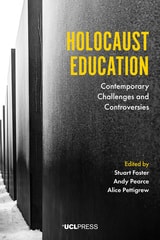
Holocaust Education
Contemporary Challenges and ControversiesEdited by Stuart Foster, Andy Pearce, and Alice Pettigrew
University College London, 2020
Teaching and learning about the Holocaust is central to school curriculums across the globe. But the history of the Holocaust remains controversial and can render teaching it daunting, even to the most experienced instructors. Drawing on landmark research into teaching practices and students’ knowledge, Holocaust Education provides unique insights about classroom learning. It sheds light on key challenges in Holocaust education, including the impact of misconceptions and misinformation, the dilemma posed by images of atrocity, and how to approach teaching in ethnically diverse environments. Overviews of the most significant debates in Holocaust education provide wider context for the classroom evidence. Holocaust Education offers a vital guide, leading readers through some of the most vexed areas of Holocaust challenges and controversies for teachers, researchers, and policymakers.
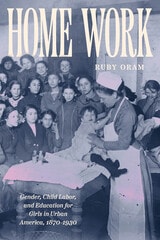
Home Work
Gender, Child Labor, and Education for Girls in Urban America, 1870–1930Ruby Oram
University of Chicago Press, 2025
In Home Work, historian Ruby Oram tells the story of how middle-class, white women reformers lobbied the state to implement various public education reforms to shape the lives of girls and women in industrial cities between 1870 and 1930. Women such as Jane Addams and Florence Kelley used education reform to target working-class communities and advocate for their middle-class ideals of girlhood and femininity, which could vary depending on the racial or socio-economic backgrounds of the girls. For example, reformers generally encouraged white girls to care for their future families, while pushing Black girls toward becoming domestic workers in others’ homes. Using Chicago as a case study, Oram also explores how many of the reforms sought by white women were in response to evolving anxieties about immigration, health, and sexual delinquency.
An illuminating addition to the history of urban education in America, Home Work enriches our understanding of educational inequality in twentieth-century schools.
Homeschooling
The History and Philosophy of a Controversial PracticeJames G. Dwyer and Shawn F. Peters
University of Chicago Press, 2019
Homeschooling
The History and Philosophy of a Controversial PracticeJames G. Dwyer and Shawn F. Peters
University of Chicago Press, 2019
This is an auto-narrated audiobook edition of this book.
Hope, Heart, and the Humanities
How a Free College Course is Changing LivesJean Cheney and L. Jackson Newell, editors, with Hikmet Sidney Loe, Jeff Metcalf, and Bridget M. Newell
University of Utah Press, 2016
Hope, Heart, and the Humanities tells the story of how Venture, a free, interdisciplinary college humanities course inspired by the national Clemente Course, has helped open doors to improve the lives of people with low incomes who face barriers to attending college. For over a decade, this course has given hundreds of adults, some of them immigrants or refugees, the knowledge, confidence, and power to rechart their lives.
Readers will go inside Venture classrooms to see what occurs when adults enter serious discussions about literature, critical writing, art history, American history, and philosophy. Apparent also are the difficulties nontraditional students, who range in age from 18 to 60, often encounter in a college classroom and the hard choices they and their teachers make. What readers may remember most are the stories and words from people whose views of the world broaden and whose directions in life changed.
Interview with Tom Williams at Access Utah
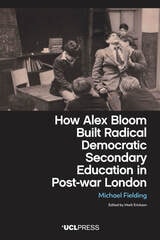
How Alex Bloom Built Radical Democratic Secondary Education in Post-war London
Michael Fielding
University College London, 2026
The true story behind a school that pioneered progressive education in post-Second World War Britain and inspired the famous film To Sir, With Love.
Alex Bloom (1895–1955) was a remarkable school leader whose reputation in his lifetime extended far beyond the UK. Against all odds, in the bomb-damaged remains of London’s East End immediately after the Second World War, he established a school that championed equality, democracy, diversity, and creativity. That school—St George-in-the-East Secondary Modern on Cable Street—is known to many as the inspiration for the novel and film To Sir, With Love, but its significance for education goes far deeper. An explicit affirmation of Bloom’s progressive values and aspirations, it had no punishments or rewards, no prizes or failures, and no set curriculum. It became a beacon for radical democratic schooling, achieving an astonishing international reputation and a lasting legacy.
Based on primary research with former teachers and pupils of St George-in-the-East, How Alex Bloom Built Radical Democratic Secondary Education in Post-war London recounts the story of the school’s founding, pedagogy, and democratic inclusivity. Through the book’s own narrative, and in short contributions from some of today’s leading educators, it examines Bloom’s contemporary and subsequent influence on education in the UK and further afield. Most of all, this book reveals Bloom’s extraordinary dedication and commitment to his staff, his pupils, and their community, exemplifying the importance of engaging with the school’s contemporary realities.
How Humans Learn
The Science and Stories behind Effective College TeachingJoshua R. Eyler
West Virginia University Press, 2018
Even on good days, teaching is a challenging profession. One way to make the job of college instructors easier, however, is to know more about the ways students learn. How Humans Learn aims to do just that by peering behind the curtain and surveying research in fields as diverse as developmental psychology, anthropology, and cognitive neuroscience for insight into the science behind learning.
The result is a story that ranges from investigations of the evolutionary record to studies of infants discovering the world for the first time, and from a look into how our brains respond to fear to a reckoning with the importance of gestures and language. Joshua R. Eyler identifies five broad themes running through recent scientific inquiry—curiosity, sociality, emotion, authenticity, and failure—devoting a chapter to each and providing practical takeaways for busy teachers. He also interviews and observes college instructors across the country, placing theoretical insight in dialogue with classroom experience.
How Myths about Language Affect Education
What Every Teacher Should KnowDavid Johnson
University of Michigan Press, 2013
How Myths about Language Affect Education: What Every Teacher Should Know clarifies some of the most common misconceptions about language, particularly those that affect teachers and the decisions they make when they teach English language learners. The chapters in this book address myths about language in general, about first and second language acquisition, about language and society, and about language and thinking. Each chapter concludes with activities for teachers that give examples, exercises, or simple questions that relate directly to teachers' everyday dealings with ELLs and language.
How Myths about Language Affect Education is not intended to be a complete introduction to linguistics; it does not contain information on phonetics or complex syntactic explanations, and technical jargon is kept to a minimum. The aim of this book is not to settle language issues but rather to highlight popular misconceptions and the ways that they influence debates regarding language and affect language policies in and out of the classroom.
How Policies Make Interest Groups
Governments, Unions, and American EducationMichael T. Hartney
University of Chicago Press, 2022
As most American labor organizations struggle for survival and relevance in the twenty-first century, teachers unions appear to be an exception. Despite being all but nonexistent until the 1960s, these unions are maintaining members, assets—and political influence. As the COVID-19 epidemic has illustrated, today’s teachers unions are something greater than mere labor organizations: they are primary influencers of American education policy. How Policies Make Interest Groups examines the rise of these unions to their current place of influence in American politics.
Michael Hartney details how state and local governments adopted a new system of labor relations that subsidized—and in turn, strengthened—the power of teachers unions as interest groups in American politics. In doing so, governments created a force in American politics: an entrenched, subsidized machine for membership recruitment, political fundraising, and electoral mobilization efforts that have informed elections and policymaking ever since. Backed by original quantitative research from across the American educational landscape, Hartney shows how American education policymaking and labor relations have combined to create some of the very voter blocs to which it currently answers. How Policies Make Interest Groups is trenchant, essential reading for anyone seeking to understand why some voices in American politics mean more than others.
How Schools Meet Students' Needs
Inequality, School Reform, and Caring LaborKatie Kerstetter
Rutgers University Press, 2023
How Schools Really Matter
Why Our Assumption about Schools and Inequality Is Mostly WrongDouglas B. Downey
University of Chicago Press, 2020
A close look at the testing data in seasonal patterns bears this out. It turns out that achievement gaps in reading skills between high- and low-income children are nearly entirely formed prior to kindergarten, and schools do more to reduce them than increase them. And when gaps do increase, they tend to do so during summers, not during school periods. So why do both liberal and conservative politicians strongly advocate for school reform, arguing that the poor quality of schools serving disadvantaged children is an important contributor to inequality? It’s because discussing the broader social and economic reforms necessary for really reducing inequality has become too challenging and polarizing—it’s just easier to talk about fixing schools. Of course, there are differences that schools can make, and Downey outlines the kinds of reforms that make sense given what we know about inequality outside of schools, including more school exposure, increased standardization, and better and fairer school and teacher measurements.
How Schools Really Matter offers a firm rebuke to those who find nothing but fault in our schools, which are doing a much better than job than we give them credit for. It should also be a call to arms for educators and policymakers: the bottom line is that if we are serious about reducing inequality, we are going to have to fight some battles that are bigger than school reform—battles against the social inequality that is reflected within, rather than generated by—our public school system.
How Schools Really Matter
Why Our Assumption about Schools and Inequality Is Mostly WrongDouglas B. Downey
University of Chicago Press, 2020
Most of us assume that public schools in America are unequal—that the quality of the education varies with the location of the school and that as a result, children learn more in the schools that serve mostly rich, white kids than in the schools serving mostly poor, black kids. But it turns out that this common assumption is misplaced. As Douglas B. Downey shows in How Schools Really Matter, achievement gaps have very little to do with what goes on in our schools. Not only do schools not exacerbate inequality in skills, they actually help to level the playing field. The real sources of achievement gaps are elsewhere.
A close look at the testing data in seasonal patterns bears this out. It turns out that achievement gaps in reading skills between high- and low-income children are nearly entirely formed prior to kindergarten, and schools do more to reduce them than increase them. And when gaps do increase, they tend to do so during summers, not during school periods. So why do both liberal and conservative politicians strongly advocate for school reform, arguing that the poor quality of schools serving disadvantaged children is an important contributor to inequality? It’s because discussing the broader social and economic reforms necessary for really reducing inequality has become too challenging and polarizing—it’s just easier to talk about fixing schools. Of course, there are differences that schools can make, and Downey outlines the kinds of reforms that make sense given what we know about inequality outside of schools, including more school exposure, increased standardization, and better and fairer school and teacher measurements.
How Schools Really Matter offers a firm rebuke to those who find nothing but fault in our schools, which are doing a much better than job than we give them credit for. It should also be a call to arms for educators and policymakers: the bottom line is that if we are serious about reducing inequality, we are going to have to fight some battles that are bigger than school reform—battles against the social inequality that is reflected within, rather than generated by—our public school system.
How Schools Work
Rebecca Barr and Robert Dreeben
University of Chicago Press, 1988
Viewing schools as part of a social organization with a hierarchy of levels—district, school, classroom, instructional group, and students—avoids the common pitfalls of lumping together any and all possible influences on student learning without regard to the actual processes of the classroom. Barr and Dreeben systematically explain how instructional groups originate, form, and change over time. Focusing on first grade reading instruction, their study shows that individual reading aptitude actually has little direct relation to group reading achievement and virtually none to the coverage of reading materials once the mean aptitude of groups is taken into consideration. Individual aptitude, they argue, is rather the basis on which teachers form reading groups that are given different instructional treatment. It is these differences in group treatment, they contend, that explain substantial differences in learning curricular material.