Results by title
115 books match the query 'Elections' and 4 start with h
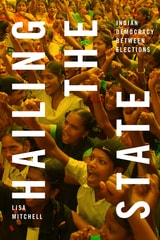
Hailing the State
Indian Democracy between ElectionsLisa Mitchell
Duke University Press, 2023

Hattie and Huey
An Arkansas TourDavid Malone
University of Arkansas Press, 1990
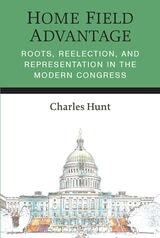
Home Field Advantage
Roots, Reelection, and Representation in the Modern CongressCharles Hunt
University of Michigan Press, 2022
Although partisan polarization gets much of the attention in political science scholarship about Congress, members of Congress represent diverse communities around the country. Home Field Advantage demonstrates the importance of this understudied element of American congressional elections and representation in the modern era: the local, place-based roots that members of Congress have in their home districts. Charles Hunt argues that legislators’ local roots in their district have a significant and independent impact on their campaigns, election outcomes, and more broadly on the relationship between members of the U.S. House of Representatives and their constituents. Drawing on original data, his research reveals that there is considerable variation in election outcomes, performance relative to presidential candidates, campaign spending, and constituent communication styles that are not fully explained by partisanship, incumbency, or other well-established theories of American political representation. Rather, many of these differences are the result of the depth of a legislator’s local roots in their district that predate their time in Congress. Hunt lays out a detailed “Theory of Local Roots” and their influence in congressional representation, demonstrating this influence empirically using multiple original measures of local roots over a full cross-section of legislators and a significant period of time.
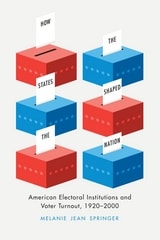
How the States Shaped the Nation
American Electoral Institutions and Voter Turnout, 1920-2000Melanie Jean Springer
University of Chicago Press, 2014
With How the States Shaped the Nation, Melanie Jean Springer places contemporary reforms in historical context and systematically explores how state electoral institutions have been instrumental in shaping voting behavior throughout the twentieth century. Although reformers often assume that more convenient voting procedures will produce equivalent effects wherever they are implemented, Springer reveals that this is not the case. In fact, convenience-voting methods have had almost no effect in the southern states where turnout rates are lowest. In contrast, the adverse effects associated with restrictive institutions like poll taxes and literacy tests have been persistent and dramatic. Ultimately, Springer argues, no single institutional fix will uniformly resolve problems of low or unequal participation. If we want to reliably increase national voter turnout rates, we must explore how states’ voting histories differ and better understand the role of political and geographical context in shaping institutional effects.