158 books match the query 'End' and 4 start with h
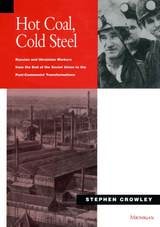
cover of Hot Coal, Cold Steel: Russian and Ukrainian Workers from the End of the Soviet Union to the Post-Communist Transformations

Hot Coal, Cold Steel

Russian and Ukrainian Workers from the End of the Soviet Union to the Post-Communist Transformations

Stephen Crowley

University of Michigan Press, 1997
Well after the disintegration of the Communist Party and the Soviet state--and through several years of economic collapse--industrial workers in almost every sector of the former Soviet Union have remained quiescent and the same ineffective and unpopular trade unions still hold a virtual monopoly on worker's representation. Why? While many argue that labor is a central variable in the development of economic and political systems, little is known about workers in the states of the former Soviet Union since the fall of Communism. In a comparative study of two groups of industrial workers--the coal miners and steelworkers--at the end of the Soviet era, Stephen Crowley sheds light on where these workers have been and where they are going.
Coal miners in the final years of the Soviet Union effectively organized and led strikes which supported the end of Communism, even though their heavy subsidies would be threatened by capitalism. Steel workers, in contrast, did not effectively organize and strike. This pattern has continued under the new governments, with the coal miners effectively organized and seeking protection from the worst consequences of marketization, while the steel workers remain weakly organized despite deteriorating economic conditions.
Based on extensive on-site research including interviews with miners and steelworkers, labor leaders and plant managers, Crowley develops a detailed picture of the conditions under which workers organize. His findings have application beyond the conditions of post-Communist Russia and Ukraine to other societies undergoing fundamental change.
This book will be of interest to sociologists and political scientists interested in the role of labor in transitional societies, the patterns of organization of labor, as well as area specialists.
Stephen Crowley is Associate Professor of Political Science, Oberlin College.
[more]
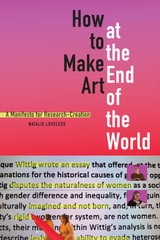
cover of How to Make Art at the End of the World: A Manifesto for Research-Creation

How to Make Art at the End of the World

A Manifesto for Research-Creation

Natalie Loveless

Duke University Press, 2019
In recent years, the rise of research-creation—a scholarly activity that considers art practices as research methods in their own right—has emerged from the organic convergences of the arts and interdisciplinary humanities, and it has been fostered by universities wishing to enhance their public profiles. In How to Make Art at the End of the World Natalie Loveless draws on diverse perspectives—from feminist science studies to psychoanalytic theory, as well as her own experience advising undergraduate and graduate students—to argue for research-creation as both a means to produce innovative scholarship and a way to transform pedagogy and research within the contemporary neoliberal university. Championing experimental, artistically driven methods of teaching, researching, and publication, research-creation works to render daily life in the academy more pedagogically, politically, and affectively sustainable, as well as more responsive to issues of social and ecological justice.
[more]
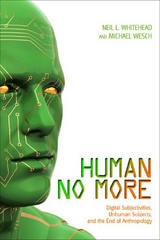
cover of Human No More: Digital Subjectivities, Unhuman Subjects, and the End of Anthropology

Human No More

Digital Subjectivities, Unhuman Subjects, and the End of Anthropology

Neil L. Whitehead

University Press of Colorado, 2012

Turning an anthropological eye toward cyberspace, Human No More explores how conditions of the online world shape identity, place, culture, and death within virtual communities.

Online worlds have recently thrown into question the traditional anthropological conception of place-based ethnography. They break definitions, blur distinctions, and force us to rethink the notion of the "subject." Human No More asks how digital cultures can be integrated and how the ethnography of both the "unhuman" and the "digital" could lead to possible reconfiguring the notion of the "human."

This provocative and groundbreaking work challenges fundamental assumptions about the entire field of anthropology. Cross-disciplinary research from well-respected contributors makes this volume vital to the understanding of contemporary human interaction. It will be of interest not only to anthropologists but also to students and scholars of media, communication, popular culture, identity, and technology.
[more]
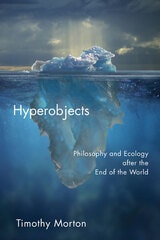
cover of Hyperobjects: Philosophy and Ecology after the End of the World

Hyperobjects

Philosophy and Ecology after the End of the World

Timothy Morton

University of Minnesota Press, 2013

Having set global warming in irreversible motion, we are facing the possibility of ecological catastrophe. But the environmental emergency is also a crisis for our philosophical habits of thought, confronting us with a problem that seems to defy not only our control but also our understanding. Global warming is perhaps the most dramatic example of what Timothy Morton calls “hyperobjects”—entities of such vast temporal and spatial dimensions that they defeat traditional ideas about what a thing is in the first place. In this book, Morton explains what hyperobjects are and their impact on how we think, how we coexist with one another and with nonhumans, and how we experience our politics, ethics, and art.

Moving fluidly between philosophy, science, literature, visual and conceptual art, and popular culture, the book argues that hyperobjects show that the end of the world has already occurred in the sense that concepts such as world, nature, and even environment are no longer a meaningful horizon against which human events take place. Instead of inhabiting a world, we find ourselves inside a number of hyperobjects, such as climate, nuclear weapons, evolution, or relativity. Such objects put unbearable strains on our normal ways of reasoning.

Insisting that we have to reinvent how we think to even begin to comprehend the world we now live in, Hyperobjects takes the first steps, outlining a genuinely postmodern ecological approach to thought and action.

[more]