403 books match the query 'Environmental Science' and 11 start with h
cover of Harnessing Farms and Forests in the Low-Carbon Economy: How to Create, Measure, and Verify Greenhouse Gas Offsets

Harnessing Farms and Forests in the Low-Carbon Economy

How to Create, Measure, and Verify Greenhouse Gas Offsets

Nicholas Institute for Environmental Policy Solutions and Zach Willey and Bill Chameides, editors, eds.

Duke University Press, 2007

As the United States moves to a low-carbon economy in order to combat global warming, credits for reducing carbon dioxide emissions will increasingly become a commodity that is bought and sold on the open market. Farmers and other landowners can benefit from this new economy by conducting land management practices that help sequester carbon dioxide, creating credits they can sell to industry to “offset” industrial emissions of greenhouse gases.

This guide is the first comprehensive technical publication providing direction to landowners for sequestering carbon and information for traders and others who will need to verify the sequestration. It will provide invaluable direction to farmers, foresters, land managers, consultants, brokers, investors, regulators, and others interested in creating consistent, credible greenhouse gas offsets as a tradable commodity in the United States.

The guide contains a non-technical section detailing methodologies for scoping of the costs and benefits of a proposed project, quantifying offsets of various sorts under a range of situations and conditions, and verifying and registering the offsets. The technical section provides specific information for quantifying, verifying, and regulating offsets from agricultural and forestry practices.

Visit the Nicholas Institute for Environmental Policy Solutions website for audio from the press conference announcing the book.
Read the press release announcing the book.
[more]
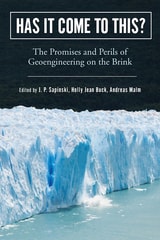
cover of Has It Come to This?: The Promises and Perils of Geoengineering on the Brink

Has It Come to This?

The Promises and Perils of Geoengineering on the Brink

J.P. Sapinski

Rutgers University Press, 2021
Geoengineering is the deliberate and large-scale intervention in the Earth's climate system in an attempt to mitigate the adverse effects of global warming. Now that climate emergency is upon us, claims that geoengineering is inevitable are rapidly proliferating. How did we get into this situation where the most extreme path now seems a plausible development? Is it an accurate representation of where we are at? Who is this “we” who is talking? What options make it onto the table? Which are left out? Whom does geoengineering serve? Why is the ensemble of projects that goes by that name so salient, even though the community of researchers and advocates is remarkably small? These are some of the questions that the thinkers contributing to this volume are exploring from perspectives ranging from sociology and geography to ethics and Indigenous studies. The editors set out this diverse collection of voices not as a monolithic, unified take on geoengineering, but as a place where creative thinkers, students, and interested environmental and social justice advocates can explore nuanced ideas in more than 240 characters. 
[more]
cover of Here and There: A Fire Survey

Here and There

A Fire Survey

Stephen J. Pyne

University of Arizona Press, 2018

Fire is special. Even among the ancient elements, fire is different because it alone is a reaction. It synthesizes its surroundings; it takes its character from its context. It varies by place, by culture, and by time. It has no single expression. There is no single way to understand it.

In this collection of essays, historian and renowned fire expert Stephen J. Pyne offers his reflections on national and global wildland fire management. Pyne distills the long saga of fire on Earth and its role in underwriting an Anthropocene that might equally be called a Pyrocene.

Presented through a mixture of journalism, history, and literary imagination, Here and There moves the discussion of fire beyond the usual formations of science and policy within a national narrative to one of thoughtful interpretation, analysis, and commentary. Centered on the unique complexities of fire management in a global world, Here and There offers a punctuation point to our understanding of wildfire.

Included in this volume:
  • How fire policy has changed within the United States
  • How policy in the United States differs from that in other countries
  • The history of one of the most famous fire paintings of all time
  • Suggested next steps for the future of fire research
[more]
cover of Highland Sanctuary: Environmental History in Tanzania’s Usambara Mountains

Highland Sanctuary

Environmental History in Tanzania’s Usambara Mountains

Christopher A. Conte

Ohio University Press, 2004
For more than a century, the world has recognized the extraordinary biological diversity of the forests of Tanzania’s Usambara Mountains. As international attention has focused on forest conservation, farmers, foresters, biologists, and the Tanzanian state have realized that only complex negotiations will save these treasured, but rapidly disappearing, landscapes. Highland Sanctuary unravels the complex interactions among agriculture, herding, forestry, the colonial state, and the landscape itself. In his examination of the region’s history of ecological transformation, Christopher Conte demonstrates how these forces have combined to create an ever-changing mosaic of forest and field. His study illuminates the debate over conservation, arguing that contingency and chance, the stuff of human history, have shaped forests in ways that rival the power of nature. In Highland Sanctuary, the forest becomes part of human history, rather than something outside of it. Highland Sanctuary cuts through a legacy of contention and ill will to inform contemporary conservation initiatives. Professor Conte explains how ecological changes take divergent paths in similar environments, in this case on mountains that harbor unique flora and fauna, and how these mountain environments achieve international importance as centers of biodiversity.
[more]
cover of History 4° Celsius: Search for a Method in the Age of the Anthropocene

History 4° Celsius

Search for a Method in the Age of the Anthropocene

Ian Baucom

Duke University Press, 2020

In History 4° Celsius Ian Baucom continues his inquiries into the place of the Black Atlantic in the making of the modern and postmodern world. Putting black studies into conversation with climate change, Baucom outlines how the ongoing concerns of critical race, diaspora, and postcolonial studies are crucial to understanding the Anthropocene. He draws on materialist and postmaterialist thought, Sartre, and the science of climate change to trace the ways in which evolving political, cultural, and natural history converge to shape a globally destructive force. Identifying the quest for limitless financial gain as the primary driving force behind both the slave trade and the continuing increase in global greenhouse gas emissions, Baucom demonstrates that climate change and the conditions of the Black Atlantic, colonialism, and the postcolony are fundamentally entwined. In so doing, he argues for the necessity of establishing a method of critical exchange between climate science, black studies, and the surrounding theoretical inquiries of humanism and posthumanism.
[more]
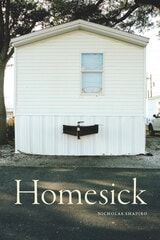
cover of Homesick

Homesick

Nicholas Shapiro

Duke University Press, 2025
Following Hurricane Katrina, the Federal Emergency Management Agency (FEMA) distributed over 120,000 trailers for emergency housing. Produced from engineered wood containing toxic amounts of formaldehyde, these shelters were vectors of illness and death. Although they were subsequently banned, FEMA trailers were resold and again used for housing, scattering their harm to other people and areas. In Homesick, Nicholas Shapiro draws on almost fifteen years working with impacted community members to trace how the story of toxic emergency housing units expands into a story of how all of our shelters became a seat of exposure and how we can collectively struggle for cleaner indoor air. Throughout, Shapiro questions the efficacy of the fundamental tools used to cultivate accountability, repair, and change, arguing for their reimagining. Detailing health effects as well as community and individual efforts to achieve better life, health, and justice, Shapiro highlights how homesickness for an otherwise future can herald meaningful change.
[more]
cover of Hope for a Heated Planet: How Americans Are Fighting Global Warming and Building a Better Future

Hope for a Heated Planet

How Americans Are Fighting Global Warming and Building a Better Future

Musil, Robert K

Rutgers University Press, 2009

Rejecting cries of gloom and doom, Hope for a Heated Planet shows how the fight against global warming can be won by the grassroots efforts of individuals. Robert K. Musil, who led the Nobel Peace Prize-winning organization Physicians for Social Responsibility, explains that a growing new climate movement can produce unprecedented change-in the economy, public health, and home-while saving the planet.

Musil draws on personal experience and compelling data in this practical and rigorous analysis of the causes and cures for global warming. The book presents all the players in the most pressing challenge facing society today, from the massive fossil fuel lobby to the enlightened corporations that are joining the movement to "go green." Musil thoroughly explains the tremendous potential of renewable energy sources-wind, solar, and biofuel-and the startling conclusions of experts who say society can do away entirely with fossil fuels. He tells readers about the engaged politicians, activists, religious groups, and students who are already working together against climate change.

But the future depends, Musil insists, on what changes ordinary citizens make. Through personal choices and political engagement, he shows how readers can cut carbon emissions and create green communities where they live. With practical and realistic solutions, Hope for a Heated Planet inspires readers to be accountable and enables them to usher in an age of sustainability for future generations.
[more]
cover of How Climate Change Comes to Matter: The Communal Life of Facts

How Climate Change Comes to Matter

The Communal Life of Facts

Candis Callison

Duke University Press, 2014

During the past decade, skepticism about climate change has frustrated those seeking to engage broad publics and motivate them to take action on the issue. In this innovative ethnography, Candis Callison examines the initiatives of social and professional groups as they encourage diverse American publics to care about climate change. She explores the efforts of science journalists, scientists who have become expert voices for and about climate change, American evangelicals, Indigenous leaders, and advocates for corporate social responsibility.

The disparate efforts of these groups illuminate the challenge of maintaining fidelity to scientific facts while transforming them into ethical and moral calls to action. Callison investigates the different vernaculars through which we understand and articulate our worlds, as well as the nuanced and pluralistic understandings of climate change evident in different forms of advocacy. As she demonstrates, climate change offers an opportunity to look deeply at how issues and problems that begin in a scientific context come to matter to wide publics, and to rethink emerging interactions among different kinds of knowledge and experience, evolving media landscapes, and claims to authority and expertise.
[more]
cover of How Green Became Good: Urbanized Nature and the Making of Cities and Citizens

How Green Became Good

Urbanized Nature and the Making of Cities and Citizens

Hillary Angelo

University of Chicago Press, 2021
As projects like Manhattan’s High Line, Chicago’s 606, China’s eco-cities, and Ethiopia’s tree-planting efforts show, cities around the world are devoting serious resources to urban greening. Formerly neglected urban spaces and new high-end developments draw huge crowds thanks to the considerable efforts of city governments. But why are greening projects so widely taken up, and what good do they do? In How Green Became Good, Hillary Angelo uncovers the origins and meanings of the enduring appeal of urban green space, showing that city planners have long thought that creating green spaces would lead to social improvement. Turning to Germany’s Ruhr Valley (a region that, despite its ample open space, was “greened” with the addition of official parks and gardens), Angelo shows that greening is as much a social process as a physical one. She examines three moments in the Ruhr Valley's urban history that inspired the creation of new green spaces: industrialization in the late nineteenth century, postwar democratic ideals of the 1960s, and industrial decline and economic renewal in the early 1990s. Across these distinct historical moments, Angelo shows that the impulse to bring nature into urban life has persistently arisen as a response to a host of social changes, and reveals an enduring conviction that green space will transform us into ideal inhabitants of ideal cities. Ultimately, however, she finds that the creation of urban green space is more about how we imagine social life than about the good it imparts. 
[more]
cover of How to Control Fire on a Burning Continent

How to Control Fire on a Burning Continent

Timothy Neale

Duke University Press, 2026

A critical and ethnographic exploration of wildfire management in Australia, one of Earth’s most fire-prone countries, Timothy Neale’s How to Control Fire on a Burning Continent critiques the colonial logics of control deployed to manage unruly environments and explores alternative forms of environmental stewardship.

Each year, Australia faces increasingly unprecedented wildfires, marked both by their scale and by the intense public disagreements about their political, cultural, and ecological causes. How to Control Fire on a Burning Continent is a critical and ethnographic exploration of wildfire management in Australia and the technoscientific systems of control that shape its current and future possibilities. Timothy Neale observes how two seemingly opposing forces—an entrenched sense of crisis and widespread normalization—combine to form an apparatus of institutional fire management that increasingly centers technical control and militarization. While sympathetic to the double binds many fire management professionals find themselves in, Neale ties contemporary wildfire problems to ongoing colonization and Indigenous dispossession, exploring Indigenous-led land management and cultural burning as a practical assertion of sovereignty. Through dialogue and collaboration with professional fire managers and Indigenous environmental stewards, Neale calls for a collective movement beyond control thinking by fostering new alliances and modes of coping with, rather than commanding, our flammable world.

[more]
cover of Hydro-criticism

Hydro-criticism

Laura Winkiel, special issue editor

Duke University Press, 0

As sea levels rise, ice caps melt, and the ocean acidifies, the twin forces of globalization and global warming have irrevocably braided human-centered history with the geologic force of the ocean. This reality has broadly challenged those working in the humanities, social sciences, and natural sciences to fundamentally alter the ways in which they produce knowledge. Contributors to this special issue of English Language Notes interrogate the methods of humanities’ recent oceanic turn—grouped here under the rubric of “ocean studies”—by reimagining human histories, aesthetics, and ontologies as entangled with the temporal and spatial scales, geographies, and agencies of the ocean. Topics include the representations of the sea and related technologies in 1950s films; multiple accounts of the ocean’s role as a mediator of power, colonization, and censorship; queer eroticism and the ocean; literature’s shifting account of seafaring in the modernist period and today; and the strange conundrum of T. S. Eliot’s “The Dry Salvages” as an inspiration for modern radical Caribbean scholars. 

Contributors. Hester Blum, Brandi Bushman, Jeremy Chow, Margaret Cohen, Elizabeth DeLoughrey, Harris Feinsod, Isabel Hofmeyr, Charne Lavery, Nicole Rizzuto, Meg Samuelson, Allison Shelton, Teresa Shewry, Maxwell Uphaus
[more]