Results by title
177 books match the query 'Equality' and 3 start with h

Healing Our Divided Society
Investing in America Fifty Years after the Kerner ReportFred Harris and Alan Curtis
Temple University Press, 2018
In 1968, the Kerner Commission concluded that America was heading toward “two societies, one black, one white—separate and unequal.” Today, America’s communities are experiencing increasing racial tensions and inequality, working-class resentment over the unfulfilled American Dream, white supremacy violence, toxic inaction in Washington, and the decline of the nation’s example around the world.
In Healing Our Divided Society, Fred Harris, the last surviving member of the Kerner Commission, along with Eisenhower Foundation CEO Alan Curtis, re-examine fifty years later the work still necessary towards the goals set forth in The Kerner Report. This timely volume unites the interests of minorities and white working- and middle-class Americans to propose a strategy to reduce poverty, inequality, and racial injustice. Reflecting on America’s urban climate today, this new report sets forth evidence-based policies concerning employment, education, housing, neighborhood development, and criminal justice based on what has been proven to work—and not work.
Contributors include: Oscar Perry Abello, Elijah Anderson, Anil N.F. Aranha, Jared Bernstein, Henry G. Cisneros, Elliott Currie, Linda Darling-Hammond, Martha F. Davis, E. J. Dionne, Jr., Marian Wright Edelman, Delbert S. Elliott, Carol Emig, Jeff Faux, Ron Grzywinski, Michael P. Jeffries, Lamar K. Johnson, Celinda Lake, Marilyn Melkonian, Gary Orfield, Diane Ravitch, Laurie Robinson, Herbert C. Smitherman, Jr., Joseph Stiglitz, Dorothy Stoneman, Kevin Washburn, Valerie Wilson, Gary Younge, Julian E. Zelizer, and the editors

Hinterland
America's New Landscape of Class and ConflictPhil A. Neel
Reaktion Books, 2018
Urgent and unsparing, this book opens our eyes to America’s new heart of darkness. Driven by an ever-expanding socioeconomic crisis, America’s class structure is recomposing itself in new geographies of race, poverty, and production. The center has fallen. Riots ricochet from city to city led by no one in particular. Anarchists smash financial centers as a resurgent far right builds power in the countryside. Drawing on his direct experience of recent popular unrest, from the Occupy movement to the wave of riots and blockades that began in Ferguson, Missouri, Phil A. Neel provides a close-up view of this landscape in all its grim but captivating detail. Inaugurating the new Field Notes series, published in association with the Brooklyn Rail, Neel’s book tells the intimate story of a life lived within America’s hinterland.
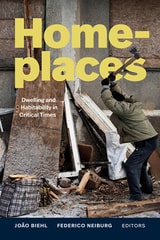
Homeplaces
Dwelling and Habitability in Critical TimesJoão Biehl and Federico Neiburg, editors
Duke University Press, 2026