Results by title
421 books match the query 'Evolution' and 13 start with h
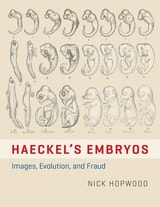
Haeckel's Embryos
Images, Evolution, and FraudNick Hopwood
University of Chicago Press, 2015
In Haeckel’s Embryos, Nick Hopwood tells this extraordinary story in full for the first time. He tracks the drawings and the charges against them from their genesis in the nineteenth century to their continuing involvement in innovation in the present day, and from Germany to Britain and the United States. Emphasizing the changes worked by circulation and copying, interpretation and debate, Hopwood uses the case to explore how pictures succeed and fail, gain acceptance and spark controversy. Along the way, he reveals how embryonic development was made a process that we can see, compare, and discuss, and how copying—usually dismissed as unoriginal—can be creative, contested, and consequential.
With a wealth of expertly contextualized illustrations, Haeckel’s Embryos recaptures the shocking novelty of pictures that enthralled schoolchildren and outraged priests, and highlights the remarkable ways these images kept on shaping knowledge as they aged.
Hayek and the Evolution of Capitalism
Naomi Beck
University of Chicago Press, 2018
Yet even among those who study his work in depth, few have looked closely at his use of ideas from evolutionary science to advance his vision of markets and society. With this book Naomi Beck offers the first full-length engagement with Hayek’s thought from this perspective. Hayek argued that the capitalism we see in advanced civilizations is an unintended consequence of group selection—groups that adopted free market behavior expanded more successfully than others. But this attempt at a scientific grounding for Hayek’s principles, Beck shows, fails to hold water, plagued by incoherencies, misinterpretations of the underlying science, and lack of evidence. As crises around the globe lead to reconsiderations of the place of capitalism, Beck’s excavation of this little-known strand of Hayek’s thought—and its failure—is timely and instructive.

Hegel’s Phenomenology, Part 2
The Evolution of Ethical and Religious Consciousness to the Absolute StandpointHoward P. Kainz
Ohio University Press, 1983
The publication in 1807 of Georg Wilhelm Frederich Hegel’s Phanomenologie des Geistes (translated alternately as “Phenomenology of Mind” or “Phenomenology of Spirit”) marked the beginning of the modern era in philosophy. Hegel’s remarkable insights formed the basis for what eventually became the Existentialist movement. Yet the Phenomenology remains one of the most difficult and forbidding works in the canon of philosophical literature.
Henri Bergson’s Creative Evolution 100 Years Later
Special Issue of SubStance, Issue 114, 36:3 (2007)Michael Kolkman
University of Wisconsin Press, 2007
This special issue of SubStance (2007) celebrates the centennial of Henri Bergson’s Creative Evolution, published in 1907. Since evolution is a living process and not a completed history, any understanding of it must necessarily be open-ended. If no one can have the last word, Bergson writes, the project of understanding evolution “will only be built up by the collective and progressive effort of many thinkers, of many observers also, completing, correcting and improving one another.”
Included in the issue are articles from Bergson scholars from the United States, Japan, France and Great Britain. Topics in the issue range from Bergson’s encounters with Darwin, Nietzsche, Derrida and Deleuze, and from the analytical to the metaphysical.
Hierarchy
Perspectives for Ecological ComplexityT. F. H. Allen and Thomas B. Starr
University of Chicago Press, 2017
This thoroughly revised and expanded second edition of Hierarchy reflects the assimilation of hierarchy theory into ecological research, its successful application to the understanding of complex systems, and the many developments in thought since. Because hierarchies and levels are habitual parts of human thinking, hierarchy theory has proven to be the most intuitive and tractable vehicle for addressing complexity. By allowing researchers to look explicitly at only the entities and interconnections that are relevant to a specific research question, hierarchically informed data analysis has enabled a revolution in ecological understanding. With this new edition of Hierarchy, that revolution continues.
History Within
The Science, Culture, and Politics of Bones, Organisms, and MoleculesMarianne Sommer
University of Chicago Press, 2016
Our interpretation of gene sequences, like our interpretation of other historical evidence, inevitably tells a story laden with political and moral values. Focusing on the work of Henry Fairfield Osborn, Julian Sorell Huxley, and Luigi Luca Cavalli-Sforza in paleoanthropology, evolutionary biology, and human population genetics, History Within asks how the sciences of human origins, whether through the museum, the zoo, or the genetics lab, have shaped our idea of what it means to be human. How have these biologically based histories influenced our ideas about nature, society, and culture? As Marianne Sommer shows, the stories we tell about bones, organisms, and molecules often change the world.
Holistic Darwinism
Synergy, Cybernetics, and the Bioeconomics of EvolutionPeter Corning
University of Chicago Press, 2005
How Life Began
Evolution's Three GenesesAlexandre Meinesz
University of Chicago Press, 2008
How Life Began elucidates three origins, or geneses, of life—bacteria, nucleated cells, and multicellular organisms—and shows how evolution has sculpted life to its current biodiversity through four main events—mutation, recombination, natural selection, and geologic cataclysm. As an ecologist who specializes in algae, the first organisms to colonize Earth, Meinesz brings a refreshingly novel voice to the history of biodiversity and emphasizes here the role of unions in organizing life. For example, the ingestion of some bacteria by other bacteria led to mitochondria that characterize animal and plant cells, and the chloroplasts of plant cells.
How to Grow a Human
Adventures in How We Are Made and Who We ArePhilip Ball
University of Chicago Press, 2019
In his most mind-bending book yet, Ball makes that disconcerting question the focus of a tour through what scientists can now do in cell biology and tissue culture. He shows how these technologies could lead to tailor-made replacement organs for when ours fail, to new medical advances for repairing damage and assisting conception, and to new ways of “growing a human.” For example, it might prove possible to turn skin cells not into neurons but into eggs and sperm, or even to turn oneself into the constituent cells of embryos. Such methods would also create new options for gene editing, with all the attendant moral dilemmas. Ball argues that such advances can therefore never be about “just the science,” because they come already surrounded by a host of social narratives, preconceptions, and prejudices. But beyond even that, these developments raise questions about identity and self, birth and death, and force us to ask how mutable the human body really is—and what forms it might take in years to come.
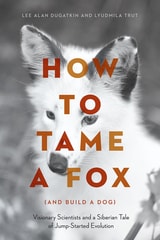
How to Tame a Fox (and Build a Dog)
Visionary Scientists and a Siberian Tale of Jump-Started EvolutionLee Alan Dugatkin and Lyudmila Trut
University of Chicago Press, 2017
Most accounts of the natural evolution of wolves place it over a span of about 15,000 years, but within a decade, Belyaev and Trut’s fox breeding experiments had resulted in puppy-like foxes with floppy ears, piebald spots, and curly tails. Along with these physical changes came genetic and behavioral changes, as well. The foxes were bred using selection criteria for tameness, and with each generation, they became increasingly interested in human companionship. Trut has been there the whole time, and has been the lead scientist on this work since Belyaev’s death in 1985, and with Lee Dugatkin, biologist and science writer, she tells the story of the adventure, science, politics, and love behind it all. In How to Tame a Fox, Dugatkin and Trut take us inside this path-breaking experiment in the midst of the brutal winters of Siberia to reveal how scientific history is made and continues to be made today.
To date, fifty-six generations of foxes have been domesticated, and we continue to learn significant lessons from them about the genetic and behavioral evolution of domesticated animals. How to Tame a Fox offers an incredible tale of scientists at work, while also celebrating the deep attachments that have brought humans and animals together throughout time.
Human Dispersal, Human Evolution, and the Sea
The Palaeolithic Seafaring DebateJohn F. Cherry
University Press of Colorado, 2025
Exploring the data in detail, the authors here show how a complex series of interrelated problems has tended to be treated in reductionist or overly simplistic terms. Cherry and Leppard elucidate this complexity by bringing to bear perspectives from archaeology, ecology, and evolutionary biology. They demonstrate not only that a series of unique circumstances—evolutionary, behavioral, environmental, and economic—conspired to drive mass, ubiquitous global colonization over the last ten millennia; but also that earlier, sparser data provide real insight into key social and behavioral thresholds, even if there is little evidence to support the “oceans as highways” model for species other than our own.
A major intervention in this important debate, Human Dispersal, Human Evolution, and the Sea explains the deep significance of the problem and the profound implications for history, archaeology, and biological anthropology.
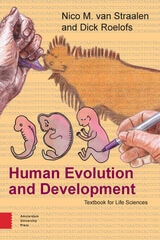
Human Evolution and Development
Nico M. van Straalen Dick Roelofs
Amsterdam University Press, 2019
The authors discuss questions like: - What do we know about ancient humans? - What happens in the development of an embryo? - How did we manage to walk upright and why did we lose our hair? - What is the relationship between language, migration and evolution? - How does our body respond to the challenges of modern society?
In addition to being a core text for the study of the life sciences, Human Evolution and Development is an easy-to-read overview for the interested layperson.
Human Flesh
Phenomenology and Evolution of the Social BodyHayden Kee
Ohio University Press, 0
Much recent research on human evolution emphasizes that social behavior and cognition are at the heart of everything that is distinctively human. This body of research generally understands sociality in terms of social reasoning and the brain that supports it. Human Flesh shifts the focus. What if human sociality is not primarily or exclusively located in the brain but rather is distributed throughout the body? What if the foundation of the human way of life lies in intercorporeity: the ways in which our affective, sensorimotor social bodies—our eyes, hands, voices, ears, and desires—open our bodies and minds up to one another?
Human Flesh develops a framework for exploring these questions based on Merleau-Ponty’s unfinished work on human evolution, combining it with contemporary research in phenomenology, embodied cognitive science, evolutionary anthropology, and primatology. It applies that framework to explore how the different senses and sensory organs take on their distinctively human variations to facilitate the intercorporeal, social human form of life. Along the way, the book interprets familiar facts about the human body in a new light and develops novel hypotheses concerning human evolution. In contrast to the widely discussed social brain hypothesis, its guiding premise is the social body hypothesis: the proposition that the human body has evolved in response to the challenges posed by the distinctively human social form of life.
Based on these concrete investigations into the human body, Human Flesh proposes a new way of thinking about familiar topics in the evolution of cognition literature, such as the emergence of higher orders of social cognition and the development of human symbolic and linguistic capacities. Ultimately, the book arrives at a new determination of human nature and the human form of life: To be human is to be Homo invisibilis, an animal obsessed with, adapted for, and dependent upon the invisible minds of other humans and the symbolic-cultural worlds opened up by their unique social bodies.