Results by title
79 books match the query 'Evolution (Biology)' and 2 start with h
Haeckel's Embryos
Images, Evolution, and FraudNick Hopwood
University of Chicago Press, 2015
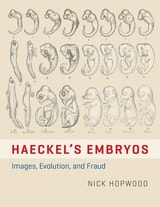
Pictures from the past powerfully shape current views of the world. In books, television programs, and websites, new images appear alongside others that have survived from decades ago. Among the most famous are drawings of embryos by the Darwinist Ernst Haeckel in which humans and other vertebrates begin identical, then diverge toward their adult forms. But these icons of evolution are notorious, too: soon after their publication in 1868, a colleague alleged fraud, and Haeckel’s many enemies have repeated the charge ever since. His embryos nevertheless became a textbook staple until, in 1997, a biologist accused him again, and creationist advocates of intelligent design forced his figures out. How could the most controversial pictures in the history of science have become some of the most widely seen?
In Haeckel’s Embryos, Nick Hopwood tells this extraordinary story in full for the first time. He tracks the drawings and the charges against them from their genesis in the nineteenth century to their continuing involvement in innovation in the present day, and from Germany to Britain and the United States. Emphasizing the changes worked by circulation and copying, interpretation and debate, Hopwood uses the case to explore how pictures succeed and fail, gain acceptance and spark controversy. Along the way, he reveals how embryonic development was made a process that we can see, compare, and discuss, and how copying—usually dismissed as unoriginal—can be creative, contested, and consequential.
With a wealth of expertly contextualized illustrations, Haeckel’s Embryos recaptures the shocking novelty of pictures that enthralled schoolchildren and outraged priests, and highlights the remarkable ways these images kept on shaping knowledge as they aged.
[more]
History Within
The Science, Culture, and Politics of Bones, Organisms, and MoleculesMarianne Sommer
University of Chicago Press, 2016
Personal genomics services such as 23andMe and Ancestry.com now offer what once was science fiction: the ability to sequence and analyze an individual’s entire genetic code—promising, in some cases, facts about that individual’s ancestry that may have remained otherwise lost. Such services draw on and contribute to the science of human population genetics that attempts to reconstruct the history of humankind, including the origin and movement of specific populations. Is it true, though, that who we are and where we come from is written into the sequence of our genomes? Are genes better documents for determining our histories and identities than fossils or other historical sources?
Our interpretation of gene sequences, like our interpretation of other historical evidence, inevitably tells a story laden with political and moral values. Focusing on the work of Henry Fairfield Osborn, Julian Sorell Huxley, and Luigi Luca Cavalli-Sforza in paleoanthropology, evolutionary biology, and human population genetics, History Within asks how the sciences of human origins, whether through the museum, the zoo, or the genetics lab, have shaped our idea of what it means to be human. How have these biologically based histories influenced our ideas about nature, society, and culture? As Marianne Sommer shows, the stories we tell about bones, organisms, and molecules often change the world.
Our interpretation of gene sequences, like our interpretation of other historical evidence, inevitably tells a story laden with political and moral values. Focusing on the work of Henry Fairfield Osborn, Julian Sorell Huxley, and Luigi Luca Cavalli-Sforza in paleoanthropology, evolutionary biology, and human population genetics, History Within asks how the sciences of human origins, whether through the museum, the zoo, or the genetics lab, have shaped our idea of what it means to be human. How have these biologically based histories influenced our ideas about nature, society, and culture? As Marianne Sommer shows, the stories we tell about bones, organisms, and molecules often change the world.
[more]