Results by title
234 books match the query 'Families' and 9 start with h
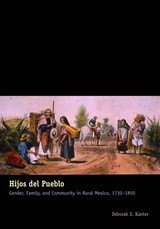
Hijos del Pueblo
Gender, Family, and Community in Rural Mexico, 1730-1850By Deborah E. Kanter
University of Texas Press, 2008
The everyday lives of indigenous and Spanish families in the countryside, a previously under-explored segment of Mexican cultural history, are now illuminated through the vivid narratives presented in Hijos del Pueblo ("offspring of the village"). Drawing on neglected civil and criminal judicial records from the Toluca region, Deborah Kanter revives the voices of native women and men, their Spanish neighbors, muleteers, and hacienda peons to showcase their struggles in an era of crisis and uncertainty (1730-1850).
Engaging and meaningful biographies of indigenous villagers, female and male, illustrate that no scholar can understand the history of Mexican communities without taking gender seriously. In legal interactions native plaintiffs and Spanish jurists confronted essential questions of identity and hegemony. At once an insightful consideration of individual experiences and sweeping paternalistic power constructs, Hijos del Pueblo contributes important new findings to the realm of gender studies and the evolution of Latin America.
Home Movies and Other Necessary Fictions
Michelle Citron
University of Minnesota Press, 1998
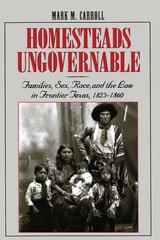
Homesteads Ungovernable
Families, Sex, Race, and the Law in Frontier Texas, 1823-1860By Mark M. Carroll
University of Texas Press, 2001
When he settled in Mexican Texas in 1832 and began courting Anna Raguet, Sam Houston had been separated from his Tennessee wife Eliza Allen for three years, while having already married and divorced his Cherokee wife Tiana and at least two other Indian "wives" during the interval. Houston's political enemies derided these marital irregularities, but in fact Houston's legal and extralegal marriages hardly set him apart from many other Texas men at a time when illicit and unstable unions were common in the yet-to-be-formed Lone Star State.
In this book, Mark Carroll draws on legal and social history to trace the evolution of sexual, family, and racial-caste relations in the most turbulent polity on the southern frontier during the antebellum period (1823-1860). He finds that the marriages of settlers in Texas were typically born of economic necessity and that, with few white women available, Anglo men frequently partnered with Native American, Tejano, and black women. While identifying a multicultural array of gender roles that combined with law and frontier disorder to destabilize the marriages of homesteaders, he also reveals how harsh living conditions, land policies, and property rules prompted settling spouses to cooperate for survival and mutual economic gain. Of equal importance, he reveals how evolving Texas law reinforced the substantial autonomy of Anglo women and provided them material rewards, even as it ensured that cross-racial sexual relationships and their reproductive consequences comported with slavery and a regime that dispossessed and subordinated free blacks, Native Americans, and Tejanos.
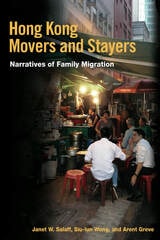
Hong Kong Movers and Stayers
Narratives of Family MigrationJanet W. Salaff, Siu-lun Wong, and Arent Greve
University of Illinois Press, 2010
Half a million Hong Kong residents fled their homeland during the thirteen years before Hong Kong's reversion to China in 1997. Nearly half of those returned within the next several years. Filled with detailed, first-hand stories of nine Hong Kong families over nearly two decades, Hong Kong Movers and Stayers is a multifaceted yet intimate look at the forces behind Hong Kong families' successful, and failed, efforts at migration and settlement.
Defining migration as a process, not a single act of leaving, Hong Kong Movers and Stayers provides an antidote to ethnocentric and simplistic theories by uncovering migration stories as they relate to social structures and social capital. The authors meld survey analysis, personal biography, and sociology and compare multiple families in order to give voice to the interplay of gender, age, and diverse family roles as motivating factors in migration.
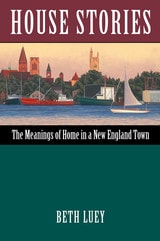
House Stories
The Meanings of Home in a New England TownBeth Luey
University of Massachusetts Press, 2017
Historic houses adorned with plaques populate New England like nowhere else in the country. These plaques note the construction year and original owner of the house, but they tell nothing about the rich lives of the people who lived there. In House Stories, Beth Luey takes readers on a virtual walking tour of several historic houses in Fairhaven, Massachusetts, a small New England coastal town, inviting us in to learn each house's secrets.
Through letters and diaries, church and business records, newspaper accounts, legal documents, and the recollections of neighbors who knew them, Luey introduces the diverse cast of historical characters who lived in these houses at various times from 1800 to the 2000s, including a Japanese castaway and his rescuer, a self-made millionaire, a seagoing adventurer, a religious pioneer, and an entrepreneurial immigrant. All of the houses are still standing and all but a lighthouse are still called home. In House Stories, Luey asks readers to join her as she considers the multiple meanings of “home” for these people and their families.
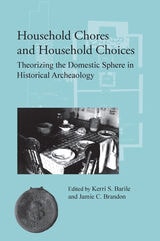
Household Chores and Household Choices
Theorizing the Domestic Sphere in Historical ArchaeologyEdited by Kerri S. Barile and James C. Brandon
University of Alabama Press, 2004
Discusses the concepts of “home,” “house,” and “household” in past societies
Because archaeology seeks to understand past societies, the concepts of "home," "house," and "household" are important. Yet they can be the most elusive of ideas. Are they the space occupied by a nuclear family or by an extended one? Is it a built structure or the sum of its contents? Is it a shelter against the elements, a gendered space, or an ephemeral place tied to emotion? We somehow believe that the household is a basic unit of culture but have failed to develop a theory for understanding the diversity of households in the historic (and prehistoric) periods.
In an effort to clarify these questions, this volume examines a broad range of households—a Spanish colonial rancho along the Rio Grande, Andrew Jackson's Hermitage in Tennessee, plantations in South Carolina and the Bahamas, a Colorado coal camp, a frontier Arkansas farm, a Freedman's Town eventually swallowed by Dallas, and plantations across the South—to define and theorize domestic space. The essays devolve from many disciplines, but all approach households from an archaeological perspective, looking at landscape analysis, excavations, reanalyzed collections, or archival records. Together, the essays present a body of knowledge that takes the identification, analysis, and interpretation of households far beyond current conceptions.
How to Do It
Guides to Good Living for Renaissance ItaliansRudolph M. Bell
University of Chicago Press, 1999
"Lively and curious reading, particularly in its cascade of anecdote, offered in a breezy, cozy, journalistic style." —Lauro Martines, Times Literary Supplement
"[Bell's] fascinating book is a window on a lost world far nearer to our own than we might imagine. . . . How pleasant to read his delightful, informative and often hilarious book." —Kate Saunders, The Independent
"An extraordinary work which blends the learned with the frankly bizarre." —The Economist
"Professor Bell has a sly sense of humor and an enviably strong stomach. . . . He wants to know how people actually behaved, not how the Church or philosophers or earnest humanists thought they should behave. I loved this book." —Christopher Stace, Daily Telegraph
How to Make a Slave and Other Essays
Jerald Walker
The Ohio State University Press, 2020
Winner, 2021 Massachusetts Book Award, Nonfiction Category
A Book of the Year pick from Kirkus, BuzzFeed, and Literary Hub
“The essays in this collection are restless, brilliant and short. . . . The brevity suits not just Walker’s style but his worldview, too.…Keeping things quick gives him the freedom to move; he can alight on a truth without pinning it into place.” —Jennifer Szalai, the New York Times
For the black community, Jerald Walker asserts in How to Make a Slave, “anger is often a prelude to a joke, as there is broad understanding that the triumph over this destructive emotion lay in finding its punchline.” It is on the knife’s edge between fury and farce that the essays in this exquisite collection balance. Whether confronting the medical profession’s racial biases, considering the complicated legacy of Michael Jackson, paying homage to his writing mentor James Alan McPherson, or attempting to break free of personal and societal stereotypes, Walker elegantly blends personal revelation and cultural critique. The result is a bracing and often humorous examination by one of America’s most acclaimed essayists of what it is to grow, parent, write, and exist as a black American male. Walker refuses to lull his readers; instead his missives urge them to do better as they consider, through his eyes, how to be a good citizen, how to be a good father, how to live, and how to love.
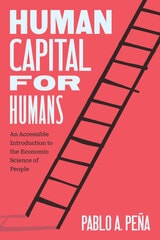
Human Capital for Humans
An Accessible Introduction to the Economic Science of PeoplePablo A. Peña
University of Chicago Press, 2025
University of Chicago economist Gary Becker won the Nobel Prize largely for his advancement of human capital theory—the idea that investing in a person’s knowledge and skills has a wide range of economic effects. Becker’s writing on the subject was technical, but his teaching, especially in his famous doctoral course at Chicago, remains legendary for its accessibility, brilliance, and applications to everyday life.
In Human Capital for Humans, economist and former Becker student Pablo A. Peña channels this classroom approach to produce an accessible, essential guide to understanding the science that has become synonymous with modern life and the economy. With an illustrative and immersive style, Peña unpacks the human capital approach to domains such as parenting, aging, marriage, health, and household labor. The result is not only intellectually elevated, but an essential introduction for learners and teachers of this subject across business, management, economics, policy, and beyond.