Results by title
366 books match the query 'Family & Relationships' and 13 start with h
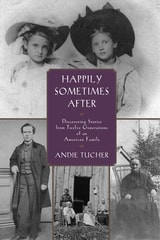
Happily Sometimes After
Discovering Stories from Twelve Generations of an American FamilyAndie Tucher
University of Massachusetts Press, 2014
A 2015 CHOICE Outstanding Academic Title
For more than four hundred years, members of the author's family have been telling stories about their American lives. They have told of impassioned elopements and heart-breaking kidnaps, of hairbreadth escapes and shocking murders, of bigamists, changelings, patriots, Indians, fires, floods, and how the great-grandmother of Chief Justice John Marshall married the pirate Blackbeard by mistake.
In this beautifully written work, Andie Tucher considers family stories as another way to look at history, neither from the top down nor the bottom up but from the inside out. She explores not just what happened—everywhere from Jamestown to Boonesborough, from the bloody field at Chickamauga to the metropolis of the Gilded Age—but also what the storytellers thought or wished or hoped or feared happened. She offers insights into what they valued, what they lost, how they judged their own lives and found meaning in them. The narrative touches on sorrow, recompense, love, pain, and the persistent tension between hope and disappointment in a nation that by making the pursuit of happiness thinkable also made unhappiness regrettable.
Based on extensive research in archives, local history societies, and family-history sources as well as conversations and correspondence, Happily Sometimes After offers an intimate and unusual perspective on how ordinary people used stories to imagine the world they wished for, and what those stories reveal about their relationships with the world they actually had.
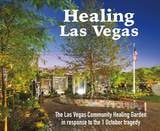
Healing Las Vegas
The Las Vegas Community Healing Garden in response to the 1 October tragedyMcAleer
University of Nevada Press, 2019
The story of the garden unfolds through photographs and the words of survivors, first responders, family members, medical professionals, counselors, and members of the community. In only a matter of days, volunteers and local businesses transformed a vacant downtown lot into a serene urban oasis. Families and friends of those lost in the tragedy soon adopted each of the fifty-eight trees planted in honor of their loved ones, and visitors left behind colorful mementos, including painted rocks, photographs, and ornaments, as well as words of encouragement, love, loss, and strength.
In the aftermath of 1 October, an often misunderstood city revealed its soul under the most heartbreaking of circumstances. The inspirational voices and stories from a community touched by tragedy provide comfort and encouragement. And the organic response to the unthinkable is a testament to how one community came together at its darkest hour, chose hope over despair, unity over hate.
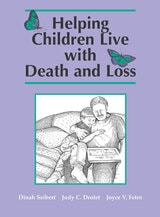
Helping Children Live With Death and Loss
Dinah Seibert, Judy C. Drolet, and Joyce V. Fetro. Illustrations by Christine I. Stetter
Southern Illinois University Press, 2003
Helping Children Live with Death and Loss is a practical guide for parents, caregivers, teachers, clergy, funeral directors, and other adults who may interact with young children between the ages of two and ten. Utilizing a developmental approach that is critical for understanding the unique characteristics and needs among children under ten, the volume is enhanced by an accessible style and format, numerous illustrations, and the positive attitude that make it possible for any reader to comprehend and apply the concepts when discussing death and loss with young children.
The scope of concepts ranges from adult self-assessment to knowledge of children’s developmental stages in learning. Building on that foundation, the book provides four basic content areas for teaching, supplies sample questions and answers, and suggests strategies for teaching general death education as well as strategies for responding to a current death or loss. The resource concludes with print and internet sources for adults and children. Helping Children Live with Death and Loss also aids adults and children in improving their communication and coping skills, which are critical for managing loss and preparing for a healthier future.
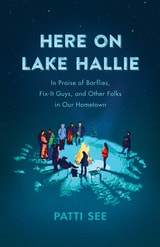
Here on Lake Hallie
In Praise of Barflies, Fix-It Guys, and Other Folks in Our HometownPatti See
Wisconsin Historical Society Press, 2022
Growing up in the 1970s and 1980s as the youngest of eight children, Patti never imagined she’d stay in Chippewa Falls as an adult. Now, living on rural Lake Hallie just five miles from her childhood home, she has a new appreciation for all that comes with country living, from ice fishing and eagle sightings to pontoon rides and tavern dice. These brief essays—many of which were originally published in the Sawdust Stories column of the Eau Claire Leader-Telegram—establish that, above all else, it’s friends, family, and other folks in our hometown who provide us with a sense of belonging.
Here, Now
EssaysMichelle Suzanne Mirsky
Northwestern University Press, 2025
A deeply felt and humorous collection examining a year in the wake of extraordinary loss
In November 2010, on the morning after election day, Mirsky lost her three-year-old son, Lev. In the year that followed, she produced a profound and provocatively humorous body of work—tackling extreme loss as well as divorce, friendship, dating, sex, comedy, and art making, all while continuing her day job as a family liaison at the same children’s hospital where Lev died. Every November, the anniversary of Lev’s loss aligns with the churn of the election cycle.
A decade later, we find Mirsky in the heart of a different crisis: supervising COVID vaccine distribution in the polarized political climate of Austin, Texas. In “An Addendum,” she turns again to themes of grief and healing, this time on a societal scale, as she reckons with the tenth anniversary of Lev’s passing. Through her un-extraordinary story of extraordinary loss, Mirsky offers proof that there is an afterward to grief.
Heroes of Their Own Lives
The Politics and History of Family Violence--Boston, 1880-1960Linda Gordon
University of Illinois Press, 2002
Powerful and moving, Heroes of Their Own Lives offers an honest understanding of a persistent problem and a realistic view of the difficulties in stopping it.
Higher Ground
New Hope for the Working Poor and Their ChildrenGreg J. Duncan
Russell Sage Foundation, 2007
Household Chores and Household Choices
Theorizing the Domestic Sphere in Historical ArchaeologyEdited by Kerri S. Barile and James C. Brandon
University of Alabama Press, 2004
Discusses the concepts of “home,” “house,” and “household” in past societies
Because archaeology seeks to understand past societies, the concepts of "home," "house," and "household" are important. Yet they can be the most elusive of ideas. Are they the space occupied by a nuclear family or by an extended one? Is it a built structure or the sum of its contents? Is it a shelter against the elements, a gendered space, or an ephemeral place tied to emotion? We somehow believe that the household is a basic unit of culture but have failed to develop a theory for understanding the diversity of households in the historic (and prehistoric) periods.
In an effort to clarify these questions, this volume examines a broad range of households—a Spanish colonial rancho along the Rio Grande, Andrew Jackson's Hermitage in Tennessee, plantations in South Carolina and the Bahamas, a Colorado coal camp, a frontier Arkansas farm, a Freedman's Town eventually swallowed by Dallas, and plantations across the South—to define and theorize domestic space. The essays devolve from many disciplines, but all approach households from an archaeological perspective, looking at landscape analysis, excavations, reanalyzed collections, or archival records. Together, the essays present a body of knowledge that takes the identification, analysis, and interpretation of households far beyond current conceptions.
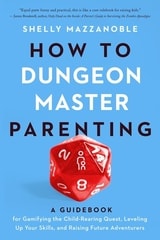
How to Dungeon Master Parenting
A Guidebook for Gamifying the Child Rearing Quest, Leveling Up Your Skills, and Raising Future AdventurersShelly Mazzanoble
University of Iowa Press, 2024
2025 National Indie Excellence Award Finalist, Parenting & Family
2025 Independent Publishers Book Awards (IPPY Awards) bronze medalist, Parenting
2024 Zibby Awards, Best Book for Parents selection
2024 Foreword INDIES Book of the Year Awards Finalist, Family & Relationship
2024 American Book Fest Best Book Award Finalist, Parenting
Gather your party, it’s time to level up your parenting game!
For years, millions of fans have looked to the beloved roleplaying game Dungeons & Dragons for fun, friendship, and entertainment. And now parents and parents-to-be can use D&D to gain inspiration and how-to when it comes to their most challenging and rewarding role yet. Dungeon Masters are not just expert storytellers and arbiters of the rules, they’re compassionate, creative, quick-thinking leaders who embody the same traits that make a great parent.
Where do you find an adventuring party who will have your back? What must-have starting equipment should you own before venturing into babyland? How does your gaming style reflect your parenting style? You don’t have to know how to be a Dungeon Master to master parenting—just think like one. Kids may not come with rulebooks, but now their parents do.
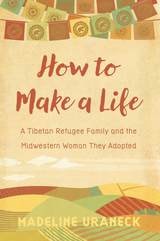
How to Make a Life
A Tibetan Refugee Family and the Midwestern Woman They AdoptedMadeline Uraneck
Wisconsin Historical Society Press, 2018
When Madeline Uraneck said hello to the Tibetan woman cleaning her office cubicle, she never imagined the moment would change her life. After learning that Tenzin Kalsang had left her husband and four children behind in a Tibetan refugee settlement in India to try to forge a better life for them, Madeline took on the task of helping her apply for US visas. When the family reunited in their new Midwestern home, Madeline became swept up in their lives, from homework and soccer games to family dinners and shared holiday traditions. By reaching out, she found more than she bargained for—a family who welcomed her as their own and taught her more than she offered them.
An evocative blend of immersion journalism and memoir, How to Make a Life shares the immigration story of a Tibetan refugee family who crossed real and cultural bridges to make a life in Madison, Wisconsin, with the assistance of the Midwestern woman they befriended. From tales of escaping Tibet over the Himalayas, to striking a balance between old traditions with new, to bridging divides one friendly gesture at a time, readers will expand their understanding of family, culture, and belonging.
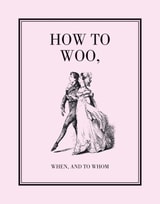
How to Woo, When, and to Whom
W. H. Collingridge
Bodleian Library Publishing, 2006
The book addresses every step in navigating the perilous territory of love, from instructions on writing love letters to the rules of public displays of affection to gracefully dealing with rejection. Also included are the most important characteristics to keep in mind when choosing The One, such as age, health, fortune, morals, and social position. On marriage, Collingridge wisely advises: “Both men and women vary greatly as to the age at which they arrive at maturity; marriage should never be undertaken before that age, and generally never after.” Even so, Collingridge lauds marriage as an institution of virtues, noting how young men’s “intellects become sharpened, their morals improved, and their energy, by certain necessity, enlarged.” (He does not, interestingly enough, note what marriage does for women.) Passages of verse by such famed literary figures as Shakespeare, Boswell, Dr. Johnson, and Lady Mary Wortley Montagu accompany the sensible advice, providing an array of poetic passages that capture the tumultuous and timeless emotions of love and rejection.
Even though today’s social scene is more analogous to Sex and the City than Emma, much of the counsel in How to Woo is surprisingly applicable to contemporary daters. An invaluable resource for both lovers and the lovelorn, How to Woo is a delightful handbook on the age-old art of courting.

Human Fertility
Henri Leridon
University of Chicago Press, 1977
The book begins with a readable, authoritative review of human fertility in its natural state. Leridon summarizes and evaluates current knowledge, drawing together rare statistical data on physiological variables as well as demographic treatments of these data. After discussing the classical framework used by demographers, Leridon undertakes a "microdemographic" analysis in which he focuses on the individual and explicates the biological processes through which social, psychological, and economic factors affect fertility. He isolates its components—fecundability, intrauterine mortality, the physiological nonsusceptible period, and sterility—then reviews the composite effect of variation in any one component.
Leridon considers situations of controlled fertility: contraception, abortion, and sterilization. The author also presents valuable new data from his own investigations of varying risks of intrauterine mortality. Finally, he shows how the previous approaches can be complemented by the use of mathematical models.
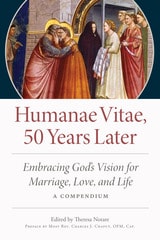
Humanae Vitae, 50 Years Later
Embracing God's Vision for Marriage, Love, and Life; A CompendiumPreface by Most. Rev. Charles J. Chaput, OFM, Cap.
Catholic University of America Press, 2019