377 books match the query 'French' and 8 start with h
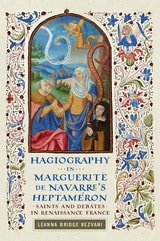
cover of Hagiography in Marguerite de Navarre’s Heptaméron: Saints and Debates in Renaissance France

Hagiography in Marguerite de Navarre’s Heptaméron

Saints and Debates in Renaissance France

Leanna Bridge Rezvani

University of Delaware Press, 2026

Marguerite de Navarre was one of the most educated and powerful women of Renaissance Europe. The Heptaméron, her celebrated collection of tales and debates, offers readers invaluable insights into diverse aspects of sixteenth-century French society. Scholars of Marguerite have written extensively on the complexities of her religious thought, but the influence of Catholic narrative tradition on the Heptaméron has been underexplored. Through an analysis of Marguerite’s tales together with literary works, religious writings, and visual images of the saints, Hagiography in Marguerite de Navarre’s Heptaméron reveals the important relationship between the Queen of Navarre’s text, hagiographic tradition, and various sixteenth-century controversies. By contextualizing the Heptaméron within these theological and literary debates, this volume illustrates how Marguerite both borrowed from and revised hagiography to lend greater authority to her writing, advocate on behalf of women, and craft an innovative response to polemics about gender, religion, and the cult of saints.
[more]
cover of Hard-Boiled Crime Fiction and the Decline of Moral Authority

Hard-Boiled Crime Fiction and the Decline of Moral Authority

Susanna Lee

The Ohio State University Press, 2016

The cynical but kind-hearted detective is the soul of the classic hard-boiled story, that chronicle of world-weary urban pessimism. In Hard-Boiled Crime Fiction and the Decline of Moral Authority, Susanna Lee argues that this fiction functions as a measure for individual responsibility in the modern world and that it demonstrates the enduring status of individual conscience across a variety of cultural crises. In this major rethinking of the hard-boiled genre, Lee suggests that, whether in Los Angeles, New York, or Paris, the hard-boiled detective is the guardian of individual moral authority and the embodiment of ideals in a corrupt environment.
Lee traces the history of the hard-boiled detective through the twentieth century and on both sides of the Atlantic (France and the United States), tying the idea of morality to the character model in nuanced, multifaceted ways. When the heroic model devolves, the very conceptual validity of individual moral authority can seem to devolve as well. Hard-Boiled Crime Fiction and the Decline of Moral Authority charts the evolution of that character model of the hard-boiled hero, the mid-century deterioration of his exemplarity, and twenty-first-century endeavors to resuscitate the accountable hero. The history of hard-boiled crime fiction tells nothing less than the story of individual autonomy and accountability in modern Western culture.
 
[more]
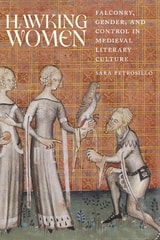
cover of Hawking Women: Falconry, Gender, and Control in Medieval Literary Culture

Hawking Women

Falconry, Gender, and Control in Medieval Literary Culture

Sara Petrosillo

The Ohio State University Press, 2023
While critical discourse about falconry metaphors in premodern literature is dominated by depictions of women as unruly birds in need of taming, women in the Middle Ages claimed the symbol of a hawking woman on their personal seals, trained and flew hawks, and wrote and read poetic texts featuring female falconers. Sara Petrosillo’s Hawking Women demonstrates how cultural literacy in the art of falconry mapped, for medieval readers, onto poetry and challenged patriarchal control. Examining texts written by, for, or about women, Hawking Women uncovers literary forms that arise from representations of avian and female bodies. Readings from Sir Orfeo, Chrétien de Troyes, Guillaume de Machaut, Chaucer’s Troilus and Criseyde, and hawking manuals, among others, show how female characters are paired with their hawks not to assert dominance over the animal but instead to recraft the stand-in of falcon for woman as falcon with woman. In the avian hierarchy female hawks have always been the default, the dominant, and thus these medieval interspecies models contain lessons about how women resisted a culture of training and control through a feminist poetics of the falconry practice.
[more]
cover of History as a Kind of Writing: Textual Strategies in Contemporary French Historiography

History as a Kind of Writing

Textual Strategies in Contemporary French Historiography

Philippe Carrard

University of Chicago Press, 2017

In academia, the traditional role of the humanities is being questioned by the “posts”—postmodernism, poststructuralism, and postfeminism—which means that the project of writing history only grows more complex. In History as a Kind of Writing, scholar of French literature and culture Philippe Carrard speaks to this complexity by focusing the lens on the current state of French historiography.

Carrard’s work here is expansive—examining the conventions historians draw on to produce their texts and casting light on views put forward by literary theorists, theorists of history, and historians themselves. Ranging from discussions of lengthy dissertations on 1960s social and economic history to a more contemporary focus on events, actors, memory, and culture, the book digs deep into the how of history. How do historians arrange their data into narratives? What strategies do they employ to justify the validity of their descriptions? Are actors given their own voice? Along the way, Carrard also readdresses questions fundamental to the field, including its necessary membership in the narrative genre, the presumed objectivity of historiographic writing, and the place of history as a science, distinct from the natural and theoretical sciences.
[more]
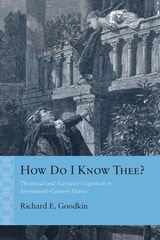
cover of How Do I Know Thee?: Theatrical and Narrative Cognition in Seventeenth-Century France

How Do I Know Thee?

Theatrical and Narrative Cognition in Seventeenth-Century France

Richard E. Goodkin

Northwestern University Press, 2015

The classical period in France presents a particularly lively battleground for the transition between oral-visual culture, on the one hand, and print culture on the other. The former depended on learning from sources of knowledge directly, in their presence, in a manner analogous to theatrical experience. The latter became characterized by the distance and abstraction of reading. How Do I Know Thee? explores the ways in which literature, philosophy, and psychology approach social cognition, or how we come to know others. Richard E. Goodkin describes a central opposition between what he calls “theatrical cognition” and “narrative cognition,” drawing both on scholarship on literary genre and mode, and also on the work of a number of philosophers and psychologists, in particular Descartes’s theory of cognition, Freudian psychoanalysis, mid‑twentieth‑century behaviorism, and the field of cognitive science. The result is a study that will be of interest not only to students of the classical period but also to those in the corresponding disciplines.
 

[more]
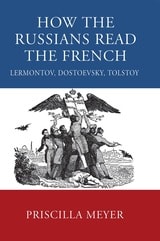
cover of How the Russians Read the French: Lermontov, Dostoevsky, Tolstoy

How the Russians Read the French

Lermontov, Dostoevsky, Tolstoy

Priscilla Meyer

University of Wisconsin Press, 2008

Russian writers of the nineteenth century were quite consciously creating a new national literary tradition. They saw themselves self-consciously through Western European eyes, at once admiring Europe and feeling inferior to it. This ambivalence was perhaps most keenly felt in relation to France, whose language and culture had shaped the world of the Russian aristocracy from the time of Catherine the Great.
            In How the Russians Read the French, Priscilla Meyer shows how Mikhail Lermontov, Fyodor Dostoevsky, and Lev Tolstoy engaged with French literature and culture to define their own positions as Russian writers with specifically Russian aesthetic and moral values. Rejecting French sensationalism and what they perceived as a lack of spirituality among Westerners, these three writers attempted to create moral and philosophical works of art that drew on sources deemed more acceptable to a Russian worldview, particularly Pushkin and the Gospels. Through close readings of A Hero of Our Time, Crime and Punishment, and Anna Karenina, Meyer argues that each of these great Russian authors takes the French tradition as a thesis, proposes his own antithesis, and creates in his novel a synthesis meant to foster a genuinely Russian national tradition, free from imitation of Western models.
 
Winner, University of Southern California Book Prize in Literary and Cultural Studies, American Association for the Advancement of Slavic Studies
[more]
cover of How to Read Barthes' Image-Music-Text

How to Read Barthes' Image-Music-Text

Ed White

Pluto Press, 2012

Roland Barthes remains one of the most influential cultural theorists of the postwar period and Image-Music-Text collects his most influential essays. Ed White provides students with a clear guide to this essential but difficult text.

As students are increasingly expected to write across a range of media, Barthes' work can be understood as an early mapping of what we now call interdisciplinary or multidisciplinary study. The book's detailed section-by-section readings makes Barthes' most important writings accessible to undergraduate readers.

This book is a perfect companion for teaching and learning Barthes' ideas in cultural studies and literary theory.
[more]
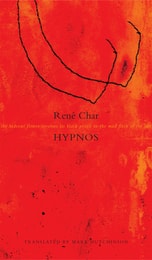
cover of Hypnos

Hypnos

René Char

Seagull Books, 2014

Now in paperback, René Char’s Hypnos is both a remarkable work of literature and a document of unique significance in the history of the French Resistance.

Hailed by the poet Paul Eluard as an "absolute masterpiece" upon its first appearance in 1946, René Char’s Hypnos is both a remarkable work of literature and a document of unique significance in the history of the French Resistance. Based on a journal Char kept during his time in the Maquis, it ranges in style from abrupt and sometimes enigmatic reflections, in which the poet seeks to establish compass bearings in the darkness of Occupied France, to narrative descriptions that throw into vivid relief the dramatic and often tragic nature of the issues he had to confront as the head of his Resistance network. A tribute to the individual men and women who fought at his side, this volume is also a meditation on the white magic of poetry and a celebration of the power of beauty to combat terror and transform our lives.

Translated into German by Paul Celan and into Italian by Vittorio Sereni, the book has never been carried over into English with the attention to style and detail that it deserves. Published in full here for the first time, this long-awaited new translation does justice at last to the incandescence and pathos of the original French.
[more]