Results by title
252 books match the query 'Future' and 10 start with h
Habeas for the Twenty-First Century
Uses, Abuses, and the Future of the Great WritNancy J. King and Joseph L. Hoffmann
University of Chicago Press, 2011
For centuries, the writ of habeas corpus has served as an important safeguard against miscarriages of justice, and today it remains at the center of some of the most contentious issues of our time—among them terrorism, immigration, crime, and the death penalty. Yet, in recent decades, habeas has been seriously abused. In this book, Nancy J. King and Joseph L. Hoffmann argue that habeas should be exercised with greater prudence.
Through historical, empirical, and legal analysis, as well as illustrative case studies, the authors examine the current use of the writ in the United States and offer sound reform proposals to help ensure its ongoing vitality in today’s justice system. Comprehensive and thoroughly grounded in a modern understanding of habeas corpus, this informative book will be an insightful read for legal scholars and anyone interested in the importance of habeas corpus for American government.
Health Extension
Community-Based Healthcare and the Future of Cooperative ExtensionCheryl L. Eschbach
Michigan State University Press, 2024
Histories of the Future
Daniel Rosenberg and Susan Harding, eds.
Duke University Press, 2005
In tightly linked studies, the contributors excavate forgotten and emergent futures of art, religion, technology, economics, and politics. They trace hidden histories of science fiction, futurism, and millennialism and break down barriers between far-flung cultural spheres. From the boardrooms of Silicon Valley to the forests of Java and from the literary salons of Tokyo to the roadside cafés of the Nevada desert, the authors stitch together the disparate images and stories of futures past and present. Histories of the Future is further punctuated by three interludes: a thought-provoking game that invites players to fashion future narratives of their own, a metafiction by renowned novelist Jonathan Lethem, and a remarkable graphic research tool: a timeline of timelines.
Contributors. Sasha Archibald, Susan Harding, Jamer Hunt, Pamela Jackson, Susan Lepselter, Jonathan Lethem, Joseph Masco, Christopher Newfield, Elizabeth Pollman, Vicente Rafael, Daniel Rosenberg, Miryam Sas, Kathleen Stewart, Anna Tsing

Hong Kong in Revolt
The Protest Movement and the Future of ChinaAu Loong-Yu
Pluto Press, 2020
Hope Is Cut
Youth, Unemployment, and the Future in Urban EthiopiaDaniel Mains
Temple University Press, 2013
How do ambitious young men grapple with an unemployment rate in urban Ethiopia hovering around fifty percent? Urban, educated, and unemployed young men have been the primary force behind the recent unrest and revolutions in North Africa and the Middle East. Daniel Mains' detailed and moving ethnographic study, Hope is Cut, examines young men's struggles to retain hope for the future in the midst of economic uncertainty and cultural globalization.
Through a close ethnographic examination of young men's day-to-day lives Hope is Cut explores the construction of optimism through activities like formal schooling, the consumption of international films, and the use of khat, a mild stimulant.
Mains also provides a consideration of social theories concerning space, time, and capitalism. Young men here experience unemployment as a problem of time—they often congregate on street corners, joking that the only change in their lives is the sun rising and setting. Mains addresses these factors and the importance of reciprocity and international migration as a means of overcoming the barriers to attaining aspirations.

Hot Towns
The Future of the Fastest Growing Communities in AmericaWolf, Peter
Rutgers University Press, 1999
Hot Towns is about the vast, current national relocation of one million Americans a year. Successful, accomplished, and well-financed people of all ages are moving to communities they view as choice—places distinguished by fine climate, physical beauty, abundant natural recreation resources, and minimal social problems and low crime. Towns in this elite roster include Santa Fe, Aspen, Boulder, Bozeman, Chapel Hill, East Hampton, and many others.
These American boom towns, Peter Wolf writes, have grown in jobs and population at two to three times the national average. But warning signs of deterioration are already evident: overbuilding, failing natural resources, rising taxes, and traffic congestion are all taking a toll on these communities. Rapid migration can enhance or swamp America’s fastest growing and most desirable communities
Wolf examines the choices that people in these areas can make to both effectively accommodate growth and yet ensure their economic futures. A wise town undergoing growth will realize that what must be preserved is not the growth in-and-for itself, but the qualities which attract people in the first place. Wolf demonstrates how it is possible—even during a town’s rapid expansion—to enhance the quality of residents’ lives, to incorporate aesthetics and design into town evolution, to protect what is precious in nature, and to preserve the best that has already been built.
Wolf concludes with a practical checklist for the residents of hot towns, allowing them to evaluate how their communities are coping with growth.
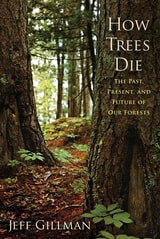
How Trees Die
The Past, Present, and Future of our ForestsJeff Gillman
Westholme Publishing, 2009
Trees have been essential to the success of human beings, providing food, shelter, warmth, transportation, and products (consider the paper you are holding). Trees are also necessary for a healthy atmosphere, literally connecting the earth with the sky. Once in wild abundance— the entire eastern North America was a gigantic forest—they have receded as we have clearcut the landscape in favor of building cities and farms, using up and abusing our forests in the process. Over the centuries, we have trained food trees, such as peach and apple trees, to produce more and better fruit at the expense of their lives. As Jeff Gillman, a specialist in the production and care of trees, explains in his acclaimed work, How Trees Die: The Past, Present, and Future of Our Forests, the death of a tree is as important to understanding our environment as how it lives. While not as readily apparent as other forms of domestication, our ancient and intimate relationship with trees has caused their lives to be inseparably entwined with ours. The environment we have created—what we put into the air and into the water, and how we change the land through farming, construction, irrigation, and highways—affects the world’s entire population of trees, while the lives of the trees under our direct care in farms, orchards, or along a city boulevard depend almost entirely on our actions. Taking the reader on a fascinating journey through time and place, the author explains how we kill trees, often for profit, but also unintentionally with kindness through overwatering or overmulching, and sometimes simply by our movements around the globe, carrying foreign insects or disease. No matter how a tree’s life ends, though, understanding the reason is essential to understanding the future of our environment.
How Would You Like to Pay?
How Technology Is Changing the Future of MoneyBill Maurer
Duke University Press, 2015
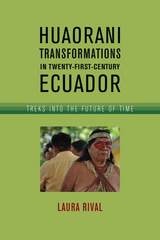
Huaorani Transformations in Twenty-First-Century Ecuador
Treks into the Future of TimeLaura Rival
University of Arizona Press, 2016
Rival’s intimate knowledge of Huaorani culture spans twenty-five years. Here in a collection of broad-ranging essays, she offers a fascinating and provocative study. The first section, “Among Forest Beings,” shows that the Huaorani have long adapted to life in the tropical rain forest with minimal reliance on horticulture, yet have developed a complex relationship with plants. In “In the Longhouse,” the second section, Rival focuses on the intimate relations that create human persons and enact kinship relations. She also discusses women’s lives and perspectives. The third section, “In the Midst of Enemies,” considers how Huaorani society fits in larger political and economic contexts, illustrating how native values shape their encounters with oil companies, the state, and other external forces. Rival carefully analyzes insider/outsider dialectics wherein Huaorani people re-create meaningful and valued worlds in the face of alien projects, such as petroleum development, carbon trading, or intercultural education.
Capitalizing on the author’s decades-long study and interactions in the community, Huaorani Transformations in Twenty-First-Century Ecuador brings new insights to the Huaorani’s unique way of relating to humans, to other-than-humans, and to the forest landscape they have inhabited for centuries.
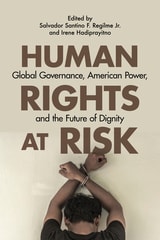
Human Rights at Risk
Global Governance, American Power, and the Future of DignitySalvador Santino F. Regilme Jr. and Irene Hadiprayitno
Rutgers University Press, 2022