Results by title
570 books match the query 'Gay Studies' and 17 start with h
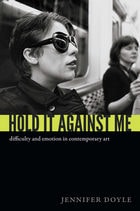
Hold It Against Me
Difficulty and Emotion in Contemporary ArtJennifer Doyle
Duke University Press, 2013
Doyle explores ideologies of emotion and how emotion circulates in and around art. Throughout, she gives readers welcoming points of entry into artworks that they may at first find off-putting or confrontational. Doyle offers new insight into how the discourse of controversy serves to shut down discussion about this side of contemporary art practice, and counters with a critical language that allows the reader to accept emotional intensity in order to learn from it.
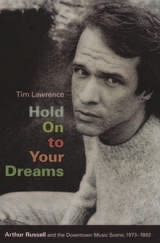
Hold On to Your Dreams
Arthur Russell and the Downtown Music Scene, 1973-1992Tim Lawrence
Duke University Press, 2009
Tim Lawrence traces Russell's odyssey from his hometown of Oskaloosa, Iowa, to countercultural San Francisco, and eventually to New York, where he lived from 1973 until his death from AIDS-related complications in 1992. Resisting definition while dreaming of commercial success, Russell wrote and performed new wave and disco as well as quirky rock, twisted folk, voice-cello dub, and hip-hop-inflected pop. “He was way ahead of other people in understanding that the walls between concert music and popular music and avant-garde music were illusory,” comments the composer Philip Glass. "He lived in a world in which those walls weren't there." Lawrence follows Russell across musical genres and through such vital downtown music spaces as the Kitchen, the Loft, the Gallery, the Paradise Garage, and the Experimental Intermedia Foundation. Along the way, he captures Russell's openness to sound, his commitment to collaboration, and his uncompromising idealism.
Home Is Where Your Politics Are
Queer Activism in the U.S. South and South AfricaJessica A. Scott
Rutgers University Press, 2024
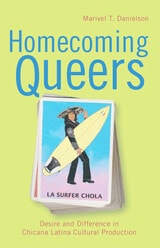
Homecoming Queers
Desire and Difference in Chicana Latina Cultural ProductionDanielson, Marivel T
Rutgers University Press, 2009
Spanning multiple genres and forms, and including scholarly theory alongside performances, films, narratives, and testimonials, Homecoming Queers leads readers along a crucial path toward understanding and overcoming the silences that previously existed across these fields.
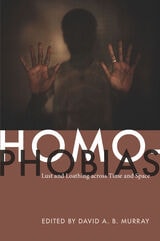
Homophobias
Lust and Loathing across Time and SpaceDavid A. B. Murray, ed.
Duke University Press, 2009
The contributors to this volume open up the scope of inquiry into processes of homophobia, moving the analysis of a particular form of “hate” into new, wider sociocultural and political fields. The ongoing production of homophobic discourses is carefully analyzed in diverse sites including New York City, Australia, the Caribbean, Greece, India, and Indonesia, as well as American Christian churches, in order to uncover the complex operational processes of homophobias and their intimate relationships to nationalism, sexism, racism, class, and colonialism. The contributors also critically inquire into the limitations of the term homophobia and interrogate its utility as a cross-cultural designation.
Contributors. Steven Angelides, Tom Boellstorff, Lawrence Cohen, Don Kulick, Suzanne LaFont, Martin F. Manalansan IV, David A. B. Murray, Brian Riedel, Constance R. Sullivan-Blum
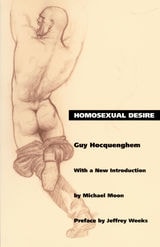
Homosexual Desire
Guy Hocquenghem
Duke University Press, 1993
Significant as one of the earliest products of the international gay liberation movement, Hocquenghem's work was influenced by the extraordinary energies unleashed by the political upheavals of both the Paris "May Days" of 1968 and the gay and lesbian political rebellions that occurred in cities around the world in the wake of New York's Stonewall riots of June 1969.
Drawing on the theoretical work of Gilles Deleuze and Félix Guattari and on the shattering effects of innumerable gay "comings-out," Hocquenghem critiqued the influential models of the psyche and sexual desire derived from Lacan and Freud. The author also addressed the relation of capitalism to sexualities, the dynamics of anal desire, and the political effects of gay group-identities.
Homosexual Desire remains an exhilarating analysis of capitalist societies' pervasive fascination with, and violent fear of, same-sex desire and addresses issues that continue to be highly charged and productive ones for queer politics.
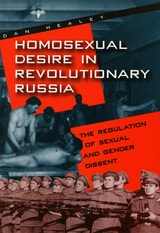
Homosexual Desire in Revolutionary Russia
The Regulation of Sexual and Gender DissentDan Healey
University of Chicago Press, 2001
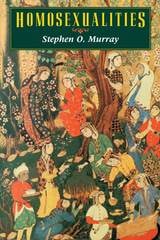
Homosexualities
Stephen O. Murray
University of Chicago Press, 2000
"[An] indispensable resource on same-sex sexual relationships and their social contexts. . . . Essential reading." —Choice
"[P]romises to deliver a lot, and even more extraordinarily succeeds in its lofty aims. . . . [O]riginal and refreshing. . . . [A] sensational book, part of what I see emerging as a new commonsense revolution within academe." —Kevin White, International Gay and Lesbian Review
Homosexuality and Psychoanalysis
Edited by Tim Dean and Christopher Lane
University of Chicago Press, 2001
Why has homosexuality always fascinated and vexed psychoanalysis? This groundbreaking collection of original essays reconsiders the troubled relationship between same-sex desire and psychoanalysis, assessing homosexuality's status in psychoanalytic theory and practice, as well as the value of psychoanalytic ideas for queer theory. The contributors, each distinguished clinicians and specialists, reexamine works by Freud, Klein, Reich, Lacan, Laplanche, and their feminist and queer revisionists. Sharing a commitment to conscious and unconscious forms of homosexual desire, they offer new perspectives on pleasure, perversion, fetishism, disgust, psychosis, homophobia, AIDS, otherness, and love. Including two previously untranslated essays by Michel Foucault, Homosexuality and Psychoanalysis will interest cultural theorists, psychoanalysts, and anyone concerned with the fate of sexuality in our time.
Contributors:
Lauren Berlant
Leo Bersani
Daniel L. Buccino
Arnold I. Davidson
Tim Dean
Jonathan Dollimore
Brad Epps
Michel Foucault
Lynda Hart
Jason B. Jones
Christopher Lane
H. N. Lukes
Catherine Millot
Elizabeth A. Povinelli
Ellie Ragland
Paul Robinson
Judith Roof
Joanna Ryan
Ramón E. Soto-Crespo
Suzanne Yang
Homosexuality in Cold War America
Resistance and the Crisis of MasculinityRobert J. Corber
Duke University Press, 1997
By exploring the representation of gay men in film noir, Corber suggests that even as this Hollywood genre reinforced homophobic stereotypes, it legitimized the gay male "gaze." He emphasizes how film noir’s introduction of homosexual characters countered the national "project" to render gay men invisible, and marked a deep subversion of the Cold War mentality. Corber then considers the work of gay male writers Tennessee Williams, Gore Vidal, and James Baldwin, demonstrating how these authors declined to represent homosexuality as a discrete subculture and instead promoted a model of political solidarity rooted in the shared experience of oppression. Homosexuality in Cold War America reveals that the ideological critique of the dominant culture made by gay male authors of the 1950s laid the foundation for the gay liberation movement of the following decade.
Honey, Honey, Miss Thang
Being Black, Gay, and on the StreetsLeon E. Pettiway
Temple University Press, 1996
Many straight Americans would never embrace homosexuals as neighbors, co-workers, or friends. Still less would they accept as equals those transgendered individuals who work the streets to provide themselves with drug money.
This book seeks to change that perception. It celebrates the lives of Shontae, China, Keisha, Detra, and Monique, five Afro-American gay hustlers who struggle to survive and to maintain a life of dignity and value in the face of their drug use and criminal activity. As individuals they vary in terms of background, the manner in which they entered the transgendered world, and the nature of their initiation into the drug subculture. None of them has escaped the ravages of urban decline, crime, drugs, and poverty that accompany life in an inner city, but by the same token, none of them has capitulated to the stresses with which they live.
It is impossible to read these accounts and not come away emotionally drained. As Monique explains, their lives take place in a world of chances. "You take a chance on living or dying, on being hurt or not being hurt, a chance on finding a friend or finding an enemy." It is from this world that their voices speak so eloquently about their families, hustling, sexuality, sexual abuse, friendship, and intimacy.
By letting these women speak, Leon E. Pettiway evokes questions and encourages discussion and a re-evaluation of those who are labeled as deviant. Pettiway reaches beyond academic convention to offer a view with depth and emotion that mere statistics could never provide. While the poverty and often destructive lifestyle of these women may be gut-wrenching, their experiences reveal joy, pain, and the profound strength of the human spirit with which we can all identify. These lives have much to teach us about ourselves and those we label as "other."
Honeypot
Black Southern Women Who Love WomenE. Patrick Johnson
Duke University Press, 2019

Honorable Bandit
A Walk across CorsicaBrian Bouldrey
University of Wisconsin Press, 2007
Brian Bouldrey traveled to the island of Corsica, with its wine-dark Mediterranean waters, powdered-sugar beach sand, sumptuous cuisine, and fine wine. And then he walked away from all of them.
Bouldrey strapped on a backpack and walked across Napoleon's native land with the same spirit many choose to dance or drink: to celebrate, to mourn, to think, to avoid thinking, to recall, to ignore, to escape, and to arrive.
This wonderfully textured account of a two-week ramble along a famous Corsican hiking trail with his German friend Petra (she was good at the downhills while he was better at the uphills) offers readers a journal that is a launching point for reflection: thoughts on cultural differences, friendship, physical challenge, personal challenge, and getting very, very lost. Part travelogue, part memoir, and part lampoon, this book offers readers an impressionistic view of a little talked about yet stunningly beautiful landscape.

HoodWitch
Faylita Hicks
Acre Books, 2019
In this collection about resilience, Hicks speaks about giving her child up for adoption, mourning the death of her fiancé, and embracing the nonbinary femme body—persevering in the face of medical malpractice, domestic abuse, and police violence. The poems find people transformed, “remade out of smoke & iron” into cyborgs and wolves, machines and witches—beings capable of seeking justice in a world that refuses them the option.
Exploring the intersections of Christianity, modern mysticism, and Afrofuturism in a sometimes urban, sometimes natural setting, Hicks finds a place where “everyone everywhere is hands in the air,” where “you know they gonna push & pull it together. / Just like they learned to.” It is a place of natural magick—where someone like Hicks can have more than one name: where they can be both dead and alive, both a mortal and a god.

How Soon Is Now?
Medieval Texts, Amateur Readers, and the Queerness of TimeCarolyn Dinshaw
Duke University Press, 2012
Whether discussing Victorian men of letters who parodied the Book of John Mandeville, a fictionalized fourteenth-century travel narrative, or Hope Emily Allen, modern coeditor of the early-fifteenth-century Book of Margery Kempe, Dinshaw argues that these and other medievalists outside the academy inhabit different temporalities than modern professionals operating according to the clock. How Soon Is Now? clears space for amateurs, hobbyists, and dabblers who approach medieval worlds from positions of affect and attachment, from desires to build other kinds of worlds. Unruly, untimely, they urge us toward a disorderly and asynchronous collective.

How the Religious Right Shaped Lesbian and Gay Activism
Tina Fetner
University of Minnesota Press, 2008
An unexpected analysis of the battle between opposing activist movements
While gay rights are on the national agenda now, activists have spent decades fighting for their platform, seeing themselves as David against the religious right’s Goliath. At the same time, the religious right has continuously and effectively countered the endeavors of lesbian and gay activists, working to repeal many of the laws prohibiting discrimination based on sexual orientation and to progress a constitutional amendment “protecting” marriage.
In this accessible and grounded work, Tina Fetner uncovers a remarkably complex relationship between the two movements—one that transcends political rivalry. Fetner shows how gay activists and the religious right have established in effect a symbiotic relationship in which each side very much affects the development of its counterpart. As lesbian and gay activists demand an end to prejudice, inclusion in marriage, the right to serve in the military, and full citizenship regardless of sexual orientation, the religious right has responded with antigay planks in Republican party platforms and the blocking of social and political change efforts. Fetner examines how the lesbian and gay movement reacts to opposition by changing rhetoric, tone, and tactics and reveals how this connection has influenced—and made more successful—the evolution of gay activism in the United States. Fetner addresses debates that lie at the center of the culture wars and, ultimately, she demonstrates how the contentious relationship between gay and lesbian rights activists and the religious right—a dynamic that is surprisingly necessary to both—challenges assumptions about how social movements are significantly shaped by their rivals.
How to Make Dances in an Epidemic
Tracking Choreography in the Age of AIDSDavid Gere
University of Wisconsin Press, 2004
David Gere, who came of age as a dance critic at the height of the AIDS epidemic, offers the first book to examine in depth the interplay of AIDS and choreography in the United States, specifically in relation to gay men. The time he writes about is one of extremes. A life-threatening medical syndrome is spreading, its transmission linked to sex. Blame is settling on gay men. What is possible in such a highly charged moment, when art and politics coincide?
Gere expands the definition of choreography to analyze not only theatrical dances but also the protests conceived by ACT-UP and the NAMES Project AIDS quilt. These exist on a continuum in which dance, protest, and wrenching emotional expression have become essentially indistinguishable. Gere offers a portrait of gay male choreographers struggling to cope with AIDS and its meanings.