Results by title
69 books match the query 'Genocide' and 3 start with h
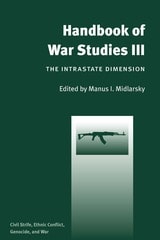
Handbook of War Studies III
The Intrastate DimensionManus I. Midlarsky, ed.
University of Michigan Press, 2009
"Midlarsky has done it again, another state-of-the art handbook on the most recent developments in the study of war. This volume is entirely new with a focus on internal war. It is a 'must-read' for scholars and students of conflict. Even the most knowledgeable will learn a great deal from the book."
---John A. Vasquez, Thomas B. Mackie Scholar in International Relations, University of
Illinois at Urbana-Champaign
"Handbook of War Studies III is a tour de force. This is a compelling and comprehensive work of scholarship. Midlarsky, as with previous volumes, has assembled an 'all star' team from the interdisciplinary field of conflict processes. In response to trends in place over the last few decades, this third volume rightly focuses on the intrastate dimension of international conflict. The volume includes lucid presentations on rational choice and political psychology as alternative visions, along with convincing treatments of civil war, ethnic conflict, genocide, and related issues. This book will be required reading for anyone with an interest in conflict processes."
---Patrick James, Director, Center for International Studies, University of Southern California
"This third volume of the Handbook is a very welcome addition with its focus on intrastate conflict. Scholarship on internal conflict has proliferated over the past decade, and therefore it is time to take stock of the work that has been done and to point out directions for future research. In this volume a team of leading scholars do just that as they provide trenchant assessments of what has been accomplished and what are the remaining big questions that require further research. This volume will be indispensable to students and scholars alike."
---Paul Huth, Editor, Journal of Conflict Resolution, and Professor of Government and Politics, University of Maryland, College Park
Handbook of War Studies III is a follow-up to Handbook of War Studies I (1993) and II (2000). This new volume collects original work from leading international relations scholars on domestic strife, ethnic conflict, genocide, and other timely topics. Special attention is given to civil war, which has become one of the dominant forms---if not the dominant form---of conflict in the world today.
Nils Petter Gleditsch, International Peace Research Institute, Oslo (PRIO), and Norwegian University of Science and Technology (NTNU), Trondheim
Håvard Hegre, University of Oslo, and International Peace Research Institute, Oslo (PRIO)
Erin K. Jenne, Central European University, Budapest
Mark Irving Lichbach, University of Maryland
Roy Licklider, Rutgers University, New Brunswick
T. David Mason, University of North Texas
Rose McDermott, Cornell University
Stephen Saideman, McGill University
Håvard Strand, International Peace Research Institute, Oslo (PRIO)
Monica Duffy Toft, Harvard University
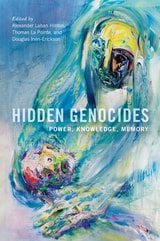
Hidden Genocides
Power, Knowledge, MemoryAlexander Laban Hinton, Thomas La Pointe, and Douglas Irvin-Erickson
Rutgers University Press, 2014
Why are some genocides prominently remembered while others are ignored, hidden, or denied? Consider the Turkish campaign denying the Armenian genocide, followed by the Armenian movement to recognize the violence. Similar movements are building to acknowledge other genocides that have long remained out of sight in the media, such as those against the Circassians, Greeks, Assyrians, the indigenous peoples in the Americas and Australia, and the violence that was the precursor to and the aftermath of the Holocaust.
The contributors to this collection look at these cases and others from a variety of perspectives. These essays cover the extent to which our biases, our ways of knowing, our patterns of definition, our assumptions about truth, and our processes of remembering and forgetting as well as the characteristics of generational transmission, the structures of power and state ideology, and diaspora have played a role in hiding some events and not others. Noteworthy among the collection’s coverage is whether the trade in African slaves was a form of genocide and a discussion not only of Hutus brutalizing Tutsi victims in Rwanda, but of the execution of moderate Hutus as well.
Hidden Genocides is a significant contribution in terms of both descriptive narratives and interpretations to the emerging subfield of critical genocide studies.
Contributors: Daniel Feierstein, Donna-Lee Frieze, Krista Hegburg, Alexander Laban Hinton, Adam Jones, A. Dirk Moses, Chris M. Nunpa, Walter Richmond, Hannibal Travis, and Elisa von Joeden-Forgey
Humanity's Ruins
Ethics, Feminism, and Genocidal HumanitarianismDanielle Bouchard
Duke University Press, 2025