Results by title
218 books match the query 'Handbooks, manuals, etc' and 12 start with h

HF Radio Systems and Circuits
William E. Sabin
The Institution of Engineering and Technology, 1998

Handbook Of Academic Writing For Librarians
Assoc of College & Research Libraries, 2013

Handbook for In-Service Training in Human Services
William Crimando
Southern Illinois University Press, 1988
A practical "how-to" workbook that outlines a plan for the design and implementation of staff in-service training programs for human service agencies and facilities.
Crimando and Riggar have made every effort to guarantee the usefulness of this text to practitioners, instructors, and students. This is a working book designed to assist trainers as they acquire the knowledge and skills needed to provide thorough, systematic in-service training that will enhance human service endeavors.
The authors have organized the nineteen chapters into four parts that treat significant steps in the training-program design process. These include analyzing problems that require training solutions; developing a proposal; writing a plan of action for training; and evaluating a program. Each of the chapters combines text, examples, exercises, and supplementary readings to foster a full appreciation of the process involved. Even those topics frequently overlooked or disregarded are included: budgeting program time and financial resources, obtaining administrative commitment, and transferring and maintaining skills in the work setting.
Handbook for Management of Human Service Agencies
T.F. Riggar and R.E. Matkin
Southern Illinois University Press, 1986
A basic guide for individuals responsible for developing and/or operating comprehensive or specialized human service programs.
Drawing on more than a decade of classroom experience and development and incorporating standards from the Commission on Accreditation of Rehabilitation Facilities (1985 Edition), Riggar and Matkin have created a management tool that is as practical for human service providers as it is for students. Here is the fundamental management knowledge required to establish or manage all types of human service programs and facilities.
The text is organized into 23 sections that describe tasks ranging from constructing mission statements and admission criteria to developing start-up budgets and allocating space for both direct and indirect services. Each section provides definitions and guidelines, practical examples, exercises, and selected references. While the focus is on the practices of the private not-for-profit sector, those working in a profit-oriented setting will find many of the sections and exercises to be valuable aids for developing, operating, and maintaining successful programs.
Handbook for Science Public Information Officers
W. Matthew Shipman
University of Chicago Press, 2015
W. Matthew Shipman’s Handbook for Science Public Information Officers covers all aspects of communication strategy and tactics for members of this growing specialty. It includes how to pitch a story, how to train researchers to navigate interviews, how to use social media effectively, and how to respond to a crisis. The handbook offers a wealth of practical advice while teaching science PIOs how to think critically about what they do and how they do it, so that they will be prepared to take advantage of any situation, rather than being overwhelmed by it.
For all science communicators—whether they’re starting their careers, crossing over from journalism or the research community, or professional communicators looking to hone their PIO skills—Shipman’s Handbook for Science Public Information Officers will become their go-to reference.
Handbook of Academic Writing for Librarians
Christopher Hollister
Assoc of College & Research Libraries, 2014
This primary reference tool for the library and information science (LIS) community supports those who either desire or are required to publish in the professional literature. LIS students at the masters and doctoral levels can also benefit from this comprehensive volume.
Handbook of Engaged Scholarship
Contemporary Landscapes, Future Directions: Volume 1: Institutional ChangeHiram E. Fitzgerald
Michigan State University Press, 2010
In the preface to the Handbook of Engaged Scholarship, Hiram Fitzgerald observes that the Kellogg Commission's challenge to higher education to engage with communities was a significant catalyst for action. At Michigan State University, the response was the development of "engaged scholarship," a distinctive, scholarly approach to campus-community partnerships.
Engaged scholars recognize that community based scholarship is founded on an underpinning of mutual respect and recognition that community knowledge is valid and that sustainability is an integral part of the partnership agenda.
In this two-volume collection, contributors capture the rich diversity of institutions and partnerships that characterize the contemporary landscape and the future of engaged scholarship. Volume One addresses such issues as the application of engaged scholarship across types of colleges and universities and the current state of the movement. Volume Two contains essays on such topics as current typologies, measuring effectiveness and accreditation, community-campus partnership development, national organizational models, and the future landscape.
Handbook of Engaged Scholarship
Contemporary Landscapes, Future Directions: Volume 2: Community-Campus PartnershipsHiram E. Fitzgerald
Michigan State University Press, 2010
In the preface to the Handbook of Engaged Scholarship, Hiram Fitzgerald observes that the Kellogg Commission's challenge to higher education to engage with communities was a significant catalyst for action. At Michigan State University, the response was the development of "engaged scholarship," a distinctive, scholarly approach to campus-community partnerships.
Engaged scholars recognize that community based scholarship is founded on an underpinning of mutual respect and recognition that community knowledge is valid and that sustainability is an integral part of the partnership agenda.
In this two-volume collection, contributors capture the rich diversity of institutions and partnerships that characterize the contemporary landscape and the future of engaged scholarship. Volume One addresses such issues as the application of engaged scholarship across types of colleges and universities and the current state of the movement. Volume Two contains essays on such topics as current typologies, measuring effectiveness and accreditation, community-campus partnership development, national organizational models, and the future landscape.

Handbook of Medical Sociology, Sixth Edition
Chloe E. Bird
Vanderbilt University Press, 2010
• social networks, neighborhoods, and social capital
• disability
• dying and "the right to die"
• health disparities
• the growing influence of the pharmaceutical industry
• the Internet
• evidence-based medicine and quality of care
• health social movements
• genetics
• religion, spirituality, and health

How to Do It
Guides to Good Living for Renaissance ItaliansRudolph M. Bell
University of Chicago Press, 1999
"Lively and curious reading, particularly in its cascade of anecdote, offered in a breezy, cozy, journalistic style." —Lauro Martines, Times Literary Supplement
"[Bell's] fascinating book is a window on a lost world far nearer to our own than we might imagine. . . . How pleasant to read his delightful, informative and often hilarious book." —Kate Saunders, The Independent
"An extraordinary work which blends the learned with the frankly bizarre." —The Economist
"Professor Bell has a sly sense of humor and an enviably strong stomach. . . . He wants to know how people actually behaved, not how the Church or philosophers or earnest humanists thought they should behave. I loved this book." —Christopher Stace, Daily Telegraph
How to Lobby Alaska State Government
Clive S. Thomas
University of Alaska Press, 2019
This book starts by helping new lobbyists to think politically, by explaining the structure and operation of state government, the psychology and needs of public officials, and where the power lies in Juneau—who’s got political clout. How to Lobby then moves into the nitty-gritty of a lobbying campaign. It covers the basics of group influence, campaign planning and management, the pros and cons of various group tactics, tips on face-to-face meetings, and the challenges of lobbying day-to-day. In addition to extensive guidance on what to do, this book also emphasizes the things to avoid that will undermine or eliminate a lobbyist’s chances of success. Pragmatic and portable, this book will be valuable to new and professional lobbyists both, and anyone looking for fresh perspectives on this important business.
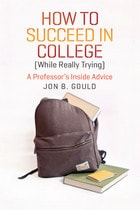
How to Succeed in College (While Really Trying)
A Professor's Inside AdviceJon B. Gould
University of Chicago Press, 2010
After years of preparation and anticipation, many students arrive at college without any real knowledge of the ins and outs of college life. They’ve been focused on finding the right school and have been carefully guided through the nuances of the admissions process, but too often they have little knowledge about how college will be different from high school or what will be expected of them during that crucial first year and beyond. Written by an award-winning teacher, How to Succeed in College (While Really Trying) provides much-needed help to students, offering practical tips and specific study strategies that will equip them to excel in their new environment.
Drawing on years of experience teaching at a variety of campuses, from large research universities to small liberal arts colleges, Jon B. Gould gives readers the lay of the land and demystifies the college experience. In the course of the book, students will learn how to identify the best instructors, how to choose classes and settle on a major, how to develop effective strategies for reading and note taking, and how to write good papers and successfully complete exams.
Because much of the college experience takes place outside of the classroom, Gould also advises students on how to effectively manage their cocurricular activities, work obligations, and free time, as well as how to take advantage of the typically untapped resources on every campus. With candid advice and insights from a seasoned insider, this guide will leave students better prepared not only to succeed in college but to enjoy it as well.