Results by title
332 books match the query 'Health & Fitness' and 13 start with h
Heal Your Heart
How You Can Prevent or Reverse Heart DiseaseGould, K. Lance
Rutgers University Press, 2000
Healing Powers
Alternative Medicine, Spiritual Communities, and the StateFred M. Frohock
University of Chicago Press, 1992
"Frohock goes beyond the often irreconcilable differences between scientific biomedicine and alternative care by clarifying the social and legal dilemmas they present. . . . A noteworthy contribution forcing us to rethink what medical care is all about."—Jeffrey Michael Clare, Journal of the American Medical Association
"The book does more and better than simply provide a social-scientific proposal. It also gives not only a hearing but a voice to those who follow alternative therapies. . . . Frohock's accounts of their stories—along with the stories of the medical professionals—are eloquent and fascinating."—Allen Verhey, Medical Humanities Review
"Contains a storehouse of valuable information about the historical, philosophical, and psychological bases of alternative approaches to healing."—Marshall B. Kapp, New England Journal of Medicine
"Frohock introduces us to the scientific naturopaths and to physicians who believe in the mind's power to heal, to charismatics who believe in but cannot explain their powers, to those who test God and those who merely accept. He writes so well that I felt I had met these people."—Arthur W. Frank, Christian Century
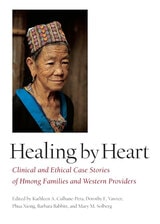
Healing by Heart
Clinical and Ethical Case Stories of Hmong Families and Western ProvidersKathleen A. Culhane-Pera
Vanderbilt University Press, 2003
Ranging in age from young infants to older adults, the patients in the stories present a wide range of health problems. The clinicians are from family practice, internal medicine, pediatrics, emergency medicine, surgery, obstetrics-gynecology, psychiatry/psychology, and hospice.
Each of the fourteen case stories is accompanied by discussion questions as well as two or three commentaries. The commentaries--written by patients, family members, shaman, Western clinicians (including Hmong physicians, nurses, and social workers), medical anthropologists, health care ethicists, social workers, psychologists, and clergy--are rich in personal reflections on cross-cultural health care experiences. Readers are rewarded with a combination of perspectives, including those of Hmong authors who have not previously published in English and scholars with years of professional experience working with the Hmong in Laos, Thailand, and the United States.
The editors offer a model for delivering culturally responsive health care with special attention to matters of cross-cultural health care ethics. The model identifies questions health care providers can focus on as they seek to understand the health-related moral commitments and practices prevalent in the cultural groups they serve, ethical questions that arise frequently and with great poignancy in cross-cultural health care relationships, and points to consider when a patient's treatment wish challenges the provider's professional integrity.
By sharing stories of suffering, confusion, and success, Healing by Heart couples an accessible method of learning about others with concrete recommendations about how to enhance cross-cultural health care relationships.
Health Humanities Reader
Jones, Therese
Rutgers University Press, 2014
In Health Humanities Reader, editors Therese Jones, Delese Wear, and Lester D. Friedman have assembled fifty-four leading scholars, educators, artists, and clinicians to survey the rich body of work that has already emerged from the field—and to imagine fresh approaches to the health humanities in these original essays. The collection’s contributors reflect the extraordinary diversity of the field, including scholars from the disciplines of disability studies, history, literature, nursing, religion, narrative medicine, philosophy, bioethics, medicine, and the social sciences.
With warmth and humor, critical acumen and ethical insight, Health Humanities Reader truly humanizes the field of medicine. Its accessible language and broad scope offers something for everyone from the experienced medical professional to a reader interested in health and illness.
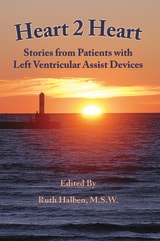
Heart 2 Heart
Stories from Patients with Left Ventricular Assist DevicesEdited by Ruth Halben, M.S.W.
Michigan Publishing Services, 2016
hardships they and their families endured as well as how many found hope after receiving an LVAD.
Each chapter is written by a different patient or a patient’s family member, creating a unique
collection of stories that reveals the realities of living life with an implanted heart pump. Heart 2 Heart is composed of seventeen patient voices, where fourteen males and three females of different ethnicities and ages share with the reader their tale--from their initial diagnosis, to their eventual LVAD procedure performed at the University of Michigan Hospital.
The editor, Ruth Halben, M.S.W., is a clinical social worker in the University of Michigan Health System who works with LVAD patients and their families. Ruth is one of the first LVAD social workers in the nation, and she draws both from her expertise and her heartfelt relationships with her patients to bring together this wonderful resource for current and future LVAD patients.
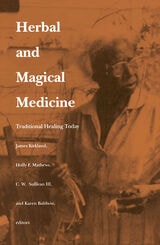
Herbal and Magical Medicine
Traditional Healing TodayJames K. Kirkland, Holly Matthews, C. W. Sullivan III and Karen Baldwin, eds.
Duke University Press, 1992
The authors provide illuminating commentary on the major forms of naturopathic and magico-religious medicine practiced in the United States. Other essays explain the persistence of these traditions in our modern technological society and address the bases of folk medical concepts of illness and treatment and the efficacy of particular pratices. The collection suggests a model for collaborative research on traditional medicine that can be replicated in other parts of the country. An extensive bibliography reveals the scope and variety of research in the field.
Contributors. Karen Baldwin, Richard Blaustein, Linda Camino, Edward M. Croom Jr., David Hufford, James W. Kirland, Peter Lichstein, Holly F. Mathews, Robert Sammons, C. W. Sullivan III
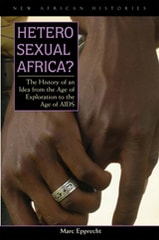
Heterosexual Africa?
The History of an Idea from the Age of Exploration to the Age of AIDSMarc Epprecht
Ohio University Press, 2008
Heterosexual Africa? The History of an Idea from the Age of Exploration to the Age of AIDS builds from Marc Epprecht’s previous book, Hungochani (which focuses explicitly on same-sex desire in southern Africa), to explore the historical processes by which a singular, heterosexual identity for Africa was constructed—by anthropologists, ethnopsychologists, colonial officials, African elites, and most recently, health care workers seeking to address the HIV/AIDS pandemic. This is an eloquently written, accessible book, based on a rich and diverse range of sources, that will find enthusiastic audiences in classrooms and in the general public.
Epprecht argues that Africans, just like people all over the world, have always had a range of sexualities and sexual identities. Over the course of the last two centuries, however, African societies south of the Sahara have come to be viewed as singularly heterosexual. Epprecht carefully traces the many routes by which this singularity, this heteronormativity, became a dominant culture. In telling a fascinating story that will surely generate lively debate, Epprecht makes his project speak to a range of literatures—queer theory, the new imperial history, African social history, queer and women’s studies, and biomedical literature on the HIV/AIDS pandemic. He does this with a light enough hand that his story is not bogged down by endless references to particular debates.
Heterosexual Africa? aims to understand an enduring stereotype about Africa and Africans. It asks how Africa came to be defined as a “homosexual-free zone” during the colonial era, and how this idea not only survived the transition to independence but flourished under conditions of globalization and early panicky responses to HIV/AIDS.
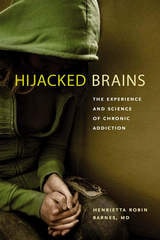
Hijacked Brains
The Experience and Science of Chronic AddictionHenrietta Robin Barnes
Dartmouth College Press, 2015
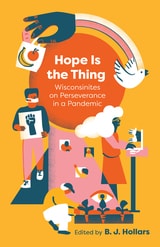
Hope is the Thing
Wisconsinites on Perseverance in a PandemicB. J. Hollars
Wisconsin Historical Society Press, 2021
As the one hundred essays and poems gathered here demonstrate, hope comes in many forms: a dad dance, a birth plan, an unblemished banana, a visit from a neighborhood dog, the revival of an old tradition, empathy. The contributors are racially, geographically, and culturally diverse, representing a rough cross section of Wisconsin voices, from truck driver to poet laureate, from middle school student to octogenarian, from small business owner to seasoned writer. The result is a book-length exploration of the depth and range of hope experienced in times of crisis, as well as an important record of what Wisconsinites were facing and feeling through these historic times.
Hospital Time
Amy Hoffman
Duke University Press, 1997
Hoffman became central to Riegle’s caregiving when he asked her to be his health-care proxy, and although she willingly chose to do this, she explores her conflicting feelings about herself in this role and about her involvement with Riegle and his grueling struggle with hospitalization, illness, and, finally, death. She tells of the waves of grief that echoed throughout her life, awakening memories of other losses, entering her dreams and fantasies, and altering her relationships with friends, family, and even total strangers.
Hoffman’s memoir gives voice to the psychological and emotional havoc AIDS creates for those in the difficult role of caring for the terminally ill and it gives recognition to the role that lesbians continue to play in the AIDS emergency. A foreword by Urvashi Vaid, former executive director of the National Gay and Lesbian Task Force, offers a meditation on the politics of AIDS and the role of family in the lives of lesbians and gay men.
How to Have Theory in an Epidemic
Cultural Chronicles of AIDSPaula A. Treichler
Duke University Press, 1999
“AIDS is more than an epidemic disease,” Treichler writes, “it is an epidemic of meanings.” Exploring how such meanings originate, proliferate, and take hold, her essays investigate how certain interpretations of the epidemic dominate while others are obscured. They also suggest ways to understand and choose between overlapping or competing discourses. In her coverage of roughly fifteen years of the AIDS epidemic, Treichler addresses a range of key issues, from biomedical discourse and theories of pathogenesis to the mainstream media’s depictions of the crisis in both developed and developing countries. She also examines representations of women and AIDS, treatment issues, and the role of activism in shaping the politics of the epidemic. Linking the AIDS tragedy to a uniquely broad spectrum of contemporary theory and culture, this collection concludes with an essay on the continued importance of theoretical thought for untangling the sociocultural phenomena of AIDS—and for tackling the disease itself.
With an exhaustive bibliography of critical and theoretical writings on HIV and AIDS, this long-awaited volume will be essential to all those invested in studying the course of AIDS, its devastating medical effects, and its massive impact on contemporary culture. It should become a standard text in university courses dealing with AIDS in biomedicine, sociology, anthropology, gay and lesbian studies, women’s studies, and cultural and media studies.
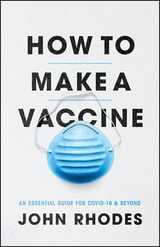
How to Make a Vaccine
An Essential Guide for COVID-19 and BeyondJohn Rhodes
University of Chicago Press, 2021
As the COVID-19 pandemic has affected every corner of the world, changing our relationship to our communities, to our jobs, and to each other, the most pressing question has been—when will it end? Researchers around the globe are urgently trying to answer this question by racing to test and distribute a vaccine that could end the greatest public health threat of our time. In How to Make a Vaccine, an expert who has firsthand experience developing vaccines tells an optimistic story of how three hundred years of vaccine discovery and a century and a half of immunology research have come together at this powerful moment—and will lead to multiple COVID-19 vaccines.
Dr. John Rhodes draws on his experience as an immunologist, including working alongside a young Anthony Fauci, to unravel the mystery of how vaccines are designed, tested, and produced at scale for global deployment. Concise and accessible, this book describes in everyday language how the immune system evolved to combat infection, how viruses responded by evolving ways to evade our defenses, and how vaccines do their work. That history, and the pace of current research developments, make Rhodes hopeful that multiple vaccines will protect us. Today the complex workings of the immune system are well understood. The tools needed by biomedical scientists stand ready to be used, and more than 160 vaccine candidates have already been produced. But defeating COVID-19 won’t be the end of the story: Rhodes describes how discoveries today are also empowering scientists to combat future threats to global health, including a recent breakthrough in the development of genetic vaccines, which have never before been used in humans.
As the world prepares for a vaccine, Rhodes offers a current and informative look at the science and strategies that deliver solutions to the crisis.
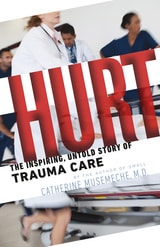
Hurt
The Inspiring, Untold Story of Trauma CareCatherine Musemeche
Dartmouth College Press, 2016