116 books match the query 'Health aspects' and 5 start with h
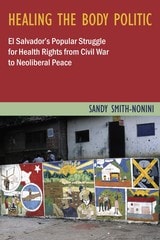
cover of Healing the Body Politic: El Salvador's Popular Struggle for Health Rights from Civil War to Neoliberal Peace

Healing the Body Politic

El Salvador's Popular Struggle for Health Rights from Civil War to Neoliberal Peace

Smith-Nonini, Sandy

Rutgers University Press, 2010

Incorporating investigative journalism and drawing on interviews with participants and leaders, Sandy Smith-Nonini examines the contested place of health and development in El Salvador over the last two decades. Healing the Body Politic recounts the dramatic story of radical health activism from its origins in liberation theology and guerrilla medicine during the third-world country's twelve-year civil war, through development of a remarkable "popular health system," administered by lay providers in a former war zone controlled by leftist rebels. This ethnography casts light on the conflicts between the conservative Ministry of Health and primary health advocates during the 1990s peace process--a time when the government sought to dismantle the effective peasant-run rural system. It offers a rare analysis of the White Marches of 2002û2003, when radicalized physicians rose to national leadership in a successful campaign against privatization of the social security health system. Healing the Body Politic contributes to the productive integration of medical and political anthropology by bringing the semiotics of health and the body to bear on cultural understandings of warfare, the state, and globalization.
[more]
cover of Health and Welfare during Industrialization

Health and Welfare during Industrialization

Edited by Richard H. Steckel and Roderick Floud

University of Chicago Press, 1997

In this unique anthology, Steckel and Floud coordinate ten essays that bring a new perspective to inquiry about standard of living in modern times. These papers are arranged for international comparison, and they individually examine evidence of health and welfare during and after industrialization in eight countries: the United States, Britain, Sweden, the Netherlands, France, Germany, Japan, and Australia.
The essays incorporate several indicators of quality of life, especially real per capita income and health, but also real wages, education, and inequality. And while the authors use traditional measures of health such as life expectancy and mortality rates, this volume stands alone in its extensive use of new "anthropometric" data—information about height, weight and body mass index that indicates changes in nations' well-being. Consequently, Health and Welfare during Industrialization signals a new direction in economic history, a broader and more thorough understanding of what constitutes standard of living.

[more]
cover of Homesick

Homesick

Nicholas Shapiro

Duke University Press, 2025

Following Hurricane Katrina, the Federal Emergency Management Agency (FEMA) distributed over 120,000 trailers for emergency housing. Produced from engineered wood containing toxic amounts of formaldehyde, these shelters were vectors of illness and death. Although they were subsequently banned, FEMA trailers were resold and again used for housing, scattering their harm to other people and areas. In Homesick, Nicholas Shapiro draws on almost fifteen years working with impacted community members to trace how the story of toxic emergency housing units expands into a story of how all of our shelters became a seat of exposure and how we can collectively struggle for cleaner indoor air. Throughout, Shapiro questions the efficacy of the fundamental tools used to cultivate accountability, repair, and change, arguing for their reimagining. Detailing health effects as well as community and individual efforts to achieve better life, health, and justice, Shapiro highlights how homesickness for an otherwise future can herald meaningful change.
[more]
cover of Hope for a Heated Planet: How Americans Are Fighting Global Warming and Building a Better Future

Hope for a Heated Planet

How Americans Are Fighting Global Warming and Building a Better Future

Musil, Robert K

Rutgers University Press, 2009

Rejecting cries of gloom and doom, Hope for a Heated Planet shows how the fight against global warming can be won by the grassroots efforts of individuals. Robert K. Musil, who led the Nobel Peace Prize-winning organization Physicians for Social Responsibility, explains that a growing new climate movement can produce unprecedented change-in the economy, public health, and home-while saving the planet.

Musil draws on personal experience and compelling data in this practical and rigorous analysis of the causes and cures for global warming. The book presents all the players in the most pressing challenge facing society today, from the massive fossil fuel lobby to the enlightened corporations that are joining the movement to "go green." Musil thoroughly explains the tremendous potential of renewable energy sources-wind, solar, and biofuel-and the startling conclusions of experts who say society can do away entirely with fossil fuels. He tells readers about the engaged politicians, activists, religious groups, and students who are already working together against climate change.

But the future depends, Musil insists, on what changes ordinary citizens make. Through personal choices and political engagement, he shows how readers can cut carbon emissions and create green communities where they live. With practical and realistic solutions, Hope for a Heated Planet inspires readers to be accountable and enables them to usher in an age of sustainability for future generations.

[more]
cover of Hush: Media and Sonic Self-Control

Hush

Media and Sonic Self-Control

Mack Hagood

Duke University Press, 2019

For almost sixty years, media technologies have promised users the ability to create sonic safe spaces for themselves—from bedside white noise machines to Beats by Dre's “Hear What You Want” ad campaign, in which Colin Kaepernick's headphones protect him from taunting crowds. In Hush, Mack Hagood draws evidence from noise-canceling headphones, tinnitus maskers, LPs that play ocean sounds, nature-sound mobile apps, and in-ear smart technologies to argue the true purpose of media is not information transmission, but rather the control of how we engage our environment. These devices, which Hagood calls orphic media, give users the freedom to remain unaffected in the changeable and distracting spaces of contemporary capitalism and reveal how racial, gendered, ableist, and class ideologies shape our desire to block unwanted sounds. In a noisy world of haters, trolls, and information overload, guarded listening can be a necessity for self-care, but Hagood argues our efforts to shield ourselves can also decrease our tolerance for sonic and social difference. Challenging our self-defeating attempts to be free of one another, he rethinks media theory, sound studies, and the very definition of media.
[more]