Results by title
82 books match the query 'Hermeneutics' and 10 start with h
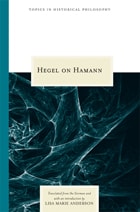
Hegel on Hamann
G. W. F. Hegel
Northwestern University Press, 2008
In 1828, G. W. F. Hegel published a critical review of Johann George Hamann, a retrospective of the life and works of one of Germany's most enigmatic and challenging thinkers and writers. While Hegel's review had enjoyed a central place in Hamann studies since its appearance, Hegel on Hamann is the first English translation of the important work. Philosophers, theologians, and literary critics welcome Anderson's stunning translation since Hamann is gaining renewed attention, not only as a key figure of German intellectual history, but also as an early forerunner of postmodern thought. Relationships between Enlightenment, Counter Enlightenment, and Idealism come to the fore as Hegel reflects on Hamann's critiques of his contemporaries Immanuel Kant, Moses Mendelssohn, J. G. Herder, and F. H. Jacobi. Hegel on Hamann also includes an introduction to Hegel's review, as well as an essay on the role of friendship in Hamann's life, in Hegel's thought, and in German intellectual culture more broadly. Rounding out the volume are its extensive annotations and bibliography, which facilitate further study of eighteenth- and nineteenth-century philosophy in English and German. This book is essential both for readers of Hegel or Hamann and for those interested in the history of German thought, the philosophy of religion, language and hermeneutics, or friendship as a philosophical category.
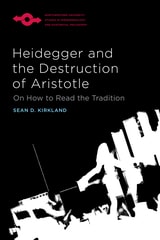
Heidegger and the Destruction of Aristotle
On How to Read the TraditionSean D. Kirkland
Northwestern University Press, 2023
A bold new conception of Heidegger’s project of Destruktion as a method of interpreting history
For Martin Heidegger, our inherited traditions provide the concepts through which we make our world intelligible. Concepts we can also oppose, disrupt, and even exceed. First, however, if Western philosophy is our inheritance, we must submit it to Destruktion—starting with Aristotle. Heidegger and the Destruction of Aristotle: On How to Read the Tradition presents a new conception of Heidegger’s “destruction” as a way of reading.
Situated between Nietzschean genealogy and Derridean deconstruction, this method uncovers in Aristotle the most vital originating articulations of the Western tradition and gives us the means to confront it. Sean D. Kirkland argues this is not a rejection of the past but a sophisticated and indeed timely hermeneutic tool—a complex, illuminating, and powerful method for interpreting historical texts at our present moment. Acknowledging the historical Heidegger as a politically compromised and still divisive figure, Kirkland demonstrates that Heideggerian destruction is a method of interpreting history that enables us to reorient and indeed transform its own most troubling legacies.
Hermeneutic Phenomenology
The Philosopher of Paul RicoeurDon Ihde
Northwestern University Press, 1971
Hermeneutical Heidegger
Edited by Michael Bowler and Ingo Farin
Northwestern University Press, 2016
Hermeneutics and Truth
Brice R. Wachterhauser
Northwestern University Press, 1994
No thinkers have wrestled with the issue of truth and interpretation in more illuminating ways for the Continental tradition of philosophy than Heidegger and Gadamer. Hermeneutics and Truth is a dual focus on Heidegger and Gadamer, but it concentrates primarily on Gadamer's efforts to think through the issue of truth for hermeneutics and only secondarily on Heidegger's thought on this issue.
Hermeneutics
Interpretation Theory in Schleiermacher, Dilthey, Heidegger, and GadamerRichard E. Palmer
Northwestern University Press, 1969
Palmer principally treats the conception of hermeneutics enunciated by Heidegger and developed into a “philosophical hermeneutics” by Hans-Georg Gadamer. He provides a brief overview of the field of hermeneutics by surveying some half-dozen alternate definitions of the term and by examining in detail the contributions of Friedrich Schleiermacher and Wilhelm Dilthey. In the “Manifesto” which concludes the book, Palmer suggests the potential significance of hermeneutics for literary interpretation.
When the context of interpretation is pressed to its limits, hermeneutics becomes the philosophical analysis of what is involved in every act of understanding. In this context, hermeneutics becomes relevant not simply to the humanistic disciplines, in which linguistic and historical understanding are crucial, but to scientific forms of interpretation as well, for it asserts the principles involved in any and every act of interpretation.

Hermeneutics
Questions and ProspectsShapiro Gary
University of Massachusetts Press, 0

Hooked
Art and AttachmentRita Felski
University of Chicago Press, 2020
How does a novel entice or enlist us? How does a song surprise or seduce us? Why do we bristle when a friend belittles a book we love, or fall into a funk when a favored TV series comes to an end? What characterizes the aesthetic experiences of feeling captivated by works of art? In Hooked, Rita Felski challenges the ethos of critical aloofness that is a part of modern intellectuals’ self-image. The result is sure to be as widely read as Felski’s book, The Limits of Critique.
Wresting the language of affinity away from accusations of sticky sentiment and manipulative marketing, Felski argues that “being hooked” is as fundamental to the appreciation of high art as to the enjoyment of popular culture. Hooked zeroes in on three attachment devices that connect audiences to works of art: identification, attunement, and interpretation. Drawing on examples from literature, film, music, and painting—from Joni Mitchell to Matisse, from Thomas Bernhard to Thelma and Louise—Felski brings the language of attachment into the academy. Hooked returns us to the fundamentals of aesthetic experience, showing that the social meanings of artworks are generated not just by critics, but also by the responses of captivated audiences.
How We Became Human
Mimetic Theory and the Science of Evolutionary OriginsPierpaolo Antonello
Michigan State University Press, 2015
Human Identity
Claude Romano, Samuel R. Webb
Northwestern University Press, 2027
Examining philosophical views of human identity and calling for a shift in how we discuss this essential concept
The problem of identity is one of the most debated contemporary issues in philosophy and the social sciences. Human Identity does not approach this question from a sociological or political position but rather seeks to take a step away from the dominant approach in metaphysics and analytical philosophy, putting forward a dialogical concept of identity inspired mainly by the phenomenological-hermeneutic tradition. Claude Romano argues that the question of identity can only be satisfactorily formulated from the point of view of an intrinsically social understanding of the human being: The identity that matters in our lives is the one we can assume before others in truthful conduct and thus the one for which we can bear responsibility in the first person.
Romano carefully examines the full historical sweep of the philosophy of identity, referencing not only classic thinkers, including Descartes, Locke, Kant, and Husserl, but also contemporary interlocutors, such as Richard Moran and Charles Larmore. He engages in a sustained dialogue with these fellow philosophers, historical and current, while arguing for a complete paradigm shift in our approach to identity. Romano contends that we need to move on from the question Who?, as used by a prosecutor or judge to identify a guilty party, and instead look to the question used by Montaigne to define himself: Who am I?