Results by title
61 books match the query 'Histories' and 14 start with h

Heritages of Portuguese Influence
Histories, Spaces, Texts, and ObjectsGuest edited by Miguel Bandeira Jerónimo, Anna M. Klobucka, and Walter Rossa
Tagus Press, 2022
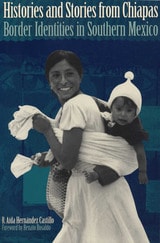
Histories and Stories from Chiapas
Border Identities in Southern MexicoBy R. Aída Hernández Castillo
University of Texas Press, 2001
The 1994 Zapatista uprising of Chiapas' Maya peoples against the Mexican government shattered the state myth that indigenous groups have been successfully assimilated into the nation. In this wide-ranging study of identity formation in Chiapas, Aída Hernández delves into the experience of a Maya group, the Mam, to analyze how Chiapas' indigenous peoples have in fact rejected, accepted, or negotiated the official discourse on "being Mexican" and participating in the construction of a Mexican national identity.
Hernández traces the complex relations between the Mam and the national government from 1934 to the Zapatista rebellion. She investigates the many policies and modernization projects through which the state has attempted to impose a Mexican identity on the Mam and shows how this Maya group has resisted or accommodated these efforts. In particular, she explores how changing religious affiliation, women's and ecological movements, economic globalization, state policies, and the Zapatista movement have all given rise to various ways of "being Mam" and considers what these indigenous identities may mean for the future of the Mexican nation. The Spanish version of this book won the 1997 Fray Bernardino de Sahagún national prize for the best social anthropology research in Mexico.
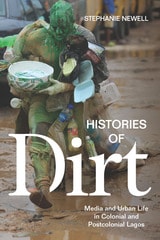
Histories of Dirt
Media and Urban Life in Colonial and Postcolonial LagosStephanie Newell
Duke University Press, 2020
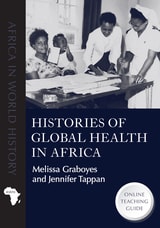
Histories of Global Health in Africa
Melissa Graboyes and Jennifer Tappan
Ohio University Press, 0
Histories of Global Health in Africa offers a concise and compelling introduction to the development and practice of global health on the African continent over the past century. Rather than centering institutions, the book foregrounds the people whose lives and labor have shaped global health—including African communities receiving care and the practitioners and experts who have long driven biomedical work across the region.
Drawing on cutting-edge scholarship, the book traces the colonial roots of global health and examines how these legacies continue to influence contemporary interventions, from vaccination campaigns and disease eradication efforts to epidemic responses. Its accessible thematic chapters explore key topics, including data collection, demography, ethics, and equity.
Designed for classroom use and ideal for nonspecialists, Histories of Global Health in Africa provides a flexible structure and a rich suite of teaching materials, including online multimedia components. It is an essential resource for students and readers seeking to understand how global health has evolved—and why its future depends on confronting its past.

Histories of Infamy
Francisco López de Gómara and the Ethics of Spanish ImperialismCristián A. Roa-de-la-Carrera
University Press of Colorado, 2005
- Luis Fernando Restrepo, University of Arkansas
“In an eloquent and thorough exegesis, Roa-de-la-Carrera reveals how and why López de Gómara, having written the best of all possible books in exultation of Spanish imperialism, nevertheless failed to convince the readers of his time."
- Susan Schroeder, Tulane University
In Histories of Infamy, Cristián Roa-de-la-Carrera explores Francisco López de Gómara's (1511-ca.1559) attempt to ethically reconcile Spain's civilizing mission with the conquistadors' abuse and exploitation of Native peoples.
The most widely read account of the conquest in its time, Gómara's Historia general de las Indias y Conquista de México rationalized the conquistadors' crimes as unavoidable evils in the task of bringing "civilization" to the New World. Through an elaborate defense of Spanish imperialism, Gómara aimed to convince his readers of the merits of the conquest, regardless of the devastation it had wrought upon Spain's new subjects. Despite his efforts, Gómara's apologist text quickly fell into disrepute and became ammunition for Spain's critics. Evaluating the effectiveness of ideologies of colonization, Roa-de-la-Carrera's analysis will appeal to scholars in colonial studies and readers interested in the history of the Americas.

Histories of Race and Racism
The Andes and Mesoamerica from Colonial Times to the PresentLaura Gotkowitz, ed.
Duke University Press, 2012
Contributors
Rossana Barragán
Kathryn Burns
Andrés Calla
Pamela Calla
Rudi Colloredo-Mansfeld
María Elena García
Laura Gotkowitz
Charles R. Hale
Brooke Larson
Claudio Lomnitz
José Antonio Lucero
Florencia E. Mallon
Khantuta Muruchi
Deborah Poole
Seemin Qayum
Arturo Taracena Arriola
Sinclair Thomson
Esteban Ticona Alejo

Histories of Scientific Observation
Edited by Lorraine Daston and Elizabeth Lunbeck
University of Chicago Press, 2010
Observation is the most pervasive and fundamental practice of all the modern sciences, both natural and human. Its instruments include not only the naked senses but also tools such as the telescope and microscope, the questionnaire, the photographic plate, the notebook, the glassed-in beehive, and myriad other ingenious inventions designed to make the invisible visible, the evanescent permanent, the abstract concrete. Yet observation has almost never been considered as an object of historical inquiry in itself. This wide-ranging collection offers the first examination of the history of scientific observation in its own right, as both epistemic category and scientific practice.
Histories of Scientific Observation features engaging episodes drawn from across the spectrum of the natural and human sciences, ranging from meteorology, medicine, and natural history to economics, astronomy, and psychology. The contributions spotlight how observers have scrutinized everything—from seaweed to X-ray radiation, household budgets to the emotions—with ingenuity, curiosity, and perseverance verging on obsession. This book makes a compelling case for the significance of the long, surprising, and epistemologically significant history of scientific observation, a history full of innovations that have enlarged the possibilities of perception, judgment, and reason.

Histories of Southeastern Archaeology
Edited by Shannon Tushingham, Jane Hill, and Charles H. McNutt
University of Alabama Press, 2002
Histories of Southeastern Archaeology originated as a symposium at the 1999 Southeastern Archaeological Conference (SEAC) organized in honor of the retirement of Charles H. McNutt following 30 years of teaching anthropology. Written for the most part by members of the first post-depression generation of southeastern archaeologists, this volume offers a window not only into the archaeological past of the United States but also into the hopes and despairs of archaeologists who worked to write that unrecorded history or to test scientific theories concerning culture.
The contributors take different approaches, each guided by experience, personality, and location, as well as by the legislation that shaped the practical conduct of archaeology in their area. Despite the state-by-state approach, there are certain common themes, such as the effect (or lack thereof) of changing theory in Americanist archaeology, the explosion of contract archaeology and its relationship to academic archaeology, goals achieved or not achieved, and the common ground of SEAC.
This book tells us how we learned what we now know about the Southeast's unwritten past. Of obvious interest to professionals and students of the field, this volume will also be sought after by historians, political scientists, amateurs, and anyone interested in the South.
Additional reviews:

Histories of Technology, the Environment, and Modern Britain
Edited by Jon Agar and Jacob Ward
University College London, 2018
Histories of the Future
Daniel Rosenberg and Susan Harding, eds.
Duke University Press, 2005
In tightly linked studies, the contributors excavate forgotten and emergent futures of art, religion, technology, economics, and politics. They trace hidden histories of science fiction, futurism, and millennialism and break down barriers between far-flung cultural spheres. From the boardrooms of Silicon Valley to the forests of Java and from the literary salons of Tokyo to the roadside cafés of the Nevada desert, the authors stitch together the disparate images and stories of futures past and present. Histories of the Future is further punctuated by three interludes: a thought-provoking game that invites players to fashion future narratives of their own, a metafiction by renowned novelist Jonathan Lethem, and a remarkable graphic research tool: a timeline of timelines.
Contributors. Sasha Archibald, Susan Harding, Jamer Hunt, Pamela Jackson, Susan Lepselter, Jonathan Lethem, Joseph Masco, Christopher Newfield, Elizabeth Pollman, Vicente Rafael, Daniel Rosenberg, Miryam Sas, Kathleen Stewart, Anna Tsing
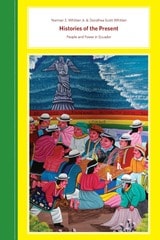
Histories of the Present
People and Power in EcuadorNorman E. Whitten Jr. and Dorothea Scott Whitten
University of Illinois Press, 2011

Histories of the Transgender Child
Jules Gill-Peterson
University of Minnesota Press, 2018
A groundbreaking twentieth-century history of transgender children
With transgender rights front and center in American politics, media, and culture, the pervasive myth still exists that today’s transgender children are a brand new generation—pioneers in a field of new obstacles and hurdles. Histories of the Transgender Child shatters this myth, uncovering a previously unknown twentieth-century history when transgender children not only existed but preexisted the term transgender and its predecessors, playing a central role in the medicalization of trans people, and all sex and gender.
Beginning with the early 1900s when children with “ambiguous” sex first sought medical attention, to the 1930s when transgender people began to seek out doctors involved in altering children’s sex, to the invention of the category gender, and finally the 1960s and ’70s when, as the field institutionalized, transgender children began to take hormones, change their names, and even access gender confirmation, Julian Gill-Peterson reconstructs the medicalization and racialization of children’s bodies. Throughout, they foreground the racial history of medicine that excludes black and trans of color children through the concept of gender’s plasticity, placing race at the center of their analysis and at the center of transgender studies.
Until now, little has been known about early transgender history and life and its relevance to children. Using a wealth of archival research from hospitals and clinics, including incredible personal letters from children to doctors, as well as scientific and medical literature, this book reaches back to the first half of the twentieth century—a time when the category transgender was not available but surely existed, in the lives of children and parents.

Histories on Econometrics, Volume 43
Marcel Boumans, Ariane Dupont-Kieffer, Dou Qin, editors
Duke University Press, 0
Contributors: John Aldrich, Jeff E. Biddle, Olav Bjerkholt, Marcel Boumans, Chao-Hsi Huang, Robert W. Dimand, Duo Qin, Ariane Dupont-Kieffer, Hsiang-Ke Chao, Aiko Ikeo, Francisco Louçã, Mary S. Morgan, Daniela Parisi, Alain Pirotte, Charles G. Renfro, Thomas Stapleford, Sofia Terlica
Marcel Boumans is Associate Professor of Economics at the University of Amsterdam. Ariane Dupont-Kieffer is a Researcher at the French National Institute of Research on Transport and Safety. Duo Qin is Reader of Economics at the University of London.

How Oceans Become
Histories and Futures of the High Seas and Deep OceansThomas Brandt, Knut Ove Eliassen, Mats Ingulstad, Gard Paulsen
University of Chicago Press, 0
An anthology grounded in the idea that oceans are human realities, shaped by human interests, interactions, and technologies.
Historically and geographically diverse, oceans exist in the plural. Oceans become oceans through how they are represented, what resources they are deemed to hold, and the regulatory governance to which they are subjected. These are the three key components of “ocean making” this volume employs to shed light on the complex issues facing ocean governance today.
The anthology reaches back to the oceans of the early modern European expansion and up to the current concerns of anthropogenic changes and resource depletion. Chapters address activities and regulatory concerns regarding maritime transport, fisheries, deep-sea mining, wave energy, and whaling, and span from the southern oceans around Antarctica to the current shedding of the icy mantle of the Arctic Ocean. By drawing together scholars from a wide range of disciplines—including history, comparative literature, media studies, political science, law, and anthropology—How Oceans Become opens a multi-layered, interdisciplinary approach to studying the oceans’ entanglements with human cultures and societies.