51 books match the query 'Holocaust survivors' and 5 start with h
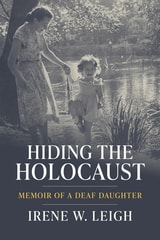
cover of Hiding the Holocaust: Memoir of a Deaf Daughter

Hiding the Holocaust

Memoir of a Deaf Daughter

Irene W. Leigh

Gallaudet University Press, 2026
From her parents, deaf psychologist Irene W. Leigh learned how quickly safety could be yanked away. Her parents, Jews who barely escaped Nazi Germany on the eve of World War II, tried to shield Leigh from harm, never talking about the horrors they endured, and it was not until recently that she began to discover the truth by uncovering a shocking document. Having rebuilt their lives from scratch, first in England and then in America, Leigh’s parents passed down a legacy of ambition, persistence, and achievement, shaping her resilience in response to bias and discrimination. In this deeply personal memoir, Hiding the Holocaust, Leigh explores how this unspoken history and inherited trauma has informed her personal, familial, academic, and career experiences. Using a lifespan narrative structure focusing on memories, reflections, and recreated dialogue, Leigh narrates the subtle ways in which Holocaust trauma and loss affected not only her parents but also herself as a deaf child, teen, adult, and parent.
[more]
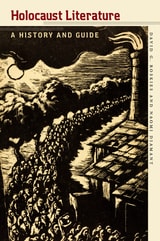
cover of Holocaust Literature: A History and Guide

Holocaust Literature

A History and Guide

David G. Roskies and Naomi Diamant

Brandeis University Press, 2013
What is Holocaust literature? When does it begin and how is it changing? Is there an essential core that consists of diaries, eyewitness accounts of the concentration camps, and tales of individual survival? Is it the same everywhere: West and East, in Australia as in the Americas, in poetry as in prose? Is this literature sacred and separate, or can it be studied alongside other responses to catastrophe? What works of Holocaust literature will be read a hundred years from now—and why? Here, for the first time, is a historical survey of Holocaust literature in all genres, countries, and major languages. Beginning in wartime, it proceeds from the literature of mobilization and mourning in the Free World to the vast literature produced in Nazi-occupied ghettos, bunkers and places of hiding, transit and concentration camps. No less remarkable is the new memorial literature that begins to take shape within weeks and months of the liberation. Moving from Europe to Israel, the United States, and beyond, the authors situate the writings by real and proxy witnesses within three distinct postwar periods: “communal memory,” still internal and internecine; “provisional memory” in the 1960s and 1970s, when a self-conscious Holocaust genre is born; and “authorized memory,” in which we live today. Twenty book covers—first editions in their original languages—and a guide to the “first hundred books” show the multilingual scope, historical depth, and artistic range of this extraordinary body of writing.
[more]
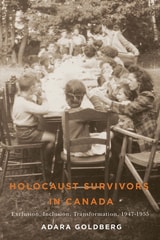
cover of Holocaust Survivors in Canada: Exclusion, Inclusion, Transformation, 1947-1955

Holocaust Survivors in Canada

Exclusion, Inclusion, Transformation, 1947-1955

Adara Goldberg

University of Manitoba Press, 2015
[more]
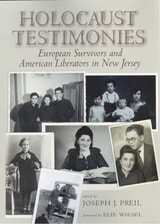
cover of Holocaust Testimonies: European Survivors and American Liberators in New Jersey

Holocaust Testimonies

European Survivors and American Liberators in New Jersey

Preil, Joseph J

Rutgers University Press, 2001

A project of the Holocaust Resource Center of Kean University, New Jersey, this book is a reference tool for teaching the Holocaust, for Holocaust survivors and their families, and for the general reader. Drawing on the center’s central missions is to produce and preserve a series of oral-history videotapes based on the personal experiences of Holocaust survivors who reside in New Jersey. Joseph J. Preil brings together the most compelling testimonies of 153 Holocaust survivors as well as twenty concentration-camp liberators. Through these riveting accounts, the book traces the mass murder of the Jews across Europe in a geographical as well as chronological order. The testimonies in each chapter are grouped by the witnesses’ country or region of origin, preceded by a brief introduction of the history of events in a particular area. In the last part of the book, American soldiers recount their impressions of being present at the liberation of the camps.

“If you can imagine that the Jew to the German was like a cockroach. In the United States, if you step on a cockroach . . . it doesn’t mean anything to you. The same thing, exactly the same thing, the Jew was to the German—a cockroach. . . . One particular Shabbos (Sabbath), they shot twelve or thirteen people in my area. In other words, the German had the right, if he saw me, any Jew that he saw in the street, he could go over to you calmly, take out his revolver, and put it to your head, and shoot you down like a . . . roach. . . . It was a free-for-all.”—Testimony of Sol Einhorn, cited in Holocaust Testimonies: European Survivors and American Liberators in New Jersey
[more]
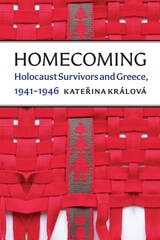
cover of Homecoming: Holocaust Survivors and Greece, 1941–1946

Homecoming

Holocaust Survivors and Greece, 1941–1946

Katerina Králová

Brandeis University Press, 2025

Documents the lives of Greek Jews who returned after surviving persecution, combat, and exile during World War II.
 
Homecoming records the experiences of Greek Jews who returned to their native country after World War II, when many went into hiding, fought in combat, became refugees, or were deported, some to Nazi death camps. Though they wanted more than anything to survive and come home, those who returned to postwar Greece faced isolation, anguish, deprivation, and hostility in the midst of a civil war. Their stories, which rarely feature in discussions of the Holocaust, raise important questions about its aftermath across Europe. Based on exhaustive archival research and new interviews with Holocaust survivors across several continents, Kateřina Králová’s new book adds to our understanding of the genocide and its impact.
[more]